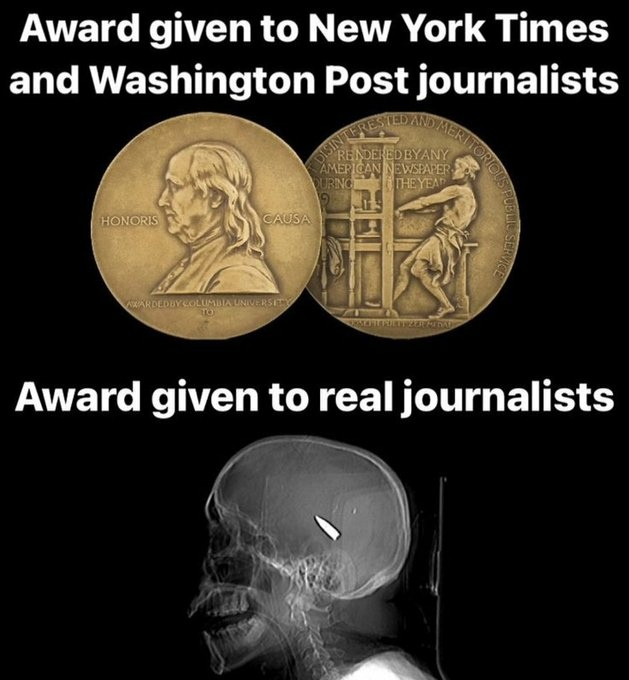
Time for a spot the difference…

The media outlet Al Jazeera accused Israeli forces of “deliberately targeting and killing our colleague” on Wednesday after Palestinian journalist Shireen Abu Akleh was shot in the face while covering a raid on the Jenin refugee camp in the occupied West Bank.
In a statement, the Al Jazeera Media Network said that Abu Akleh—who worked as the publication’s Palestine correspondent—was wearing a press jacket that clearly identified her as a journalist when Israeli forces shot her “with live fire.”
Al Jazeera, which is based in Qatar, called the attack “a blatant murder,” saying Abu Akleh, 51, was “assassinated in cold blood.”
The statement continued:
Al Jazeera Media Network condemns this heinous crime, which intends to only prevent the media from conducting their duty. Al Jazeera holds the Israeli government and the occupation forces responsible for the killing of Shireen. It also calls on the international community to condemn and hold the Israeli occupation forces accountable for their intentional targeting and killing of Shireen.
The Israeli authorities are also responsible for the targeting of Al Jazeera producer Ali al-Samudi, who was also shot in the back while covering the same event, and he is currently undergoing treatment.
Al Jazeera extends its sincere condolences to the family of Shireen in Palestine, and to her extended family around the world, and we pledge to prosecute the perpetrators legally, no matter how hard they try to cover up their crime, and bring them to justice.
The daily newspaper USA Today is the second-most circulated print newspaper in the United States — more than The New York Times and more than double The Washington Post. Only The Wall Street Journal has higher circulation numbers.
On Sunday, the paper published and heavily promoted a repellent article complaining that “defendants accused in the Capitol riot Jan. 6 crowdfund their legal fees online, using popular payment processors and an expanding network of fundraising platforms, despite a crackdown by tech companies.” It provided a road map for snitching on how these private citizens — who are charged with serious felonies by the U.S. Justice Department but as of yet convicted of nothing — are engaged in “a game of cat-and-mouse as they spring from one fundraising tool to another” in order to avoid bans on their ability to raise desperately needed funds to pay their criminal lawyers to mount a vigorous defense.
In other words, the only purpose of the article — headlined: “Insurrection fundraiser: Capitol riot extremists, Trump supporters raise money for lawyer bills online” — was to pressure and shame tech companies to do more to block these criminal defendants from being able to raise funds for their legal fees, and to tattle to tech companies by showing them what techniques these indigent defendants are using to raise money online.
The USA Today reporters went far beyond merely reporting how this fundraising was being conducted. They went so far as to tattle to PayPal and other funding sites on two of those defendants, Joe Biggs and Dominic Pezzola, and then boasted of their success in having their accounts terminated:
As of Wednesday afternoon, the Biggs fundraiser was listed as having received $52,201. Pezzola had received $730. Biggs’ campaign disappeared from the site shortly after USA TODAY inquired about it….
Friday, a USA TODAY reporter donated to Pezzola’s fundraiser using Stripe. Stripe told USA TODAY it does not comment on individual users. A USA TODAY reporter was able to make a $1 donation to Pezzola’s fundraiser using Venmo, a payment app owned by PayPal. After being alerted by USA TODAY, Venmo removed the account.
Soon a PayPal account took its place. PayPal caught that and removed it, too.
Wow, what brave and intrepid journalistic work: speaking truth to power and standing up to major power centers by . . . working as little police officers for tech giants to prevent private citizens from being able to afford criminal lawyers. Clear the shelves for the imminent Pulitzer. Whatever you think about the Capitol riot, everyone has the right to a legal defense and to do what they can to ensure they have the best legal defense possible — especially when the full weight of the Justice Department is crashing down on your head even for non-violent offenses, which is what many of these defendants are charged with due to the politically charged nature of the investigation.
The right to a vigorous defense has always been a central cause of mine as a lawyer and a journalist (it also used to be a central cause of left-wing groups like the ACLU, years ago; it was that same principle that caused then-candidate Kamala Harris to solicit donations last summer that went to protesters charged with violent rioting). A federal prosecutor was recently referred for disciplinary procedures for publicly threatening to charge some of these Capitol protesters with sedition, one of the gravest crimes in the U.S. Code. That is how grave the legal jeopardy is faced by these people trying to raise money for lawyers.
What makes all of this extra grotesque is that, as The Washington Post reported, most of those charged with various crimes in connection with the January 6 Capitol riot, including many whose charges stem just from their presence inside the Capitol, not the use of any violence, are people with serious financial difficulties: not surprising for a country in the middle of a major economic and joblessness crisis, where neoliberalism and global trade deals have destroyed entire industries and communities for decades:
Nearly 60 percent of the people facing charges related to the Capitol riot showed signs of prior money troubles, including bankruptcies, notices of eviction or foreclosure, bad debts, or unpaid taxes over the past two decades, according to a Washington Post analysis of public records for 125 defendants with sufficient information to detail their financial histories. . . . The group’s bankruptcy rate — 18 percent — was nearly twice as high as that of the American public, The Post found. A quarter of them had been sued for money owed to a creditor. And 1 in 5 of them faced losing their home at one point, according to court filings.
This USA Today article is thus yet another example of journalists at major media outlets abusing their platforms to attack and expose anything other than the real power centers which compose the ruling class and govern the U.S.: the CIA, the FBI, security state agencies, Wall Street, Silicon Valley oligarchs. To the extent these journalists pay attention to those entities at all — and they barely ever do — it is to venerate them and mindlessly disseminate their messaging like stenographers, not investigate them. Investigating people who actually wield real power is hard.

A liberal “journalist” advocated for “porn for children” where “no one gets choked.”
Writer Flora Gill, who boasts on her Twitter profile of writing for GQ, ST Style Magazine, The Sunday Times Magazine, and Evening Standard, claimed that children need “entry level porn.”
“Someone needs to create porn for children. Hear me out,” Gill tweeted Thursday. “Young teens are already watching porn but they’re finding hardcore, aggressive videos that give a terrible view of sex. They need entry level porn! A soft core site where everyone asks for consent and no one gets choked.”
A group of 26 journalists has come together to object to the COVID-19 “fearmongering” and the censorship of alternative views by mainstream media and Big Tech platforms since the beginning of the pandemic.
According to the group, the result of the fearmongering and censorship has been the public receiving a “distorted view of the truth.”
The group calls itself “Holding the Line: Journalists Against COVID Censorship.”
It comprises mostly UK-based journalists working at newspapers, broadcasters, and PR companies as staffers or freelancers.
The members were interviewed by Press Gazette, with most preferring to remain anonymous for fear of retribution from their employers.
However, some were more than happy to be named, including Sonia Elijah and Karen Harradine, investigative journalists for The Conservative Woman, former BBC journalist Tony Gosling, and Laura Berril, a PR and tech journalist.
The group’s mission is to promote a “prejudice-free” environment where journalists can air their concerns and raise awareness on lesser-covered issues.
Journalists could face prison sentences of up to 14 years for stories that embarrass the Government under plans to reform the Official Secrets Act.
Under a consultation run by Priti Patel‘s Home Office, which closes later this week, reporters who handle leaked documents would not have a defence if charged under new laws designed to clamp down on foreign agents.
The 1989 act is being updated to take into account the impact of the internet age, especially in the area of speedy data transfer.
Human rights organisations and the Law Commission, which drew up the proposals, say there should be a ‘public interest defence’ included to prevent the prosecution of journalists who receive leaked documents.
But in a paper released for the consultation, the Home Office said such a move would ‘undermine our efforts to prevent damaging unauthorised disclosures, which would not be in the public interest’.
Critics suggested that if the rules were in place now it could have led to a prosecution of the journalists who revealed this month that Matt Hancock was breaking Covid rules by having an affair with his married aide, because it relied on leaked CCTV footage.
The revelation prompted his resignation and the end of his marriage. But last week the Information Commissioner’s Office faced criticism for searching two homes as part of an investigation into how the material emerged and found its way onto the Sun’s front page.
That Russia placed “bounties” on the heads of U.S. soldiers in Afghanistan was one of the most-discussed and consequential news stories of 2020. It was also, as it turns out, one of the most baseless — as the intelligence agencies who spread it through their media spokespeople now admit, largely because the tale has fulfilled and outlived its purpose.
The saga began on July 29, 2020, when The New York Times announced that unnamed “American intelligence officials” have concluded that “a Russian military intelligence unit secretly offered bounties to Taliban-linked militants for killing coalition forces in Afghanistan — including targeting American troops.” The paper called it “a significant and provocative escalation” by Russia. Though no evidence was ever presented to support the CIA’s claims — neither in that original story nor in any reporting since — most U.S. media outlets blindly believed it and spent weeks if not longer treating it as proven, highly significant truth. Leading politicians from both parties similarly used this emotional storyline to advance multiple agendas.
The story appeared — coincidentally or otherwise — just weeks after President Trump announced his plan to withdraw all troops from Afghanistan by the end of 2020. Pro-war members of Congress from both parties and liberal hawks in corporate media spent weeks weaponizing this story to accuse Trump of appeasing Putin by leaving Afghanistan and being too scared to punish the Kremlin. Cable outlets and the op-ed pages of The New York Times and Washington Post endlessly discussed the grave implications of this Russian treachery and debated which severe retaliation was needed. “This is as bad as it gets,” said House Speaker Nancy Pelosi. Then-candidate Joe Biden said Trump’s refusal to punish Russia and his casting doubt on the truth of the story was more proof that Trump’s “entire presidency has been a gift to Putin,” while Sen. Ben Sasse (R-NE) demanded that, in response, the U.S. put Russians and Afghans “in body bags.”
 Hellbound and Down
You must be logged in to post a comment.