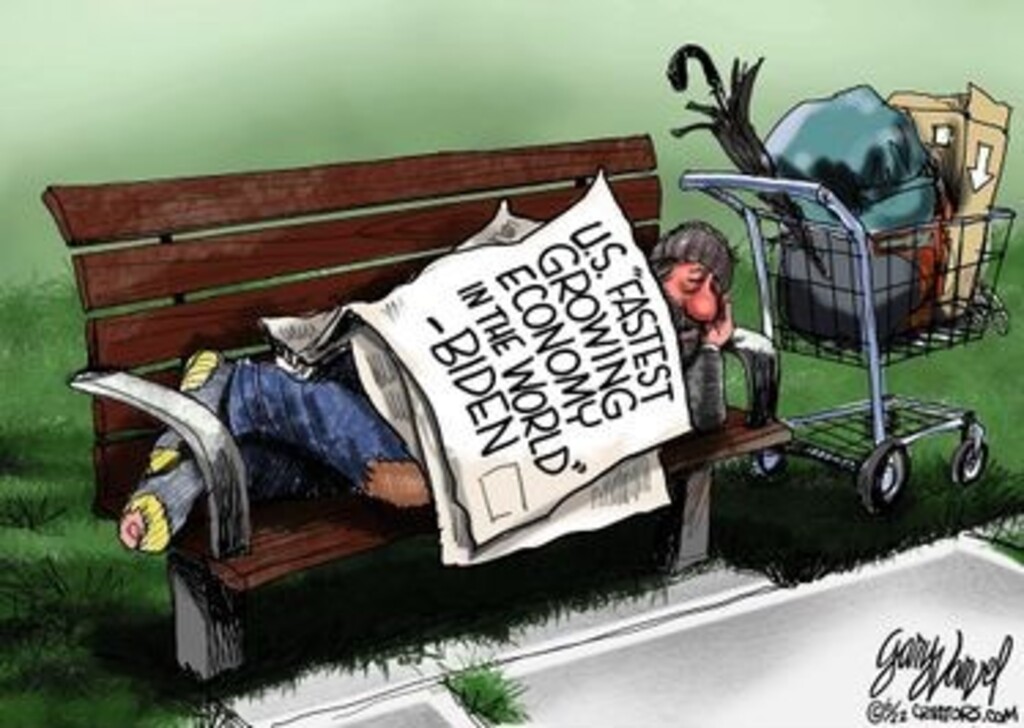
Sure, Joe…

Kim Drotar is a public school teacher who rents an apartment in St Louis. But she doesn’t have the best neighbors.
“They’re 19, 20 and have parties and bang on my door in the middle of the night and, you know, just to be jerks,” she says.
Drotar’s a single mom with a daughter in 5th grade. She’s been trying to find a house she can afford to buy.
“I just want some place where she can ride her bike and make friends with the neighbors and play with the kids and they can come over.”
But she keeps getting outbid when she makes offers. And now with mortgage rates up sharply she says she’s just been priced out completely. Meanwhile, continuing to rent is getting harder to afford, too.
Kim Drotar says her rent rising by 22% this year is making it harder for her to save for a down payment on a house.
“My rent is increasing 22% this year,” she says. “It’s harder and harder to save more for a down payment.”
A new report from Redfin shows that nationally listed rents for available apartments rose 15% from a year ago. And the median listed rent for an available apartment rose above $2,000 a month for the first time.
President Biden used the phrase “Putin’s price hike” again in a reaction to Friday’s Consumer Price Index report revealing continued high inflation, showing once again that the US government believes Americans are idiots.
“Make no mistake about it: I understand inflation is a real challenge to American families. Today’s inflation report confirms what Americans already know: Putin’s Price Hike is hitting America hard,” Biden said in a statement. “My administration is going to continue to do everything it can to lower prices for the American people.”
Which is of course absurd. Prices were already soaring and inflation was already at a 40-year high before Russia invaded Ukraine on the 24th of February, and there was never anything inscribed upon the fabric of reality which said the US needed to respond to that invasion with an economic war that has made everything worse. The US initiated these unprecedented acts of economic warfare in response to an invasion it could easily have prevented with a little diplomacy, and has managed to do so without even hurting the strength of the ruble at all.
There are many people Americans could blame for their shrinking bank accounts, but Putin isn’t one of them.
Currently, gas prices throughout the country are reaching record highs. For months, the establishment left has been blaming soaring prices on “greedy capitalism” and for months, their constituency has been lapping it up. In reality, gas prices are high because of federal government intervention in the market, sanctions which have skewed competition, and runaway inflation thanks to irresponsible monetary policy by the fed which has printed trillions over the last two years.
As blowhards in DC mull price controls and point fingers, the effects of soaring prices are hitting main street America hard. Unfortunately, the “solution” proposed by the economically illiterate political class will only make matters worse. As Congress pushes legislation to add to inflation, the results of their already-failed policies are trickling down.
The American Automobile Association (AAA) has reported that Michigan had seen one of the highest average weekly gas-price surges in the country. Prices were previously climbing weekly but are now increasing on a daily basis. On Tuesday, a gallon of regular fuel cost $5.21, up from $5.17 the day before. A week ago, it was $4.70 a gallon. Last year, gas prices were $3.01 a gallon, marking a ridiculous 73% increase.
Gas prices were already putting a strain on US drivers, who have increasingly been left stuck on motorways with empty tanks as they try to “test the limits of their fuel gauges,” according to the AAA. But now the issue is beginning to severely affect police departments and other agencies.
According to Michigan County Administrator Nicole Frost, who spoke with the Detroit Free Press, the local sheriff’s office had already spent 96% of its fuel budget with three-and-a-half months still to go until the end of the fiscal year.
In one such instance, police departments in several Michigan counties have begun to implement a rather laughable policy in regards to policing. Several police departments in the state have informed officers to handle “whatever calls are acceptable” — by phone. Seriously.

Not too long ago, the elite were trying to put a happy face on our growing economic problems. It was obvious that things were trending in a very alarming direction, but they kept assuring us that any bumps in the road were just temporary and that a new golden age of prosperity was just around the corner. Needless to say, there were dead wrong, and now some of them are publicly admitting the truth. For example, JPMorgan Chase CEO Jamie Dimon just publicly stated that an economic “hurricane” is rapidly approaching…
Jamie Dimon is no meteorologist, but the JPMorgan Chase CEO is predicting an economic “hurricane” caused by the war in Ukraine, rising inflation pressures and interest rate hikes from the Federal Reserve.
“Right now it’s kind of sunny, things are doing fine. Everyone thinks the Fed can handle this,” Dimon said at a Bernstein conference. “That hurricane is right out there down the road coming our way.”
JPMorgan Chase is one of the most important financial institutions in the entire world.
So it is a really big thing for Dimon to make a statement like this.
Of course he is right on target. An economic hurricane is coming, and it is going to be far more horrible than most Americans could possibly imagine right now.
Treasury Secretary Janet Yellen also just said something that is making a lot of headlines.
Last year she insisted that high inflation would just be “transitory,” but now she is openly admitting that she “was wrong”…
“I was wrong then about the path that inflation would take. As I mentioned, there have been unanticipated and large shocks to the economy […] that I, at the time, didn’t fully understand.”
.@SecYellen on inflation being transitory: “I was wrong then about the path that inflation would take. As I mentioned, there have been unanticipated and large shocks to the economy […] that I, at the time, didn’t fully understand.” https://t.co/AlrXn4kT0r pic.twitter.com/9tqxo0iA3B
— The Hill (@thehill) June 1, 2022
It isn’t exactly a surprise that she turned out to be completely wrong about high inflation being transitory.
We knew that she was wrong when she said it.
But I will give her credit for publicly admitting a mistake. Many in Washington will never do such a thing under any circumstances.
At this point, it should be obvious to everyone that we are in the midst of an absolutely horrifying inflation crisis.
As Americans bear the brunt of a sagging economy, the Biden administration appears to be framing this as a good thing, believing that citizens will be better off in the future if current supply shortages and high gas prices spiral out of control.
The United States, according to President Joe Biden, is in the midst of an “incredible transition”—one that will pave the way for a green economy.
While the administration may tout the benefits of a sustainable future, the question remains as to what will happen to average Americans while this “transition” takes place.
More importantly, what’s the endgame of all this that Americans don’t know about?
Biden, during a May 23 joint press conference in Japan with the country’s Prime Minister Kishida Fumio, used the word “transition” to seemingly admit that soaring gasoline prices are just part of his administration’s overall plan for moving from hydrocarbons to renewables.
“When it comes to the gas prices, we’re going through an incredible transition that is taking place that, God willing, when it’s over, we’ll be stronger and the world will be stronger and less reliant on fossil fuels when this is over,” Biden said.
The comment seems to suggest that ensuring the country’s gas supply is not high on Biden’s agenda, though the administration did announce to release of 1 million barrels of crude oil a day for six months between May and August.
Biden’s remarks angered some Republican lawmakers, including Rep. Elise Stefanik (R-N.Y.) said the president is “painfully out-of-touch.”
“The pain at the pump every #NY21 family feels is a direct result of Joe Biden and House Democrats’ Far-Left agenda,” Stefanik wrote on Twitter.
Sen. Rick Scott (R-Fla.) also took exception, writing on Twitter, “the only ‘incredible transition’ we want from Joe Biden is his transition to retirement.”
“Every family in America is paying record-breaking high gas prices thanks to @JoeBiden’s war on American energy—but the president doesn’t care,” Scott added.

House Speaker Nancy Pelosi belatedly jumped into America’s baby formula crisis on Friday, calling nationwide shortages “unconscionable” and setting an emergency vote next week. But while she tried to get Democrats caught up on a crisis that caught them by surprise, her administrative office was busy ramping up new perks for lawmakers.
House members were alerted to two new perks this week compliments of the chamber’s Democrat leadership: fully paid memberships to Peloton gyms as well as a brand new liquor and drinks outlet.
Republicans immediately seized on the optics, saying doling out additional benefits to lawmakers when everyday Americans are struggling to fill gas tanks, grocery carts or baby bottles was a bridge too far, even for Washington.
“Washington Dems couldn’t be more out of touch,” Rep. Drew Ferguson (R-Ga.) wrote as he tweeted out a new announcement by the House Chief Administrative Officer announcing a new “House Drinks storefront” in the Rayburn House Office Building where lawmakers and staff can buy beverages, wine and liquor.
“Whether you’re hosting a meeting or an office event or just want to stock up on your favorite drinks, House Drinks sells water, soda, juice, alcohol and spirits,” the announcement boasted. “Six, twelve and 24-packs are available depending on the drink.”



You must be logged in to post a comment.