MEMBERS OF ISRAEL’S RULING LIKUD PARTY ONCE PLANNED TO ASSASSINATE HENRY KISSINGER

FORMER SECRETARY OF STATE Henry Kissinger died on Wednesday at the age of 100 — though if the predecessors of Israel’s ruling Likud party had their way, he may not have made it even halfway to the century mark.

Despite his reputation as a geopolitical kingmaker, Kissinger was never able to fully impose total U.S. authority upon Israel, but he did seek to leverage U.S. influence — sometimes against what the right-wing Likud party viewed as its interests.

In the 1970s, Kissinger was so hated by the Likud party, which now controls Israel’s far-right coalition government, that some of its members tried to have him assassinated, according to a news report from the time.

“A die-hard clique of Israeli right-wingers has put out a $150,000 ‘contract’ for the assassination of Secretary of State Kissinger,” the New York Daily News reported in 1977, citing senior State Department officials. When reports of a possible hit on Kissinger first came out, it was believed to be the work of Palestinian militants, but senior officials told the paper that they were certain that the threat was emanating from the Likud party.

The Likud hard-liners who put up the money — described as “a small, radical splinter faction within Israel’s Likud opposition bloc” — were reportedly upset at Kissinger’s diplomacy around the end of the 1973 Arab–Israeli War. Kissinger had been instrumental in disengagement agreements with Egypt and Syria that saw Israel withdrawing from territories it had conquered. On the Israeli side, Likud’s rival Labor Party had worked with Kissinger to agree to the compromises.

The 1973 war had also led to a damaging oil embargo by Arab states against the U.S., and Kissinger was said to be willing to cut any deal necessary to turn the spigot back on — which the 1974 disengagement deals accomplished.

Of the hit, the Daily News reported, “The motive was said to be revenge against Kissinger for allegedly selling out Israel during his Mideast shuttle diplomacy.”

Keep reading

Henry Kissinger, War Criminal Beloved by America’s Ruling Class, Finally Dies

Henry Kissinger died on Wednesday at his home in Connecticut, his consulting firm said in a statement. The notorious war criminal was 100.

Measuring purely by confirmed killsthe worst mass murderer ever executed by the United States was the white-supremacist terrorist Timothy McVeigh. On April 19, 1995, McVeigh detonated a massive bomb at the Murrah federal building in Oklahoma City, killing 168 people, including 19 children. The government killed McVeigh by lethal injection in June 2001. Whatever hesitation a state execution provokes, even over a man such as McVeigh — necessary questions about the legitimacy of killing even an unrepentant soldier of white supremacy — his death provided a measure of closure to the mother of one of his victims. “It’s a period at the end of a sentence,” said Kathleen Treanor, whose four-year-old McVeigh killed. 

McVeigh, who in his own psychotic way thought he was saving America, never remotely killed on the scale of Kissinger, the most revered American grand strategist of the second half of the 20th century. 

The Yale University historian Greg Grandin, author of the biography Kissinger’s Shadow, estimates that Kissinger’s actions from 1969 through 1976, a period of eight brief years when Kissinger made Richard Nixon’s and then Gerald Ford’s foreign policy as national security adviser and secretary of state, meant the end of between three and four million people. That includes “crimes of commission,” he explained, as in Cambodia and Chile, and omission, like greenlighting Indonesia’s bloodshed in East Timor; Pakistan’s bloodshed in Bangladesh; and the inauguration of an American tradition of using and then abandoning the Kurds. 

“The Cubans say there is no evil that lasts a hundred years, and Kissinger is making a run to prove them wrong,” Grandin told Rolling Stone not long before Kissinger died. “There is no doubt he’ll be hailed as a geopolitical grand strategist, even though he bungled most crises, leading to escalation. He’ll get credit for opening China, but that was De Gaulle’s original idea and initiative. He’ll be praised for detente, and that was a success, but he undermined his own legacy by aligning with the neocons. And of course, he’ll get off scot free from Watergate, even though his obsession with Daniel Ellsberg really drove the crime.”

Keep reading

HOW HENRY KISSINGER PAVED THE WAY FOR ORLANDO LETELIER’S ASSASSINATION

ON THE MORNING of September 21, 1976, Orlando Letelier, the former foreign minister of Chile living in exile in the United States, was driving to work in downtown Washington, D.C., when a bomb planted in his car exploded, killing him and one passenger while wounding another.

Letelier was assassinated in the heart of Washington by the brutal regime of Chilean President Augusto Pinochet, a far-right dictator who gained power in a 1973 coup backed by the Nixon administration and the CIA, overthrowing the socialist government of President Salvador Allende. Letelier served as foreign minister for Allende, and later was arrested and tortured by Pinochet. After a year in prison, Letelier was released thanks to international diplomatic pressure and eventually settled in Washington, where he was a prominent opponent of the Pinochet regime.

Even in exile, Letelier still had a target on his back. The Pinochet regime, along with the right-wing governments of Argentina and Uruguay, launched a vicious international assassination program — code-named Operation Condor — to kill dissidents living abroad, and Letelier was one of Operation Condor’s most prominent victims.

Nearly 50 years later, the full story of Letelier’s assassination, one of the most brazen acts of state-sponsored terrorism ever conducted on American soil, is still coming into focus.

Now, the 100th birthday of former Secretary of State Henry Kissinger, which has been marked in the press by both powerful investigations as well as puff pieces and hagiography, offers an opportunity to reexamine the Letelier assassination and the broader U.S. role in overthrowing Chile’s democratically elected government in order to impose a brutal dictatorship. It was one of the darkest chapters in Kissinger’s career and one of the most blatant abuses of power in the CIA’s long and ugly history.

Keep reading

BLOOD ON HIS HANDS

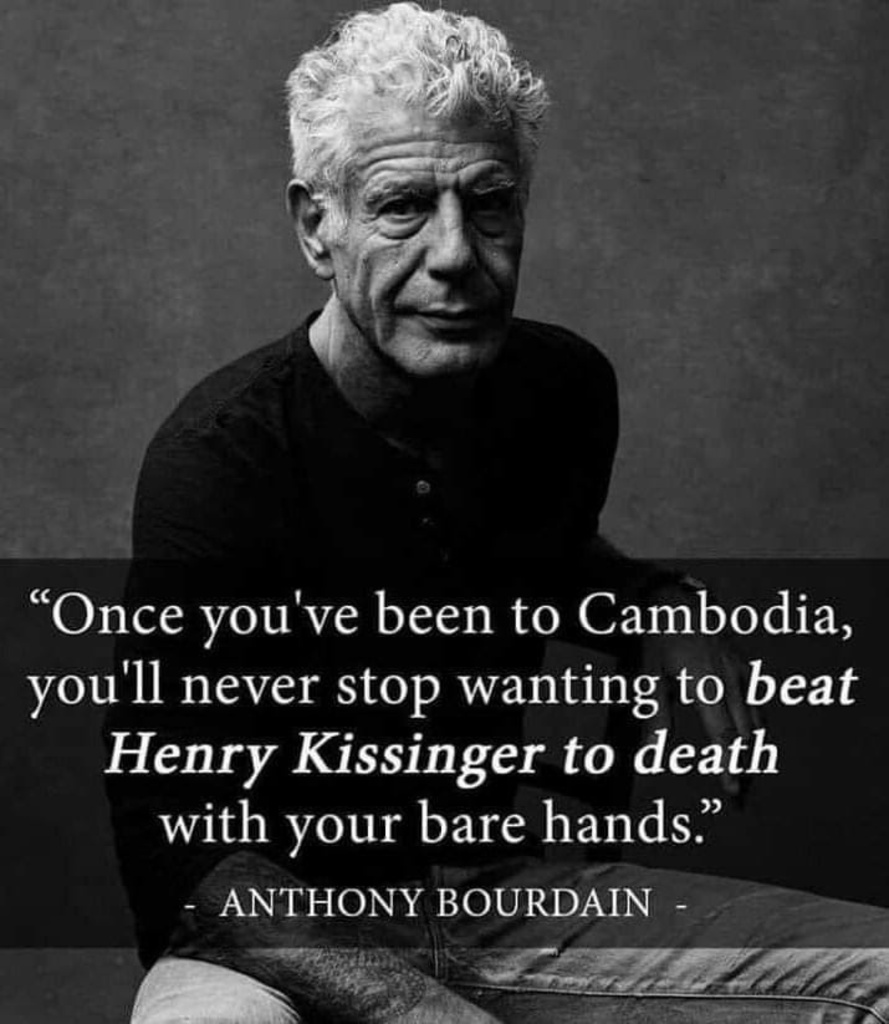
TA SOUS, CAMBODIA — At the end of a dusty path snaking through rice paddies lives a woman who survived multiple U.S. airstrikes as a child.

Round-faced and just over 5 feet tall in plastic sandals, Meas Lorn lost an older brother to a helicopter gunship attack and an uncle and cousins to artillery fire. For decades, one question haunted her: “I still wonder why those aircraft always attacked in this area. Why did they drop bombs here?”

The U.S. carpet bombing of Cambodia between 1969 and 1973 has been well documented, but its architect, former national security adviser and Secretary of State Henry Kissinger, who will turn 100 on Saturday, bears responsibility for more violence than has been previously reported. An investigation by The Intercept provides evidence of previously unreported attacks that killed or wounded hundreds of Cambodian civilians during Kissinger’s tenure in the White House. When questioned about his culpability for these deaths, Kissinger responded with sarcasm and refused to provide answers.

Keep reading

Modern US Warmongering Is Scaring Henry Kissinger

In a new interview with The Wall Street Journal, immortal Hague fugitive Henry Kissinger says the US is acting in a crazy and irrational way that has brought it to the edge of war with Russia and China:

Mr. Kissinger sees today’s world as verging on a dangerous disequilibrium. “We are at the edge of war with Russia and China on issues which we partly created, without any concept of how this is going to end or what it’s supposed to lead to,” he says. Could the U.S. manage the two adversaries by triangulating between them, as during the Nixon years? He offers no simple prescription. “You can’t just now say we’re going to split them off and turn them against each other. All you can do is not to accelerate the tensions and to create options, and for that you have to have some purpose.”


On the question of Taiwan, Mr. Kissinger worries that the U.S. and China are maneuvering toward a crisis, and he counsels steadiness on Washington’s part. “The policy that was carried out by both parties has produced and allowed the progress of Taiwan into an autonomous democratic entity and has preserved peace between China and the U.S. for 50 years,” he says. “One should be very careful, therefore, in measures that seem to change the basic structure.”


Mr. Kissinger courted controversy earlier this year by suggesting that incautious policies on the part of the U.S. and NATO may have touched off the crisis in Ukraine. He sees no choice but to take Vladimir Putin’s stated security concerns seriously and believes that it was a mistake for NATO to signal to Ukraine that it might eventually join the alliance: “I thought that Poland—all the traditional Western countries that have been part of Western history—were logical members of NATO,” he says. But Ukraine, in his view, is a collection of territories once appended to Russia, which Russians see as their own, even though “some Ukrainians” do not. Stability would be better served by its acting as a buffer between Russia and the West: “I was in favor of the full independence of Ukraine, but I thought its best role was something like Finland.”

Kissinger: “We are at the edge of war with Russia and China on issues which we partly created, without any concept of how this is going to end or what it’s supposed to lead to.” https://t.co/mytxSajU6Q

— Gal Luft (@GalLuft) August 13, 2022

I don’t know about you, but to me this warning is much, much more ominous coming from a bloodsoaked swamp monster than it would be from some anti-imperialist peace activist who was speaking from outside the belly of the imperial machine. This man is a literal war criminal who, as a leading empire manager, helped to unleash unfathomable horrors all around the world the consequences of which are still being felt today.

Keep reading

Henry Kissinger: A Warmonger’s Lying Continues

In his 99th year and with his 19th book, Henry A. Kissinger repeats the same deceitful accounts regarding his dangerous use of military power, including nuclear threats. In the 1970s as the national security adviser and secretary of state for presidents Richard Nixon and Gerald Ford, Kissinger occupied an unusually powerful position in the national security arena.  His  newest book, “Leadership: Six Studies in World Strategy,” is valuable because of his experiences in the political and academic communities, but it must be read carefully in view of the self-aggrandizing nature of his self-promotion.

Kissinger, who believed in the possibility of limited nuclear war in the 1950s, favored the use of a nuclear card in the war between India and Pakistan in 1971, and the October War in the Middle East in 1973.  On an earlier occasion, in 1970, when the Nixon administration was faced with a threat about the Soviet construction of a submarine repair facility in Cuba, Kissinger wanted to send a strong military signal to the Soviets.  Nixon wisely said, “I think we can resolve this with diplomacy.”  Nixon was right.

The following year, during the Indian-Pakistan War, Kissinger feared that the Soviet Union would use the war to “move against” the Chinese and that if “we don’t do anything, we’ll be finished.”  Nixon wanted to know if Kissinger meant that we should “start lobbing nuclear weapons in, is that what you mean?”  Kissinger made it clear that he meant must just that, referring to it as the “final showdown.”  (I was an intelligence analyst at the Department of State in the early 1970s, a period when Kissinger and his director of the Bureau of Intelligence, William Hyland, were convinced that the Soviets were prepared to go to war against China.  There was no intelligence to support their obsession.)

The White House tapes reveal both Nixon and Kissinger at their worst during the crisis in South Asia.  In addition to Nixon’s typical vulgarity and his contempt for Indian President Indira Gandhi, the president told Kissinger that the Indians needed a “mass famine.”  Kissinger sneered at people who “bleed” for the Bengalis of East Pakistan.  Nixon and Kissinger moved to gratuitously deploy an aircraft carrier into the Bay of Bengal, which angered the Pentagon because of the danger of escalation and caused a great deal of nervousness throughout the military chain of command. They also approved a covert supply of sophisticated U.S. fighter aircraft via Jordan and Iran, despite explicit warnings from the Department of State and the Department of Defense that such arms transfers to Pakistan were illegal under U.S. law.

Like his earlier memoirs, Kissinger says almost nothing about the slaughter of Bengalis in East Pakistan, insisting that Pakistan’s atrocities were “clearly under its domestic jurisdiction.”  He also sanitizes Nixon’s racial animus toward Indians, and makes no mention of the unusual “dissent cable” that was signed by 20 foreign service officers who condemned Kissinger’s willingness to ignore the “selective genocide” that was taking place in East Pakistan.   Kissinger mocked the cable’s author, Archer Blood, the U.S. Consul General in Dacca, as a “coward.”

It is noteworthy that in a conversation with Nixon regarding Soviet Jews, Kissinger displayed a similar lack of concern about the plight of Soviet Jews and remarked that “if the Soviets put Jews into gas chambers in the Soviet Union, it is not an American concern.  Maybe a humanitarian concern.”  Nixon agreed: “I know.  We can’t blow up the world because of it.”  Nixon and Kissinger catered to the world’s dictators in Brazil, Greece, Portugal, Indonesia, Iran, Spain, and South Korea, and in the case of Pakistan, they catered to that country’s murderous generals.

The October War found Kissinger essentially in charge of national security policy.  These were the worst days of the Watergate crisis for Richard Nixon, and his use of anti-depressants and alcohol often placed him hors de combatin the fall of 1973.  This was certainly true on the evening of October 24, when Kissinger illegally called a meeting of the National Security Council (NSC) and elevated the nuclear alert system to DefCon III, signifying a serious crisis short of preparing for nuclear war.  The National Security Act of 1947 explicitly states that only the president or the vice president could run an NSC meeting, although the president could provide written authorization for another individual to chair the meeting.  Nixon was not at the meeting just before midnight, and General Al Haig refused Kissinger’s request to awaken the president.  Gerald Ford had not been confirmed as vice president; he was not at the meeting.  There is no record of any written authorization.

Keep reading