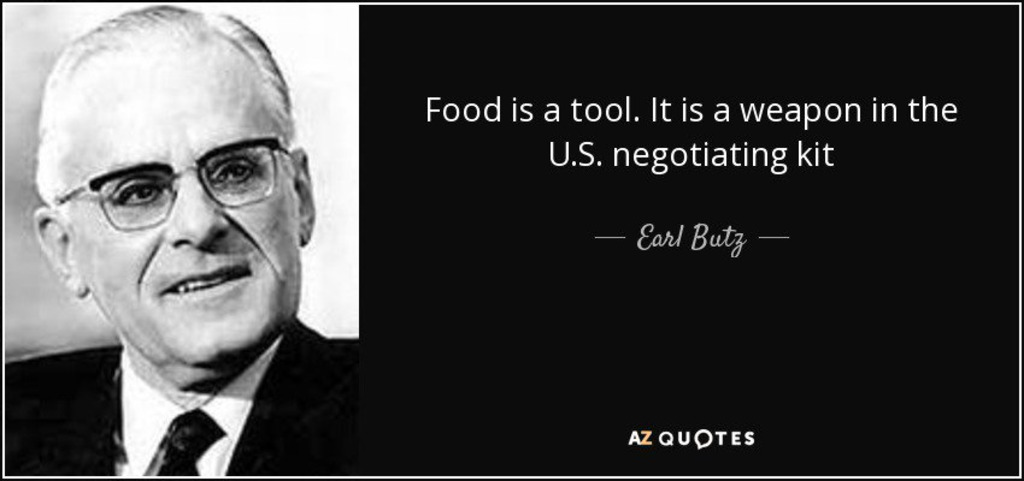
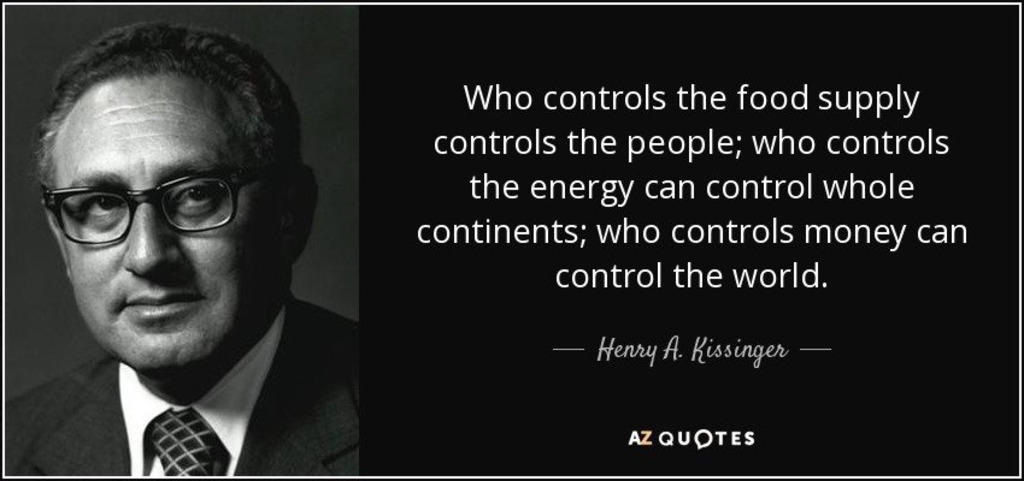
Earl Butz on food as a weapon…

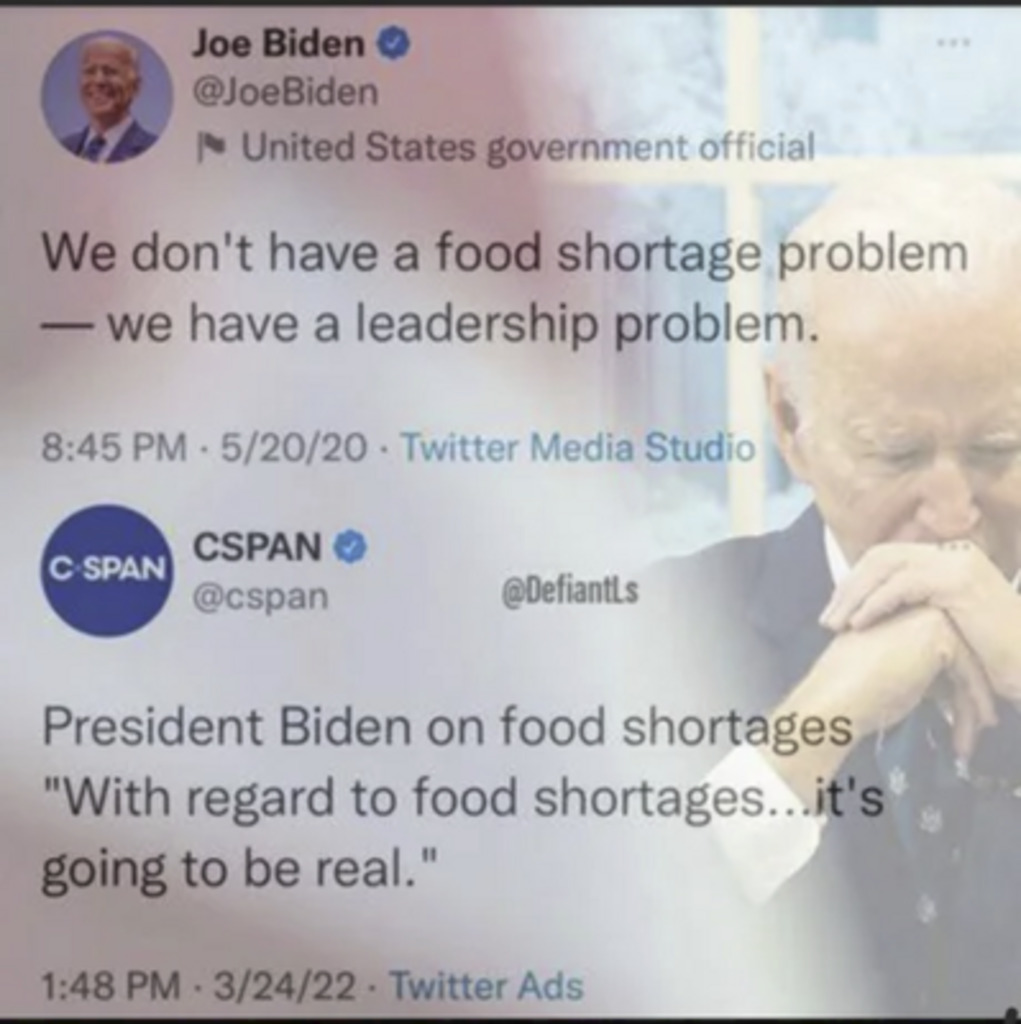
President Joe Biden acknowledged during a press conference in Brussels on Thursday that food shortages will hit the world as a result of Russia’s war in Ukraine.
“It’s going to be real,” Biden said when asked about discussions with world leaders about food shortages.
He pointed out that Russia and Ukraine were considered the “breadbasket of Europe,” producing nearly a third of wheat exports around the world. Biden also previewed tough times ahead for food supplies across the globe.
“The price of these sanctions is not just imposed upon Russia; it’s imposed upon an awful lot of countries, as well, including European countries and our country, as well,” Biden said.
Biden said he and Canadian Prime Minister Justin Trudeau promised European leaders the United States and Canada will act to bolster their supplies of grain.
The executive director of the UN’s World Food Program is saying that we are now facing “a catastrophe on top of a catastrophe.” Unfortunately, he is not exaggerating. The global price of food was skyrocketing even before the war on the other side of the globe erupted, and now many of the countries that are extremely dependent on agricultural exports from Ukraine and Russia are going to have to turn elsewhere for answers. Meanwhile, severe drought is threatening production in the other major “breadbasket” of the world. We are being warned that the winter wheat harvest in the U.S. could be “disastrous” this year, and that is very unwelcome news. Because if some sort of a miracle does not happen, we will soon see hunger and famine on a scale that once would have been unimaginable to many people.
We really are facing a “perfect storm” as far as global food production is concerned. The following comes from a recent New York Times article…
Ukrainian farms are about to miss critical planting and harvesting seasons. European fertilizer plants are significantly cutting production because of high energy prices. Farmers from Brazil to Texas are cutting back on fertilizer, threatening the size of the next harvests.
China, facing its worst wheat crop in decades after severe flooding, is planning to buy much more of the world’s dwindling supply. And India, which ordinarily exports a small amount of wheat, has already seen foreign demand more than triple compared with last year.
The new global energy crisis just keeps pushing fertilizer prices higher and higher.
This is something that I have been warning about for months, and now the mainstream media is finally acknowledging that we have a truly historic challenge on our hands.
In fact, they are not openly admitting that fertilizer prices have “more than doubled or tripled in price over the past year”…
In another ominous signal to fertilizer customers, earlier this month European fertilizer producers said they were slowing or halting production because of soaring energy prices. Many fertilizers are made with natural gas.
The world’s major fertilizers have now more than doubled or tripled in price over the past year.
Actually, in some cases fertilizer prices have actually quadrupled.
How are the poorer parts of the world supposed to deal with that?
It is easy to tell them to use less fertilizer, but using less fertilizer will mean less food is grown.
You could soon be eating genetically modified beef thanks to the US Food and Drug Administration.
The FDA claims that two gene-edited breeds of beef cattle produced by a major breeder are safe for human consumption.
The two breeds of cow in question have been edited so they grow short slick coats.
This change is not thought to be harmful to the meat or the cow.
Experts suggest this genetic modification is “low risk”.
That means Acceligen, the company which produces the breed, doesn’t need to seek approval to sell it.
This is said to be the first time that the FDA has made such an assessment.
The federal agency has never given a “low-risk” premarket approval before to a gene-edited animal food product.
Washington State University is amplifying claims that farmer’s markets and food charities are examples of “white supremacy” and “white dominant culture.” It has nothing to do with helping farmers thrive. This is about creating left-wing social justice activists.
The Agriculture Program Coordinator for WSU’s San Juan County Extension Ag Program promoted a webinar event titled, “Examining Whiteness in Food Systems.” During the hour-long presentation, attendees learned that “white supremacy culture” creates food insecurity by “center[ing] whiteness across the food system.”
The materials claim that “whiteness defines foods as either good or bad” and that farmer’s markets are merely white spaces.
This webinar is the latest example of a critical race theory lens framing noncontroversial issues as racist. And given WSU operates a 4-H program, it’s worth wondering how much of this will eventually get in front of young kids.
In addition to banning Monsanto/Bayer’s cancer-causing Roundup herbicide by 2024, Mexico is now pledging to rid the country of GMO corn by the same date.
To do so, it plans to gradually replace 16 million tons in annual imports of GMO corn from the United States with ancient, indigenous varieties.
President Andrés Manuel López Obrador first made the decree on January 2, noting that bio-security authorities would “revoke and refrain from granting permits for the release of genetically modified corn seeds into the environment.”
Following through with that promise, Mexican health safety regulators just denied a permit for Monsanto/Bayer’s latest GMO corn variety last month.
As we approach a winter of discontent and Global food systems go from bad to worse, there’s trouble in paradise.
At the root of these problems, Government responses to COVID-19 have contributed to a six-fold increase in famine-like conditions as global supply chains collapse, and field trials for gene-edited crops and farm animals begin in the UK.
Against this perfect storm, the UN’s World Food Systems Summit convened last month, with Member States joining the private sector, civil society groups and researchers, to bring about “tangible, positive changes” to the world’s food systems, and as the story goes, “drive recovery from COVID-19.”
But even if we could solve our problems using the same logic that created them, there are deeper, institutional problems undermining the integrity of the Summit.
Specifically, its corporate capture by one man, whose vision of the future of food security places the interests of civil society and farming communities in a different universe to the corporations he is beholden to.
A household name on the world stage of disaster-capitalism, there is more to Bill Gates than doomsayer-general terrorising the world’s population into a permanent state of suspended animation, and it typically involves the future of food security.
Food insecurity in the Land of the Free is at a historical high. Thanks to the fed printing trillions to pay for their irresponsible and economically devastating lockdown policies, food costs have gone through the roof, supply chains are disrupted, there are fewer workers, and the impact is empty shelves. According to a report in Bloomberg, some of the countries largest food distributors are reporting difficulties in fulfilling orders.
Naturally, if the retail food supply is in a rut, the food banks and charities reflect this. The U.S. Census Bureau reported in March that as many as 9 million children live in a household where they don’t eat enough because the parents can’t afford it. And now, those who are able to donate, can’t due to shortages in the supply chain.
One company, however, isn’t reporting any shortages and, according to a shocking account, has an excess so large, they are throwing thousands of pounds of food away every single day.
An anonymous whistleblower from inside Amazon has exposed a practice by the delivery giant that removes any claims of Amazon running an efficient and sustainable ship. This person claims to be an employee inside an Amazon warehouse and has provided photographs of thousands of food items being destroyed on a daily basis — with the expiration dates days or weeks away.
 Hellbound and Down
You must be logged in to post a comment.