
Did you vote for that?

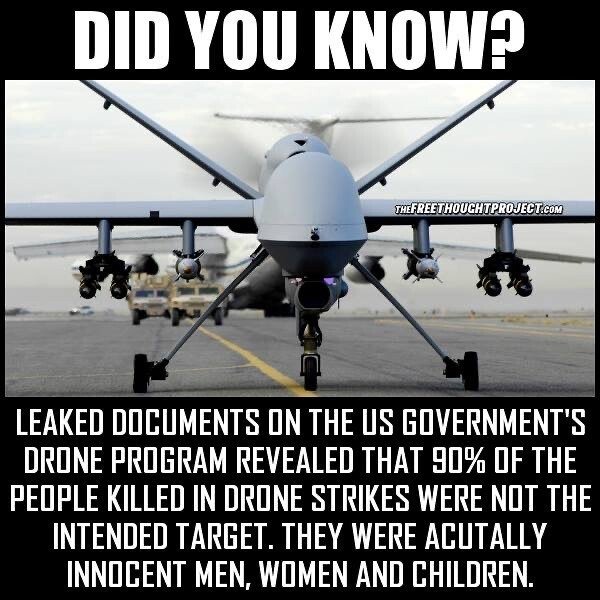
Press freedom, peace, and human rights advocates are rallying behind Daniel Hale, the former intelligence analyst who blew the whistle on the U.S. government’s drone assassination program, and who pleaded guilty Wednesday in federal court to violating the Espionage Act.
The Washington Post reports Hale, who was set to go on trial next week, pleaded guilty to a single count of violating the 1917 law that has been used to target whistleblowers including Julian Assange, John Kiriakou, Chelsea Manning, Edward Snowden, Jeffrey Sterling, Reality Winner, and others.
Hale was charged in 2019 during the Trump administration after he leaked classified information on the U.S. government’s targeted assassination program to a reporter, who according to court documents, matches the description of The Intercept founding editor Jeremy Scahill. He is the first person to face sentencing for an Espionage Act offense during the administration of President Joe Biden.
As vice president under President Barack Obama, Biden contributed to the creation of whistleblower protections in the Dodd-Frank Wall Street Reform and Consumer Protection Act, while simultaneously serving in an administration that, while promising “a new era of open government,” relentlessly targeted individuals who revealed U.S. war crimes and other classified information.
Imagine in the near future, a swarm of tiny drones patrolling the skies across the country. These drones are not being flown by any pilot and are entirely autonomous, carrying out their directives coded into them during manufacturing — surveil, record, follow, and even predict your next move. Sounds like something out of a dystopian Sci-Fi flick, right? Well, there is no need to imagine this scenario or to watch it in a movie.
It is already here.
Adam Bry and Abraham Bachrach, the CEO and CTO, respectively at a company called Skydio have helped usher in this new reality. The duo started together at MIT before moving on to Google and working on Project Wing Google.
After moving on from building self-flying aircraft at Google, the duo founded Skydio and has been giving their autonomous drones to police departments ever since — for free.
“We‘re solving a lot of the core problems that are needed to make drones trustworthy and able to fly themselves,” Bry told Forbes in an interview this week. “Autonomy—that core capability of giving a drone the skills of an expert pilot built in, in the software and the hardware—that’s really what we’re all about as a company.”
According to Forbes, Skydio “claims to be shipping the most advanced AI-powered drone ever built: a quadcopter that costs as little as $1,000, which can latch on to targets and follow them, dodging all sorts of obstacles and capturing everything on high-quality video. Skydio claims that its software can even predict a target’s next move, be that target a pedestrian or a car.”
The U.S. Navy has handed a contract to Raytheon for versions of its Coyote small unmanned aerial vehicle configured as loitering munitions, also known as “suicide drones.” The service says that it specifically wants them to support the development of unmanned surface and underwater vehicles as platforms to launch drone swarms, which could offer a slate of game-changing capabilities.
The Pentagon announced the deal, valued at up to almost $33 million if all the options were to be exercised, in its daily contracting notice on Feb. 26, 2021. The announcement said that the contract, which the Office of Naval Research (ONR) awarded to Raytheon, was for “Coyote Block 3 (CB3) Autonomous Strike” drones to support work on “Autonomous Swarm/Strike – Loitering Munitions.”
This is “a rapid capability effort to achieve operational launch capability from unmanned surface vessels (USVs) and an unmanned underwater vessel (UUV). The intended concept of operations (CONOP) and tactics, techniques and procedures (TTPs) are to provide intelligence, surveillance and reconnaissance (ISR) and precision strike capability from maritime platforms,” the contracting notice added. “Additionally, the High Volume Long Range Precision Strike (HVLRPS) from USVs and Fires (HVLRPF) from UUVs demonstrations will leverage prior efforts including the Innovative Naval Prototype (INP) and progress on the Mobile Precision Attack Vehicle (MoPAV).”
For a couple of decades, police forces across the country have been militarized. Stepping into a new decade, police forces, like NYPD, are seeking to deploy automation and artificial intelligence systems to combat crime.
NYPD first received the robot dog, called “Digidog,” a couple of months ago. At the time, NYPD Technical Assistance Response Unit Inspector (TARU) Frank Digiacomo told ABC7 that the four-legged robotic dog “will save lives, protect people, and protect officers and that’s our goal.”
Digidog is like any Boston Dynamics Spot robot – though this one is equipped with lights, two-way communication, and video cameras.
The latest video shows the 70-pound robot being tested in the Bronx. The department also deployed the robotic dog back in October to a Brooklyn shooting.

To summarize the company’s manifesto. It said: “See Spot KILL!! Spot is an empathy-building tool, because: Cute and approachable!”
Here’s the manifesto:
See Spot Run. It tops out at a blistering 3mph.
See Spot Roll Over. Spot is an empathy missile, shaped like man’s best friend and targeted straight at our fight or flight instinct. When killer robots come to America they will be wrapped in fur, carrying a ball. Spot is Rob Rhinehart’s ideal pet: it never shits.
Good Boy, Spot! Everyone in this world takes one look at cute little Spot and knows: this thing will definitely be used by police and the military to murder people. And what do police departments have? Strong unions! Spot is employee of the month. You never need to union bust a robot – but a robot can union bust you.
The manifesto continued, “Boston Dynamics and they HATED this idea.” They said the robotics company even offered them two free robots to call off the event.
See Spot KILL!! Spot is an empathy building tool, because: Cute and approachable! We talked with Boston Dynamics and they HATED this idea. They said they would give us another TWO Spots for FREE if we took the gun off. That just made us want to do this even more and if our Spot stops working just know they have a backdoor override built into each and every one of these little robots.
See Spot Fall Over And Freak Out. Quite an experience to live in fear, isn’t it? That’s what it is to be a slave. Our saving grace: Spot is evil but not very good at its job.
Boston Dynamics wasn’t thrilled with the stunt.
Loitering munitions, otherwise known as kamikaze drones, differ from other weapons in being relatively slow but able to patrol an area for a prolonged period looking for targets before identifying, selecting and attacking them.
The LRUSV is much smaller than the flagship Sea Hunter unmanned experimental vessel and the Navy’s Overlord robot transport but shares many of their goals. Like them, the LRUSV is supposed to travel the sea lanes without direct human supervision, sailing safely with other vessels. Unlike them it will “collaboratively interact with other vessels as a cluster,” suggesting that numbers of LRUSV would be deployed together. Such a cluster could unleash a swarm of dozens, hundreds or even thousands of small drones to overwhelm a target. (And while they might not be able to sink a warship, knocking out radar and defensive systems would leave it an easy target for other weapons).
Raytheon previously developed low-cost swarming drones based on their proven Coyote under the U.S. Navy’s LOCUST program in 2015. The goal was for a swarm which would work together collaboratively as a unit – and which would collectively cost less than a single missile. By 2016, 30 of the 13-pound drones were flying together, but the swarm size is likely to have increased significantly since.
As reported last month, a would-be assassin’s bullet struck but did not penetrate Trump’s bedroom window while he slept during the early morning hours on January 26. Bullet proof glass, which he had installed recently, probably saved his life. And ballistic experts who at first speculated that the shot originated from a chopper hovering off the coast have dismissed that hypothesis in favor of a more plausible premise—an armed drone.
A source in Trump’s orbit speaking under condition of anonymity has given Real Raw News more information on the shocking assassination attempt and subsequent investigation.
Trump’s investigation team, our source said, dismissed the gunman in a helicopter theory after obtaining radar logs from Palm Beach Intl. Airport and the US Coast Guard Station, Lake Worth Inlet. Neither radar had detected a helicopter within 15 miles of Mar-a-Lago between 3:00-4:00 that morning.
Although radar is an imperfect technology—and helicopters are small—most civilian and military radar systems employ a technology called Multilateration, a technique for figuring out a ‘vehicle’s’ position based on measurement of the times of arrival of energy waves having a known speed when propagating either from or to multiple system stations. In short, if a helicopter were there, radar would have detected it.
Trump, of course, did not deduce this on his own. To interpret the radar data, Trump hired USAF retired CMsgt. Anthony Vance, who for 12 years was a Radar Approach Control operator at Joint Base Andrews, which was then called Andrews Airforce Base. After retiring from the military, Vance was tower chief at JFK Intl. Airport, one of the busiest airports in the world. He has spent most of his life interpreting radar nuances.
“Vance studied the logs and said he was 99% certain that no helicopter was in the vicinity of Mar-a-Lago when the bullet hit the window. Trump believed him, but was still furious and wanted answers. Upon closer inspection of the radar logs, Vance saw something he thought might interest Trump,” our source said.
The logs revealed four surface contacts, or ships, within three miles of Mar-a-Lago at around the time of the attack.
A radar’s ability to detect and track surface contacts is dependent on several variables—sea and atmospheric conditions, the size of the vessel and, most important, whether the ship has a mast. The taller the mast, the greater the chance it will reflect a radar signal to the source.
“Vance figured out that the nearest contact was stationary about a half mile off the coast when the round hit the window. Within minutes, that contact headed due west and accelerated to 30knots. The only landmass west is the Bahamas, but the radar lost track after thirty miles. These discoveries made Trump’s people dump the helicopter theory and think about a drone having been launched from the ship.”
Trump enlisted the aid of a former General Atomics aeronautical engineer, Stephen Duckworth, to bolster the drone theory. Duckworth had extensive credentials and had played a pivotal role in the development of the US military’s MQ-1 Predator UMV.
Duckworth excluded commercially available drones as possible culprits, but he told Trump that a custom-built drone fitted with gyroscopic stabilizers and advanced night vision or thermal optics could have, theoretically, fired a weapon affixed to the chassis.
“You do know the CIA has this stuff?” Duckworth reportedly told Trump.


You must be logged in to post a comment.