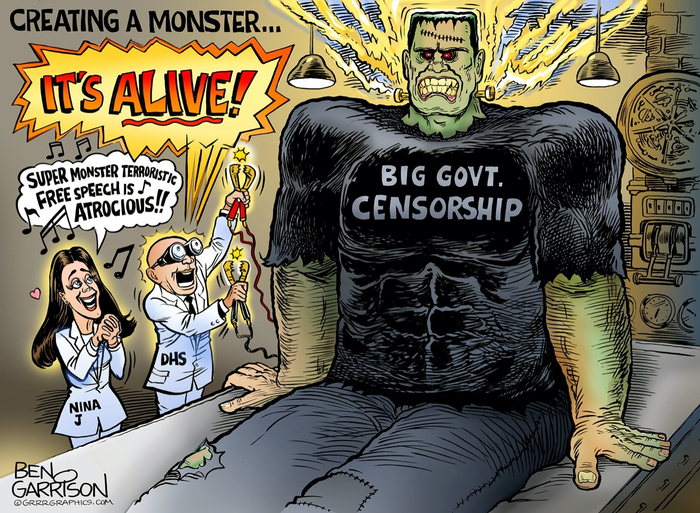
Censorship monster…

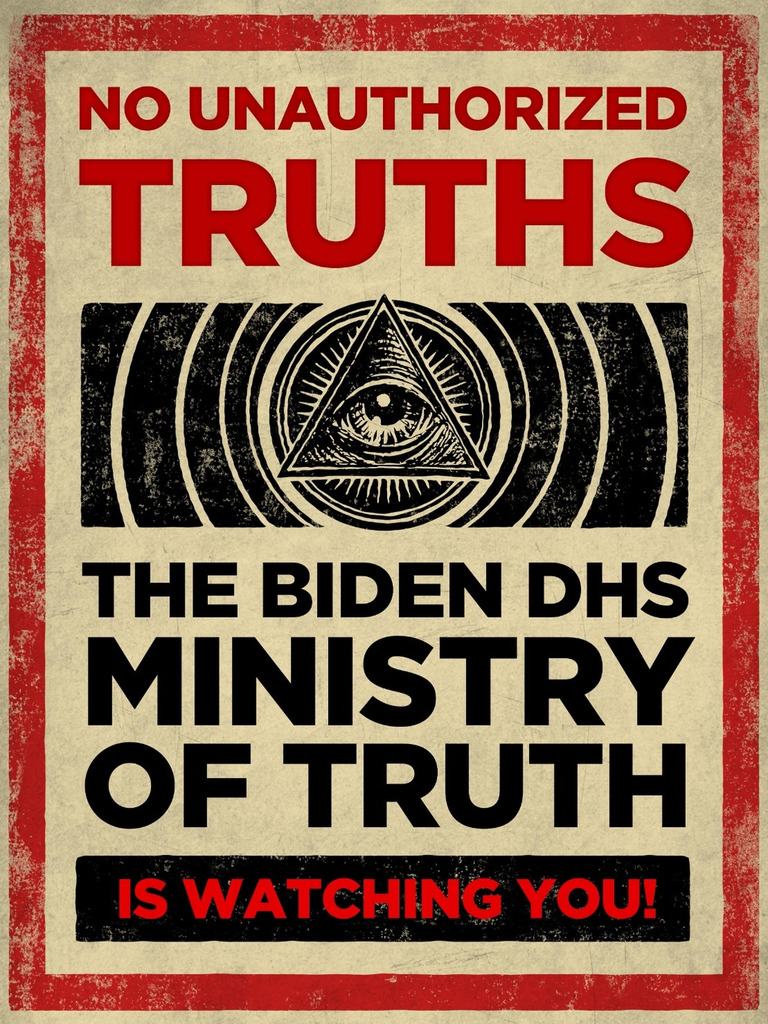
A “Disinformation Governance Board” has just been created and is going to be run by the Department of Homeland Security. Their primary goal is going to be to “police” what is deemed to be “misinformation” or “disinformation.”
No clarification has been given as of yet as to what this policing will mean, but it has been pointed out that the creation of this new Disinformation Governance Board is going to have the full strength of the DHS behind it.
DHS Secretary Alejandro Mayorkas said, “the goal is to bring the resources of (DHS) together to address this threat.”
Nina Jankowicz has been chosen to head up the new disinformation office as the executive director.

The Executive Director of the Biden White House’s newly launched Disinformation Governance Board celebrated the censorship of news reports regarding Hunter Biden’s hard drive, appearing to describe the story as “Russian disinformation.”
The Department of Homeland Security (DHS) created the board to “coordinate countering misinformation related to homeland security” focusing “on irregular migration and Russia,” according to POLITICO. The report also revealed that Nina Jankowicz – whose career has focused on partisan operations and advising foreign governments, rather than news reporting – will serve as its executive director.
While participating in U.S. Congressional hearings, Jankowicz dismissed documented links between Ukrainian energy company Burisma and the Biden family, while calling for an increase in federally-funded media outlets and an “oversight” agency of social media platforms.
She described the well-documented business ties between the first son and Burisma as “perhaps the most well-known example of information laundering” and “unsubstantiated and misleading.”
Jankowicz is a former “disinformation fellow” at the partly government-funded Wilson Center, and even advised the Ukrainian government as recently as 2016.
Before her new job at the Department of Homeland Security, President Joe Biden’s new disinformation chief Nina Jankowicz displayed her musical talent on YouTube.
In one video, Jankowicz sings a version of “My Simple Christmas Wish (Rich, Famous, and Powerful)” by David Friedman.
“I want to be rich famous and powerful! Step on all my enemies and never do a thing,” she sings as a piano plays in the background.
Jankowicz sang an edited version of the song to include “Who do I fuck” to be “famous and powerful,” instead of the original lyrics “who do I have to fake”
The Department of Homeland Security’s new ‘disinformation’ unit will be headed by a woman who says free speech makes her ‘shudder’ and who falsely labeled the Hunter Biden laptop story disinformation.
Oh dear.
Just two days after it was revealed that Elon Musk had reached an agreement to buy Twitter, DHS chief Alejandro Mayorkas announced the creation of a “disinformation governance board.”
The new board will focus primarily on “misinformation related to homeland security, focused specifically on irregular migration and Russia.”
The board will be headed by Nina Jankowicz, a former advisor to the Ukrainian Foreign Ministry who oversaw related issued at the National Democratic Institute lobby group.
“Cat’s out of the bag,” Jankowicz tweeted. “Here’s what I’ve been up to the past two months, and why I’ve been a bit quiet on here.”
Jankowicz’s view of free speech is particularly odious. Free speech apparently makes her physically shudder.
“I shudder to think about if free speech absolutists were taking over more platforms, what that would look like for the marginalized communities, which are already shouldering disproportionate amounts of this abuse,” she tweeted in response to Musk’s Twitter takeover.
After Joe Biden was declared the winner of the 2020 presidential election, independent journalist Glenn Greenwald predicted that Democrats would use the force of the government to crack down on conservative reporting under the guise of combatting “national security” threats.
Now President Biden’s Department of Homeland Security is reportedly working to create a “disinformation governance board” to counter what they determine to be false information relating to national security.
On Wednesday, Politico reported that DHS is creating the board “to coordinate countering misinformation related to homeland security, focused specifically on irregular migration and Russia.”
Nina Jankowicz will now reportedly head the new DHS board as executive director. Jankowicz was one of the prominent liberals who appeared to believe that the device was Russian disinformation.
While Russia has certainly been guilty of putting out disinformation around the globe, American intelligence officials have also labeled factual information — like Hunter Biden’s “laptop from hell”— as Russian propaganda as well. Even the mainstream media now admits that the contents of that laptop were real.
In March 2021, Jankowicz tweeted that the intelligence community “has a high degree of confidence that the Kremlin used proxies to push influence narratives, including misleading or unsubstantiated claims about President Biden, to US media, officials, and influencers, some close to President Trump.”
“A clear nod to the alleged Hunter laptop,” she posited.
It is unclear what she was suggesting was misleading or unsubstantiated — with regard to the laptop — when she sent that tweet. Various media outlets at that time had not dug into the veracity of its contents. The media and Jankowicz, appeared to accept at face value the intelligence community’s false report that it was Russian disinformation. Twitter also infamously blocked the story from its site based on information from intelligence community members.

Last Friday, Homeland Security Secretary Alejandro Mayorkas declared white supremacists and “domestic violent extremism” to be the “most prominent threat” currently facing our country. The timing could not have been more perfect. Just hours later, a jury in Grand Rapids, Michigan exposed the Justice Department’s largest alleged “domestic terrorism” case of the last 18 months as a failed FBI entrapment scheme to smear conservatives as white supremacists ahead of the 2020 election.
By refusing to convict four men accused of plotting to kidnap and kill Michigan Gov. Gretchen Whitmer before Election Day 2020, the Grand Rapids jury seemed to side with defense attorneys who argued their clients were not domestic terrorists, but entrapped by undercover FBI agents and at least a dozen informants who planned and funded the kidnapping operation.
“The key to the government’s plan was to turn general discontent with Gov. Whitmer’s COVID-19 restrictions into a crime that could be prosecuted,” defense lawyers wrote in a joint motion. “The government picked what it knew would be a sensational charge: conspiracy to kidnap the governor. When the government was faced with evidence showing that the defendants had no interest in a kidnapping plot, it refused to accept failure and continued to push its plan.”
 Hellbound and Down
You must be logged in to post a comment.