
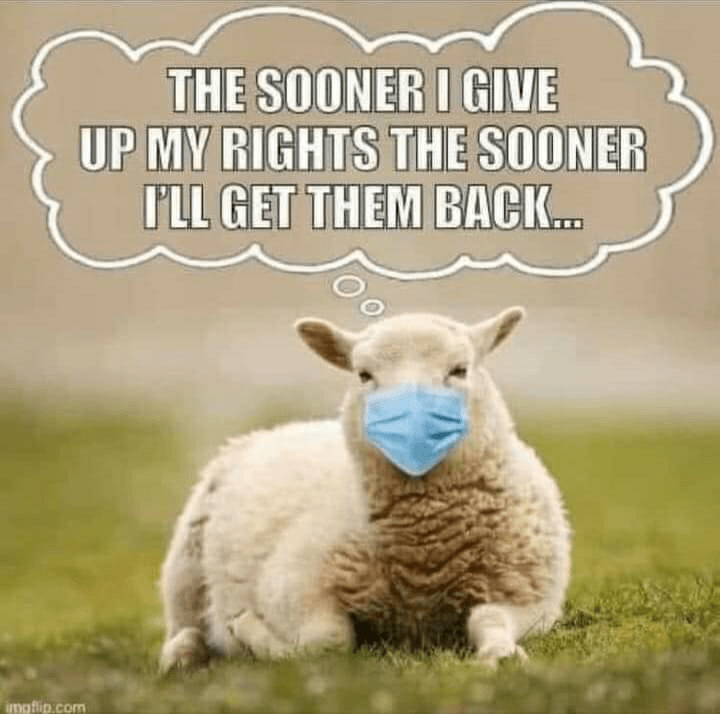
That mask, though…


Are you ready for this week’s absurdity? Here’s our weekly roll-up of the most ridiculous stories from around the world that are threats to your liberty, risks to your prosperity… and on occasion, inspiring poetic justice.
A Chinese virologist who has reportedly been in hiding for fear of her safety has stepped out into the public eye again to make the explosive claim that she has the scientific evidence to prove COVID-19 was man-made in a lab in China.
Dr. Li-Meng Yan, a scientist who says she did some of the earliest research into COVID-19 last year, made the comments Friday during an interview on British talk show “Loose Women.”
When asked where the deadly virus that has killed more than 900,000 around the globe comes from, Yan — speaking via video chat from a secret location — replied, “It comes from the lab — the lab in Wuhan and the lab is controlled by China’s government.”
She insisted that widespread reports that the virus originated last year from a wet market in Wuhan, China, are “a smokescreen.”
“The first thing is the [meat] market in Wuhan … is a smokescreen and this virus is not from nature,” Yan claimed, explaining that she got “her intelligence from the CDC in China, from the local doctors.”
The virologist has previously accused Beijing of lying about when it learned of the killer bug and engaging in an extensive cover-up of her work.
She had said that her former supervisors at the Hong Kong School of Public Health, a reference laboratory for the World Health Organization, silenced her when she sounded the alarm about human-to-human transmission in December last year.
In April, Yan reportedly fled Hong Kong and escaped to America to raise awareness about the pandemic.
Here’s what we were told: An August motorcycle rally in Sturgis, South Dakota, helped spread COVID-19 to more than a quarter-million Americans, making it the root of about 20 percent of all new coronavirus cases in the U.S. last month. So said a new white paper from the IZA Institute of Labor Economics, at least. And national news outlets ran with it.
“Sturgis Motorcycle Rally was ‘superspreading event’ that cost public health $12.2 billion,” tweeted The Hill.
“The Sturgis Motorcycle Rally held in South Dakota last month may have caused 250,000 new coronavirus cases,” said NBC News.
“The Sturgis Motorcycle Rally represents a situation where many of the ‘worst-case scenarios’ for superspreading occurred simultaneously,” the researchers write in the new paper, titled “The Contagion Externality of a Superspreading Event: The Sturgis Motorcycle Rally and COVID-19.”
Not so fast. Let’s take a look at what they actually tracked and what’s mere speculation.
According to South Dakota health officials, 124 new cases in the state—including one fatal case—were directly linked to the rally. Overall, COVID-19 cases linked to the Sturgis rally were reported in 11 states as of September 2, to a tune of at least 260 new cases, according to The Washington Post.
There very well may be more cases that have been linked to the early August event, but so far, that’s only 260 confirmed cases—about 0.1 percent of the number the IZA paper offers.
Lawmakers have mandated a variety of COVID restrictions to stem the spread of the pandemic, but not all lawmakers have been willing to follow the rules.
Governors, mayors and state health departments have required that Americans wear masks, social distance, refrain from spending time in large groups, quarantine after traveling across state lines, stay home from church services and much more.
But many political leaders and members of their families have failed to comply with social distancing rules. Here’s a list of lawmakers who appeared to dodge coronavirus-related restrictions.
Less than a day after issuing new health guidelines that banned trick-or-treating and other Halloween activities, Los Angeles County public health officials walked back the decision Wednesday.
Citing an inability to maintain safe social distancing and the potential for gatherings beyond household members, county officials initially nixed trick-or-treating along with other Halloween traditions, including haunted houses and parades.
But Public Health Director Barbara Ferrer said Wednesday that the guidelines have been “slightly revised.”
Ferrer said the change distinguishes between activities originally prohibited under the health officer order from activities that are “not recommended.”
“This year, it’s just not safe to celebrate in the ways we usually do,” Ferrer said. “We are recommending that trick-or-treating not happen this year.”
The Department of Public Health previously said that because some of the traditional ways in which Halloween is celebrated do not allow contact with nonhousehold members to be minimized, it is important to identify safer alternatives.
“Trunk-or-treat” events involving car-to-car candy dispersal, which are sometimes held by churches or schools, also are not recommended under the revised order.
Houston-area health authorities are overstating the number of new Covid-19 cases as data teams struggle to work through a backlog of old test results in the third-largest U.S. county.
On an almost daily basis, Harris County Public Health releases a tally of what it calls “new cases” that a Bloomberg analysis found includes hundreds of diagnoses that are weeks or months old. On Tuesday, for example, more than 70% of the new cases disclosed actually were detected prior to this month and some dated as far back as June.
The confusion means authorities may be exaggerating the current severity of the outbreak — and were unknowingly understating the extent of the crisis in June and July, when hospitals were stretched to their limits. The situation also highlights the dilemma facing political leaders imposing mask mandates and other restrictions based on what they presume is accurate, timely data.
So what “science” changed in the last 24 hours?
Just a day after a large group on New York restaurateurs filed a $2 billion lawsuit against Cuomo and De Blasio over the ongoing COVID lockdowns, the Governor just announced that indoor-dining will be allowed (at 25% capacity) starting on September 30th.
The restaurant owners exclaimed:
“We’ve been patient, the numbers are fantastic, the COVID statistics, we don’t know what more we could do,” said one business owner.
“This is a lawsuit. We don’t wanna do this. This is not us, we are workers. We work 100 hours a week. It’s not a luxurious lifestyle. I have waiters; none of them drove here in a Ferrari today.”
And now they can open – but who decided that 25% capacity was the right number? why not 30% or 50%?
“Because compliance is better, we can now take the next step,” the governor said.
Additional restrictions would also be placed on restaurants and their patrons, including a requirement to wear face coverings when not seated.
 Hellbound and Down
You must be logged in to post a comment.