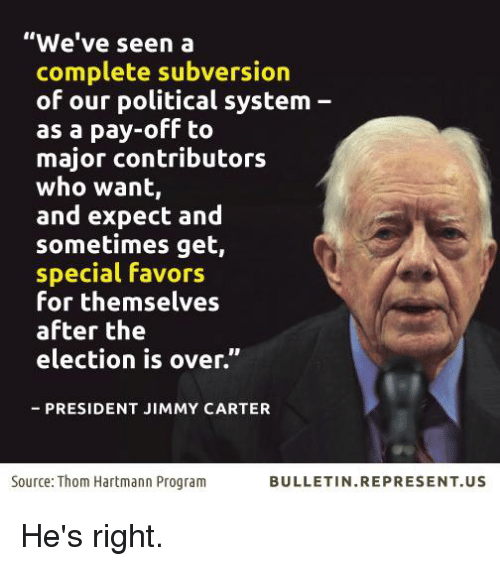
Jimmy Carter on our political system…

If you experience severe side effects after getting a Covid vaccine, lawyers tell CNBC there is basically no one to blame in a U.S. court of law.
The federal government has granted companies like Pfizer and Moderna immunity from liability if something unintentionally goes wrong with their vaccines.
“It is very rare for a blanket immunity law to be passed,” said Rogge Dunn, a Dallas labor and employment attorney. “Pharmaceutical companies typically aren’t offered much liability protection under the law.“
You also can’t sue the Food and Drug Administration for authorizing a vaccine for emergency use, nor can you hold your employer accountable if they mandate inoculation as a condition of employment.
Congress created a fund specifically to help cover lost wages and out-of-pocket medical expenses for people who have been irreparably harmed by a “covered countermeasure,” such as a vaccine. But it is difficult to use and rarely pays. Attorneys say it has compensated less than 6% of the claims filed in the last decade.
Education sector “support staff members,” corporate tax lawyers, and magazine fashion editors will all jump to the front of the coronavirus vaccination line ahead of the general population, under recommendations issued in late December by the federal government’s Centers for Disease Control and Prevention.
Self-interest dictates I should probably wait until after I get my immunity-producing doses before raising any questions about the prioritization. The government’s allocation strategy is such an inviting target, though, that it’s hard to resist taking, er, a shot.
How did we get here? On December 20, a government committee of highly educated, mostly academic experts known as the Advisory Committee on Immunization Practices voted about who should get the vaccine first. The committee has 15 voting members. Twelve of them are medical doctors. One is a lawyer. Nine—a majority—are affiliated with universities, including Stanford, Vanderbilt, Baylor, and the University of California, Los Angeles.
Naturally, the committee of doctors decided that the first vaccines should go to healthcare workers. That might seem like common sense—emergency room or intensive care doctors treating Covid-19 patients deserve to be protected against the risk of catching the disease in the workplace. Healthcare workers, though, is a big, catchall category. It includes everyone from Beverly Hills plastic surgeons conducting elective cosmetic surgery to “administrative staff,” which might be the billing clerk in the plastic surgery practice, or some hospital accounts-receivable bookkeeper or fundraiser with no patient contact.
“Healthcare personnel” are in the CDC’s phase 1a. Educational sector support staff are next in phase 1b. That could include people who are currently working from home and who ordinarily have little or no direct contact with students—say, the employees who answer telephone questions about retired professors’ pension benefits.
The next phase, 1c, encompasses the “media” and “law” categories. Like healthcare personnel, these groups are so broad that they include essential frontline workers but also some others whose prioritization is difficult to justify.
Journalists covering the pandemic by doing on-the-scene reporting from nursing homes or hospital intensive care units probably do have a strong case to be vaccinated relatively early. So do criminal defense lawyers meeting clients in prisons or jails, or making frequent in-person courtroom appearances.
The “media” and “law” categories, though, also include the copyeditors at Vogue and the big-firm lawyers who rarely show up in court but spend their time instead writing memos and helping companies minimize their taxes. Their Covid-19 risk seems pretty small, or at least small enough that it’s hard to see the rationale for those workers leapfrogging ahead of the general population.
A cynic might suspect the vaccine committee put lawyers and journalists early in the queue as a way to avoid getting sued or attracting negative press coverage.
A second California hospital has been busted for giving the Pfizer/BioNTech coronavirus vaccine to its employees’ relatives — instead of using the doses for the elderly or frontline workers.
Southern California Hospital allowed its workers to invite relatives to get vaccinated — just as another area hospital did last week, sparking criticism.
“The hospital had planned on vaccinating all of their employees, but a large number of their staff declined and they were sitting on a lot of thawed vaccines,” a woman vaccinated at Southern California Hospital told the Orange County Register. “‘They offered police officers, firefighters and first-responders to get vaccinated and also told employees they could invite four family members.”

For many American craft distillers, 2020 was already one of their worst years ever. The COVID-19-related closure of tasting rooms and cocktail bars, loss of tourism, and inability to offer in-store sampling slashed their sales revenue and cut them off from their customers. Then this week, just as it seemed they’d made it through the worst of a terrible year, the Food and Drug Administration (FDA) had one more surprise in store: The agency delivered notice to distilleries that had produced hand sanitizer in the early days of the pandemic that they now owe an unexpected fee to the government of more than $14,000.
“I was in literal disbelief when I read it yesterday,” says Aaron Bergh, president and distiller at Calwise Spirits in Paso Robles, California. “I had to confirm with my attorney this morning that it’s true.” The surprise fee caught distillers completely off guard, throwing the already suffering industry into confusion.
Other outlets involved in the propaganda operation include Forbes, the Financial Times, Newsweek, Bloomberg, Reuters, ABC News, the Economist, the Wall Street Journal, AFP, TIME magazine, LA Times, The Hill, BBC, and The Atlantic.
The relationship is revealed in the Department of Justice’s Foreign Agent Registration Act (FARA) filings, which reveal a relationship spanning over a decade between establishment media outlets and the China–United States Exchange Foundation (CUSEF).
 Hellbound and Down
You must be logged in to post a comment.