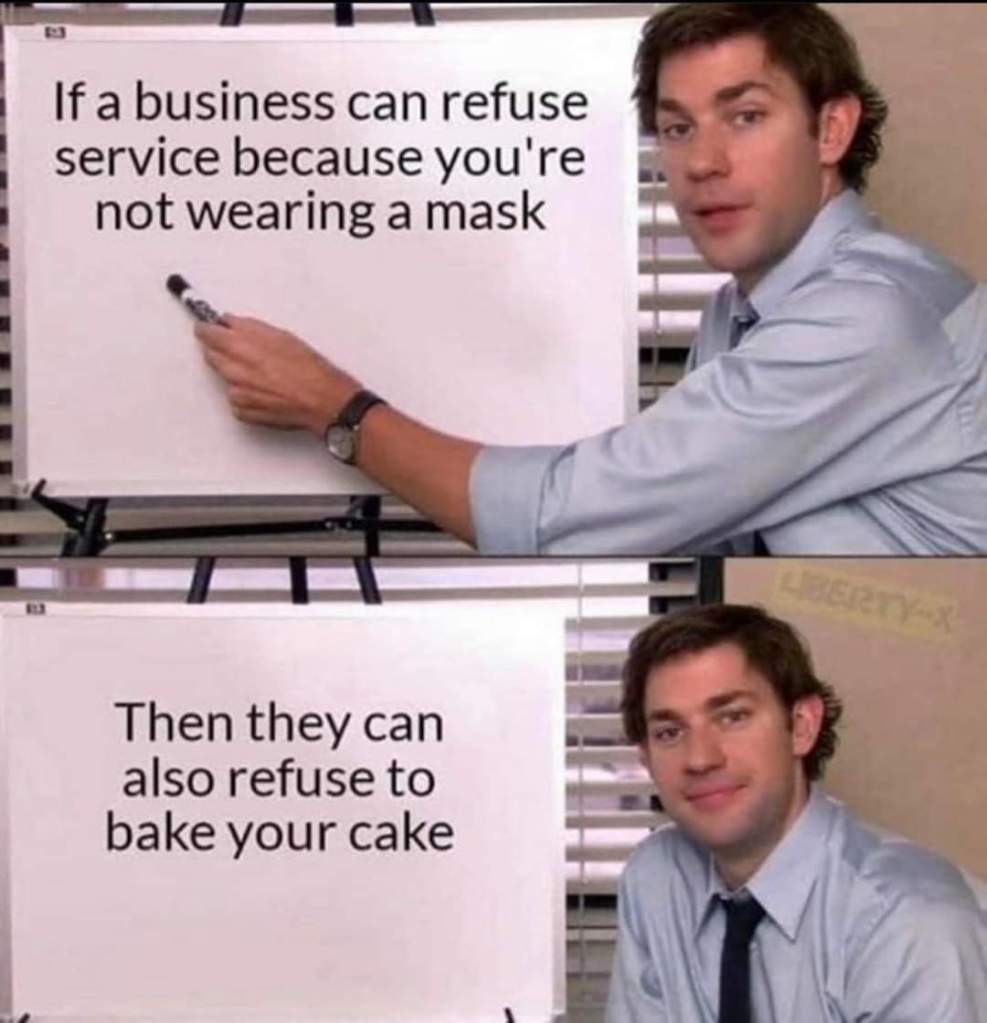
Right to refuse service?

Until recently, the overwhelming percentage of doctors recommended against masks for anyone who wasn’t sick or caring for someone who was.
Consider that on May 21 of this year, the highly respected New England Journal of Medicine stated, “We know that wearing a mask outside health care facilities offers little, if any, protection from infection.”
Consider the report by trauma & emergency physician Dr. Kelly Victory, who said, “[T]here’s no scientific justification for normal healthy people to be wearing masks.”
Okay, those are statements. What about studies?
As I dug for scientific articles both in favor of and against the wearing of masks (I really do strive to understand both sides of an issue), I came across a thorough meta-analysis of extant studies on mask efficacy. The work was conducted by Denis G. Rancourt, Ph.D, and by reading his paper, “Masks Don’t Work: A Review of Science Relevant to Covid-19 Social Policy,” you will save yourself hours of boring library research.
In an interview Rancourt did with Del Bigtree on The Highwire YouTube channel, Rancourt gave an overview of his research, saying:
“If you use only proper studies – randomized, controlled trials with verified outcomes – they all unambiguously say that there is no statistical evidence of a benefit in terms of reducing risk of getting a viral respiratory disease. They all say it.”
Rancourt also says the current narrative about wearing masks to prevent spreading Covid is simply “a river of talk, it’s a river of posturing, it’s a river of policy statements.” He says you can’t just ask people in a study if they had the sniffles last week. You have to determine if people really got sick.
“[I]f you look at those [studies],” Rancourt says, “and there have been many of them over the last decade, none of them show a statistically significant advantage to wearing a mask compared to not wearing a mask.”
For those who want to dig deeper, Rancourt’s article contains links to each randomized, controlled trial on mask efficacy, and it’s a recommended read.

An Oregon county has decided to make people of color exempt from its mandatory mask policy, citing the potential for racial profiling. The decision comes as multiple counties in Oregon have ramped up face-covering requirements to slow the spread of coronavirus.
Lincoln County’s general directive requires everyone to wear a face-covering in any indoor public setting, or any outdoor setting where six feet of social distancing can’t be maintained. But the county wrote on its website that “People of color who have heightened concerns about racial profiling and harassment due to wearing face coverings in public” are exempt from the rule.
Next month marks the beginning of the 2020/2021 academic year in several US states, and pressure is mounting to reopen schools even as the COVID-19 pandemic persists. Florida, for example, is now considered the nation’s No. 1 hot spot for the virus; yet on Monday, the state’s education commissioner issued an executive order mandating that all Florida schools open in August with in-person learning and their full suite of student services.
Many parents are balking at back-to-school, choosing instead to homeschool their children this fall.
Gratefully, this virus seems to be sparing most children, and prominent medical organizations such as the American Academy of Pediatrics have urged schools to reopen this fall with in-person learning. For some parents, fear of the virus itself is a primary consideration in delaying a child’s return to school, especially if the child has direct contact with individuals who are most vulnerable to COVID-19’s worst effects.
But for many parents, it’s not the virus they are avoiding by keeping their children home—it’s the response to the virus.


Following trial results released yesterday showing Moderna’s vaccine candidate might not be safe for human consumption – apparently, the candidate caused “adverse” reactions in roughly 50% of patients who participated in a recent study – the dozens of companies, universities and governments working on COVID-19 vaccine candidates just received another piece of disheartening news: A growing body of evidence gleaned from research into the virus suggests that antibodies may not offer protection for more than 2-3 months, for many people.

The dumpster fire of COVID predictions has shown exactly why it’s important to sustain and nurture skeptics, lest we blunder into scientific monoculture and groupthink. And yet the explosion of “cancel culture” intolerance of any opinion that doesn’t fit a shrinking “3 x 5 card” of right-think risks destroying the very tolerance and science that sustains our civilization.
Since World War II, America has suffered two respiratory pandemics comparable to COVID-19: the 1958 “Asian flu,” then the 1969 “Hong Kong flu.” In neither case did we shut down the economy—people were simply more careful. Not all that careful, of course—Jimi Hendrix was playing at Woodstock in the middle of the 1969 pandemic, and social distancing wasn’t really a thing in the “Summer of Love.”
And yet COVID-19 was very different thanks to a single “buggy mess” of a computer prediction from one Neil Ferguson, a British epidemiologist given to hysterical overestimates of deaths, from mad cow to bird flu to H1N1.
For COVID-19, Ferguson predicted 3 million deaths in America unless we basically shut down the economy. Panicked policymakers took his prediction as gospel, dressed as it was in the cloak of science.
Now, long after governments plunged half the world into a Great Depression, those panicked revisions are being quietly revised down by an order of magnitude, now suggesting a final tally comparable to 1958 and 1969.
 Hellbound and Down

You must be logged in to post a comment.