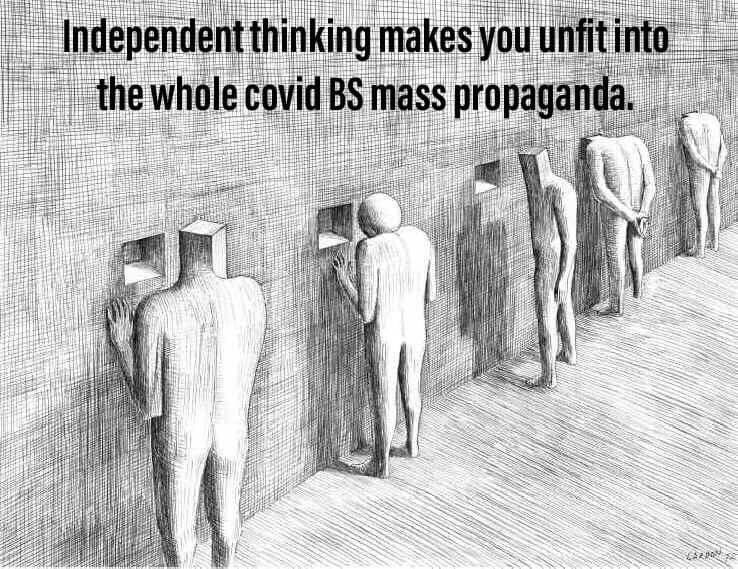
Critical thinkers need not apply…

Masks and respirators do not work. There have been extensive randomized controlled trial (RCT) studies, and meta-analysis reviews of RCT studies, which all show that masks and respirators do not work to prevent respiratory influenza-like illnesses, or respiratory illnesses believed to be transmitted by droplets and aerosol particles.
Furthermore, the relevant known physics and biology, which I review, are such that masks and respirators should not work. It would be a paradox if masks and respirators worked, given what we know about viral respiratory diseases: The main transmission path is long-residence-time aerosol particles (< 2.5 μm), which are too fine to be blocked, and the minimum-infective-dose is smaller than one aerosol particle.
The present paper about masks illustrates the degree to which governments, the mainstream media, and institutional propagandists can decide to operate in a science vacuum, or select only incomplete science that serves their interests. Such recklessness is also certainly the case with the current global lockdown of over 1 billion people, an unprecedented experiment in medical and political history.
Trust is the one thing required in getting people to follow COVID-19 safety guidelines. But, several incidents that happened in Florida over the past few weeks have raised questions about the authenticity of COVID positive numbers given by the laboratories. According to netizens, Florida COVID numbers are wrong. Let’s do a fact check.
The alarming figure of more than 15,000 people testing positive on one day in Florida has disturbed everyone. The state made international headlines for the record-breaking number of positive cases in a day.
People are questioning if the labs are providing accurate details or tampered results. Read as we break down the news of 33 Labs Busted in Florida for cooking the books.
According to a recent poll, two-thirds of voters trust Dr. Anthony Fauci, not President Trump, when it comes to information on the coronavirus.
Well, if you think you can trust Dr. Fauci, the director of the National Institute of Allergy and Infectious Diseases, you now have every reason to question his judgment. In an interview with PBS NewsHour, Dr. Fauci, the trusted expert, actually lauded New York’s response to the coronavirus.
“We know that, when you do it properly, you bring down those cases. We have done it. We have done it in New York,” he told PBS’s Judy Woodruff. “New York got hit worse than any place in the world. And they did it correctly.”
I used to have faith in Dr. Fauci’s judgement, but that faith has waned over the past few months, and is now completely gone. How exactly does anyone look at what happened in New York and say that’s a model example for fighting the coronavirus?
Let’s look at the evidence.
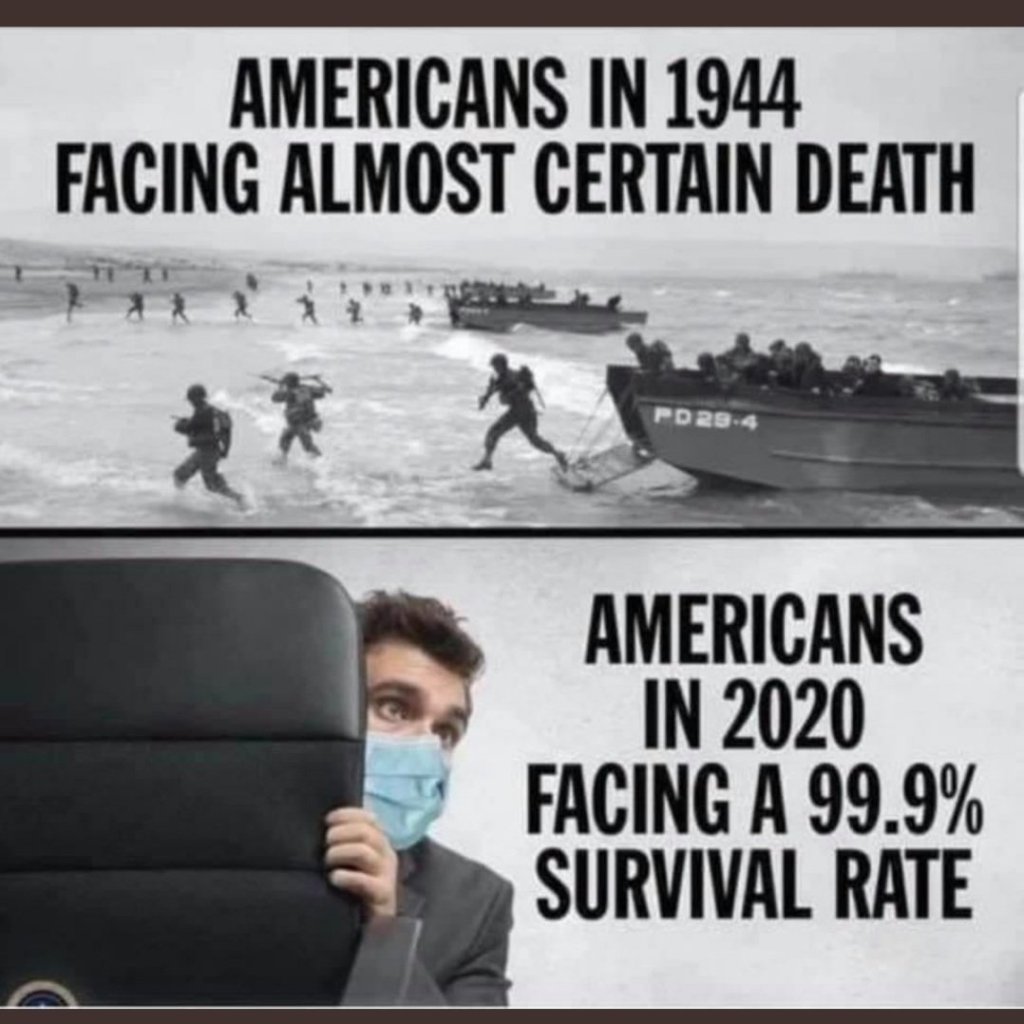
On Thursday, a Florida health official told a local news station that a young man who was listed as a COVID-19 victim had no underlying conditions.
The answer surprised reporters, who probed for additional information.
“He died in a motorcycle accident,” Dr. Raul Pino clarified. “You could actually argue that it could have been the COVID-19 that caused him to crash. I don’t know the conclusion of that one.”
The anecdote is a ridiculous example of a real controversy that has inspired some colorful memes: what should define a COVID-19 death?
While the question is important, such incidents may be just the tip of the proverbial iceberg regarding the unreliability of COVID-19 data.
Florida Gov. Ron DeSantis says he’s concerned about the accuracy of COVID-19 test results.
In a news conference Monday, he said there have been several cases where people received positive results, even though they had never been tested in the first place.
“For that to come back positive, when there was no specimen submitted, is problematic. So I’ve heard it enough to be concerned about it,” said DeSantis.
People have said they submitted their contact information at a COVID-19 testing site, but after seeing how long the line was, they decided not to wait an hour or more to get the test. Nevertheless, a few days later, they got an email or a phone call telling them that they tested positive.

Coronavirus testing has been a hot-button issue since the beginning of the pandemic. First, there weren’t enough coronavirus tests to go around. Now, a new issue has emerged—just how accurate the tests people are getting actually are. According to a July 17 study published in the International Journal of Geriatrics and Rehabilitation, 50 percent of nucleic acid coronavirus tests distributed by the Centers for Disease Control and Prevention (CDC) provided inaccurate results.
The study’s lead author, Sin Hang Lee, MD, director of Milford Molecular Diagnostics Laboratory, found that the testing kits gave a 30 percent false-positive rate and a 20 percent false-negative rate.
 Hellbound and Down
You must be logged in to post a comment.