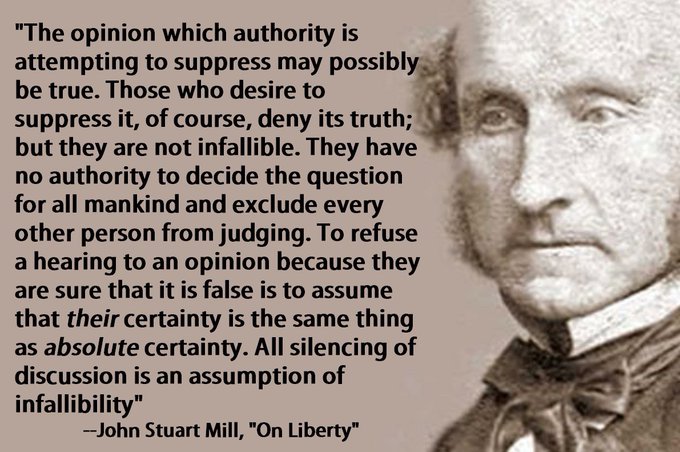
John Stuart mill on censorship…

“Since when have we Americans been expected to bow submissively to authority and speak with awe and reverence to those who represent us? The constitutional theory is that we the people are the sovereigns, the state and federal officials only our agents. We who have the final word can speak softly or angrily. We can seek to challenge and annoy, as we need not stay docile and quiet.”— Justice William O. Douglas
Absolutely, there is a war on free speech.
To be more accurate, however, the war on free speech is really a war on the right to criticize the government.
Although the right to speak out against government wrongdoing is the quintessential freedom, every day in this country, those who dare to speak their truth to the powers-that-be find themselves censored, silenced or fired.
Indeed, those who run the government don’t take kindly to individuals who speak truth to power.
In fact, the government has become increasingly intolerant of speech that challenges its power, reveals its corruption, exposes its lies, and encourages the citizenry to push back against the government’s many injustices.
This is nothing new, nor is it unique to any particular presidential administration.
In July 2022, Twitter permanently suspended Rhode Island physician Andrew Bostom after awarding the epidemiologist and longtime researcher at Brown University a fifth strike for spreading “misinformation.”
A July 26 tweet alleging that there was no solid evidence Covid-19 vaccines had prevented any children from being hospitalized—”only RCT data we have from children reveals ZERO hospitalizations prevented by vaccination vs. placebo”—was apparently the final straw.
The funny thing was, it appeared Bostom’s tweet was true.
Dr. Anish Koka, a cardiologist and writer, said he was initially skeptical of Bostom’s claim. But after speaking with him for more than an hour, he realized Bostom was citing the government’s own data, a Food and Drug Administration (FDA) briefing document that included randomized controlled trial (RCT) data on children.
“…Dr. Bostom’s tweet appears quite correct as per the FDA documents,” Koka wrote on Substack. “In the RCTs available, there does not appear to be evidence that the vaccine prevented hospitalizations.”
Stacey Plaskett, a Democrat, is the delegate from the Virgin Islands to the U.S. Congress. Last month, when independent writers Matt Taibbi and Michael Shellenberger testified before the House Judiciary Select Subcommittee on the Weaponization of the Federal Government, she described them as “so-called journalists” and sought to undermine their testimony about government pressure to restrict speech on Twitter.
She has now gone much further.
Plaskett recently sent a letter to Taibbi accusing him of perjury and suggesting that he could face up to five years in jail. The letter was obtained by Lee Fang, a writer who works with Taibbi and publishes on Substack. In it, Plaskett notes that providing false testimony to Congress “is punishable by up to five years imprisonment.”
The congresswoman’s basis for accusing Taibbi of perjury is a handful of errors that he made during the publication of the Twitter Files. These mistakes caught the attention of MSNBC’s Mehdi Hasan, who skewered Taibbi in an interview and suggested the entire Twitter Files project rested upon a house of cards.
It is true that Taibbi made some errors: In one of his tweets about the web of organizations engaged in identifying so-called misinformation on Twitter, he confused CISA, the Cybersecurity and Infrastructure Security Agency—an organ of the federal government—with CIS, the Center for Internet Security—a nonprofit. Hasan has never sufficiently explained why this mistake would render the Twitter Files obsolete; in fact, both organizations participated in the Election Integrity Partnership, a Stanford University project that sought to monitor the election-related discourse on social media. Taibbi pointed out this fact in a tweet admitting to the mistake.
Regardless, it is obviously not the case that Taibbi committed perjury. Plaskett’s letter describes the CISA/CIS mistake as an “intentional” one; this is simply false. Taibbi did not willfully mischaracterize the two organizations; when he rewrote “CIS” as “CISA,” he honestly thought the tweet in question had referred to the government agency rather than the nonprofit.
Aaron Terr, director of public advocacy at the Foundation for Individual Rights and Expression (FIRE), described Plaskett’s letter as shocking.
Facebook is censoring Pulitzer Prize-winning journalist Seymour Hersh’s story about US involvement in the destruction of Russia’s Nord Stream pipelines using a ‘fact checker’ with links to the Norwegian government in what represents a clear conflict of interest.
Earlier this year, Hersh published a report asserting that the pipelines were destroyed by the US as part of a covert operation which was organized with the aid of the Norwegian government, Norwegian Secret Service and Navy.
Journalist Michael Shellenberger first noticed the issue when he tried to post Hersh’s article to Facebook, but saw the social media giant had slapped a warning label on the link stating, “False information. Checked by independent fact-checkers.”
Except the ‘fact-checkers’ in question aren’t independent at all.
In an interview with CNBC, FDA Commissioner Dr. Robert Califf said that online misinformation was harming the life expectancy of people, there is a need for “better regulation” on how to handle health misinformation and that “specific authorities at FDA, FTC, and other areas are going to be needed.”
“We know more and more about misinformation. It relates back to this life expectancy,” Califf said. Why aren’t we using knowledge of diet? It’s not that people don’t know about it. Why aren’t we using medical products as effectively and efficiently as our peer countries? A lot of it has to do with choices that people make because of the things that influence their thinking. The COVID vaccines and the antivirals give us an easy way to talk about it, but this is not limited to those areas. In heart disease, so many people don’t take their medicines, even though they’re now generic and very low-cost, often [they’re] deluded into taking things that are sold over the Internet that aren’t effective.”
According to the FDA commissioner, one of the solutions is telling the “truth is a louder volume.”
“In the good old days, when I was a practicing cardiologist, for the most part, people developed products, they got through the FDA, the label determined what was talked about, the Internet didn’t exist, you advertised in medical meetings and journals. There was sort of a hierarchy of information that went through the prescriber or the implanter in the case of devices to the patient. Of course, the problem in that system is it left a lot of people out. We now know about that. Now, everyone’s included because everyone’s connected to the Internet. But we can put out a statement about what we’ve determined based on the highest level of evidence, within ten minutes, someone who’s thought ten minutes about it can reach a billion people. And there’s nothing that restricts them from telling things that are not true. This has always existed. … But they couldn’t reach so many people,” he explained.
He added that there isn’t enough regulation on health information and that is “impacting our health in very detrimental ways.” As such, he thinks “there is a real need for better regulation of how to deal with this complex information.”
Califf noted that the FDA already has regulatory authority over advertisements content on tech platforms. But he feels the agency could do it better.
These days, it’s hard to find any globalist who will let go of power gracefully, let alone retire from the stage of politics.
This seems to be the case with New Zealand’s increasingly unpopular radical Marxist former Prime Minister, Jacinda Ardern, who also just happens to also be a World Economic Forum young leader, and mentored by none other than Tony Blair. Undoubtedly, a brilliant resumé for any aspiring technocrat.
Not content with destroying her country’s economy and society over the last three years with her fanatical “zero Covid” lockdown and brutal vaccine mandates, Ardern is now being positioned by the Establishment to become the country’s de facto censorship Tsar…
Bloomberg News reports:
Former New Zealand Prime Minister Jacinda Ardern will lead the nation’s push for greater safeguards against terrorist and violent content online.
Ardern has been appointed Special Envoy for the ‘Christchurch Call’, a global initiative she set up in the wake of a terrorist attack in the South Island city in 2019, Prime Minister Chris Hipkins said Tuesday in Wellington. She will report directly to Hipkins and has declined to receive any remuneration for the role, which will commence on April 17, he said.
Since the 2016 elections, politicians, journalists, and many others have raised the alarm about “foreign election influence” and “disinformation,” demanding greater “content moderation” by social media platforms. It is too easy, they argued, for foreign and malign actors to quickly “go viral” at low cost, leaving the good guys unable to correct bad information. We must become more “resilient” to disinformation.
It’s now clear that all of that rhetoric was cover for a sweeping censorship effort by the federal government and government contractors.
Since December, a small but growing group of journalists, analysts, and researchers have documented the rise of a “Censorship Industrial Complex”, a network of U.S. government agencies, and government-funded think tanks. Over the last six years, these entities have coordinated their efforts to both spread disinformation and to censor journalists, politicians, and ordinary Americans. They have done so directly and indirectly, including by playing good cop/bad cop with Twitter and Facebook. Hundreds and perhaps thousands of people have been involved in these censorship and disinformation campaigns in the U.S., Canada, and the UK.
We now know, thanks to the Twitter Files, emails released by the Attorney Generals of Missouri and Louisiana, and research by others, that the Censorship Industrial Complex is violating the First Amendment by coordinating with government agencies and receiving government funding to pressure and help social media companies to both censor information, including accurate information, while spreading disinformation, including conspiracy theories.
And such efforts are continuing if not accelerating. At Biden’s “Summit for Democracy” last week, US allies in Europe demanded that Facebook censor “false narratives” and news that would “weaken our support to Ukraine.” Facebook agreed.
One of the most intelligent, influential, and fascinating public-facing leaders of the Censorship Industrial Complex is Renee DiResta, Research Manager of the Stanford Internet Observatory. Diresta has, more than anyone else, made the public case for greater government-led and government-funded censorship, writing for The New York Times, The Atlantic, Wired, and other major publications, and through public speaking, including on podcasts with Joe Rogan and Sam Harris.
To many journalists and policymakers, DiResta is one of the good guys, advocating as a citizen and hobbyist for greater U.S. government action to fight disinformation. DiResta has argued that the U.S. has been unprepared to fight the “information war” with Russia and other nations in her bylined articles for the New York Times, Washington Post, Wired, and many others. And in her 2018 Senate testimony DiResta advocated “legislation that defines and criminalizes foreign propaganda” and for allowing law enforcement to “prosecute foreign propaganda.”
DiResta, as much as any other public person in the Western world, has sounded the alarm, repeatedly and loudly, for stronger governmental and non-governmental coordination to get social media platforms to censor more information. “The Russian disinformation operations that affected the 2016 United States presidential election are by no means over,” wrote DiResta in the New York Times in December 2018. “Russian interference through social media is a chronic, widespread, and identifiable condition that we must now aggressively manage.”
In 2021, DiResta advocated for creating a government censorship center, which she euphemistically referred to as a “Center of Excellence,” within the federal government. “Creation of a ‘Center of Excellence’ within the federal government,” she said, “could tie in a federal lead with platforms, academics, and nonprofits to stay ahead of these emerging narratives and trends.” DiResta argued that her censorship center could also help spread propaganda. “As narratives emerge,” she explained, “the Center of Excellence could deploy experts to relevant federal agencies to help prepare pre-bunking and messaging, to identify trusted voices in communities, and to build coalitions to respond.”
Did the Department of Homeland Security act on DiResta’s proposal to create a censorship center? It did. But DHS didn’t call it a “Center of Excellence.” Instead, it called it a “Disinformation Governance Board,” which the agency announced publicly in April 2022.
Douglass Mackey’s Friday conviction for an election “meme” he posted on his account with over 58,000 followers has legal experts raising alarm bells about its impact on free speech.
A jury convicted Mackey for conspiring to deprive others of their right to vote through a meme he posted during the 2016 election, which advertised a way to vote for Hilary Clinton via text message. First Amendment experts say Mackey’s conviction is based on an expansive interpretation of a Conspiracy Against Rights law that could impact other forms of speech, from satire to lies in election campaigns.
While the First Amendment allows for punishing fraud, “it’s not clear Mackey’s actions qualify as fraud in a legal sense,” Aaron Terr, director of Public Advocacy for the Foundation for Individual Rights and Expression (FIRE), told the Daily Caller News Foundation.
“Fraud generally requires a speaker to make a false statement to obtain money or something of material value from the injured party, who relies on the false statement to their detriment,” he said. Even if Mackey’s actions did qualify, Terr also noted that the Justice Department indicted him using a statute that goes beyond fraudulent speech.
“It criminalizes conspiring to ‘injure’ or ‘oppress’ someone in the exercise of any constitutional right,” he said. “If that vague language covers speech that deceives people into voting improperly, it raises the troubling possibility of the government also applying it to allegedly false statements about political issues or candidates that discourage people from voting, not just misrepresentations about the logistics of exercising the franchise. Anyone who cares about free speech should be concerned about how the government might abuse this vague and broadly worded law to chill the spirited public discourse on which our democracy depends.”
After being charged with Conspiracy Against Rights, Mackey faces up to ten years in prison. Eugene Volokh, Gary T. Schwartz Distinguished Professor of Law at UCLA, told the DCNF there are two primary routes he could take for an appeal.
A researcher claims to have found a tool allowing for government intervention in Twitter’s algorithm, upon Elon Musk’s decision to allow the algorithm to become open sourced to the public.
Breitbart reports that Musk honored his promise on Friday by releasing a portion of Twitter’s recommendation algorithm on the website GitHub, where computer programmers often go to share and collaborate on work dealing with open-source code.
Web developer Steven Tey then claimed to have discovered a particular mechanism within the code that allows the U.S. government to make changes to the website’s algorithm.
“When needed, the government can intervene with the Twitter algorithm. In fact, @TwitterEng (Twitter Engineering) even has a class for it – ‘GovernmentRequested,” Tey tweeted, including a link to the code on GitHub.
Upon purchasing Twitter for $44 billion in October, Musk vowed to increase transparency and loosen restrictions on certain speech and accounts that had been imposed by previous leadership. One of his goals was to make the algorithm open source for public viewing; he later said that “our ‘algorithm’ is overly complex & not fully understood internally,” and that “people will discover many silly things, but we’ll patch issues as soon as they’re found!”
In addition, Tey discovered that the algorithm takes such factors into account as following-to-follower ratio when determining which users to promote; users with a low number of followers but a high amount of followed accounts would be negatively affected.


You must be logged in to post a comment.