
Let’s rub the lamp, shall we…

Even more astonishing still, Twitter locked the account of the New York Post, banning the paper from posting any content all day and, evidently, into Thursday morning. The last tweet from the paper was posted at roughly 2:00 p.m. ET on Wednesday.
And then, on Thursday morning, the Post published a follow up article using the same archive of materials, this one purporting to detail efforts by the Vice President’s son to pursue lucrative deals with a Chinese energy company by using his father’s name. Twitter is now also banning the sharing or posting of links to that article as well.
In sum, the two Silicon Valley giants, with little explanation, united to prevent the sharing and dissemination of this article. As Los Angeles Times reporter Matt Pearce put it, “Facebook limiting distribution is a bit like if a company that owned newspaper delivery trucks decided not to drive because it didn’t like a story. Does a truck company edit the newspaper? It does now, apparently.”
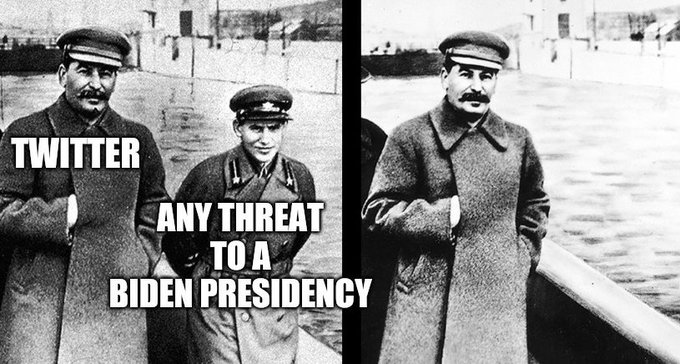
Yesterday, the New York Post published several articles claiming to show evidence of corruption on the part of Joe Biden and his son Hunter.
The charges are varied but not really surprising. One article claims Hunter introduced his father to a Ukrainian energy magnate who asked the family to use their influence to shut down an investigation into his company.
Another story suggests Hunter Biden used his family name to secure a high-paid job and stock interests in a Chinese company.
The NYP evidence these claims with emails and documents allegedly retrieved from a laptop left at a computer repair store in Delaware. The owner of the store alerted the FBI to the computer’s existence when no one came forward to pay for the repairs and he could not contact the owner.
According to the NYP, both the hard drive and laptop were then seized by the FBI. They have a copy of the grand jury subpoena, which is certainly solid evidence, if genuine.
The owner of the store claims he, prior to it being seized, made a copy of the hard drive and sent it to Rudy Giuliani, Donald Trump’s lawyer.
While this is potentially intriguing, if true, it’s not really “news”. Biden’s corruption in Ukraine has been evident since his son was appointed to the board of the largest energy company in Ukraine within weeks of the US-backed coup in 2014 (a decision so obviously dodgy even the Guardian made a joke out of it). Joe Biden himself has even admitted to applying financial pressure to get a Ukrainian State Prosecutor removed from office.
None of this is really “big news”. Corruption is rampant in the halls of power, that is as certain as death and taxes, and will continue to be so, whether or not these specific allegations are accurate.
The big news, the part of this story that should concern everyone, is that Twitter has completely blocked this material on their platform.
And we’re not talking a “soft block”, we at OffG are more than familiar with twitter’s use of “warnings”, no they literally made it impossible to share the links, even in DMs. If you try, you get his warning:
We can’t complete this request because this link has been identified by Twitter or our partners as being potentially harmful. Visit our Help Center to learn more.”
We’ve talked about twitter’s “partners” before, and they are suspect. As for being “potentially harmful”, well isn’t that subjective? Fire is vital at times, but certainly “potentially harmful” at others. Water, in sufficient quantity, is “potentially harmful”.
If you’re a liar, the truth is “potentially harmful”.
Facebook has followed suit, if in less sweeping fashion. The social media giant’s spokesperson Andy Stone announced that they would be:
“…reducing its distribution on our platform. This is part of our standard process to reduce the spread of misinformation.
This decision is pending approval by their “independent fact-checkers”, which we have also covered in detail before.
*
So what are the social media companies’ excuses reasons for blocking this content?
Well, it depends who you ask.
Twitter claims that since the emails are potentially “hacked”, posting them violates their policy regarding illegally gathered material. (Interestingly this policy was never applied to Trump’s leaked tax returns.)
Facebook, on the other hand, claim to have blocked these stories because they might be “misinformation”. A truly ludicrous precedent to set. You can’t block something that might not be true, because that applies to literally almost everything.
You do have to admire the strategy though. The pincer movement is brilliant.
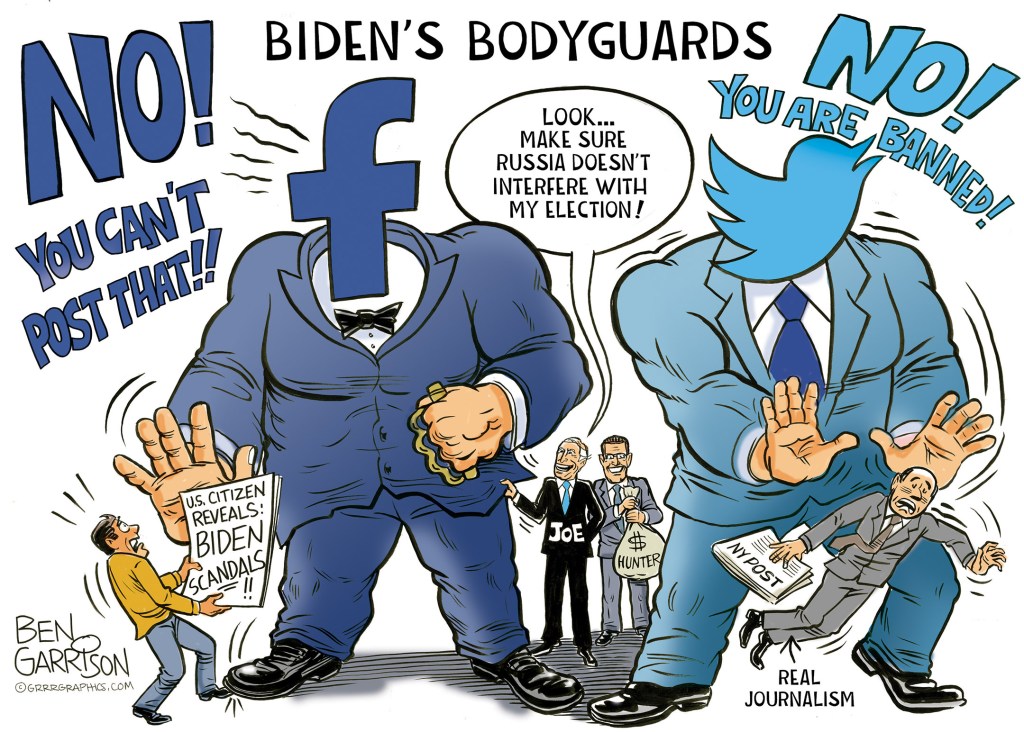
After yesterday’s cross-platform social media embargo on a New York Post exposé detailing explosive evidence against Joe and Hunter Biden, Twitter is at it again on Thursday – suspending the Trump campaign’s official account for sharing a video accusing the former Vice President of being a “liar who has been ripping off the country for years.”
According to emails obtained on a laptop reportedly abandoned at a Delaware computer repair shop (which also contained photos of Hunter smoking crack and an alleged sex tape), Hunter Biden introduced his father, then-Vice President Joe Biden, to a top executive at Burisma – a Ukrainian energy giant paying Hunter upwards of $50,000 per month to sit on its board.
“Dear Hunter, thank you for inviting me to DC and giving an opportunity to meet your father and spent [sic] some time together. It’s realty [sic] an honor and pleasure,” reads the email.
In another email from May 2014, Burisma board adviser Vadym Pozharskiy asked Hunter for “advice on how you could use your influence” on the company’s behalf.
In response to the allegations, Twitter and Facebook aggressively censored anyone sharing the Post story on Wednesday – suspended the Post itself while claiming that it was distributing ‘hacked material.’
YouTube said Thursday that it would no longer allow content that targets individuals and groups with conspiracy theories, specifically QAnon and its antecedent, “pizzagate.”
“Today, we are taking another step in our efforts to curb hate and harassment by removing more conspiracy theory content used to justify real-world violence,” the company announced on its blog.
The new rules, an expansion of YouTube’s existing hate and harassment policies, will prohibit content that “threatens or harrasses someone by suggesting they are complicit in one of these harmful conspiracies, such as QAnon or Pizzagate,” the post read.
YouTube said it would be enforcing the updated policy immediately and plans to “ramp up in the weeks to come.”
YouTube’s move to rid the platform of QAnon content follows similar recent changes by other social media platforms. In July, Twitter removed QAnon accounts and restricted QAnon content. Last week, Facebook said it would remove groups, pages and Instagram accounts that identified with QAnon.
“Censorship always defeats its own purpose, for it creates, in the end, the kind of society that is incapable of exercising real discretion.”
Henry Steele Commager
Facebook and Twitter on Wednesday limited the distribution of a New York Post story that claims to show “smoking gun” emails related to Democratic presidential nominee Joe Biden and his son.
“While I will intentionally not link to the New York Post, I want be clear that this story is eligible to be fact checked by Facebook’s third-party fact checking partners,” tweeted Andy Stone, a spokesman for Facebook. “In the meantime, we are reducing its distribution on our platform.”


You must be logged in to post a comment.