America Reaps What Trump Sows: The Price of Policing the Globe

“In a sense, blowback is simply another way of saying that a nation reaps what it sows.” — Chalmers Johnson

What goes around comes around.

That is the terrible law of blowback.

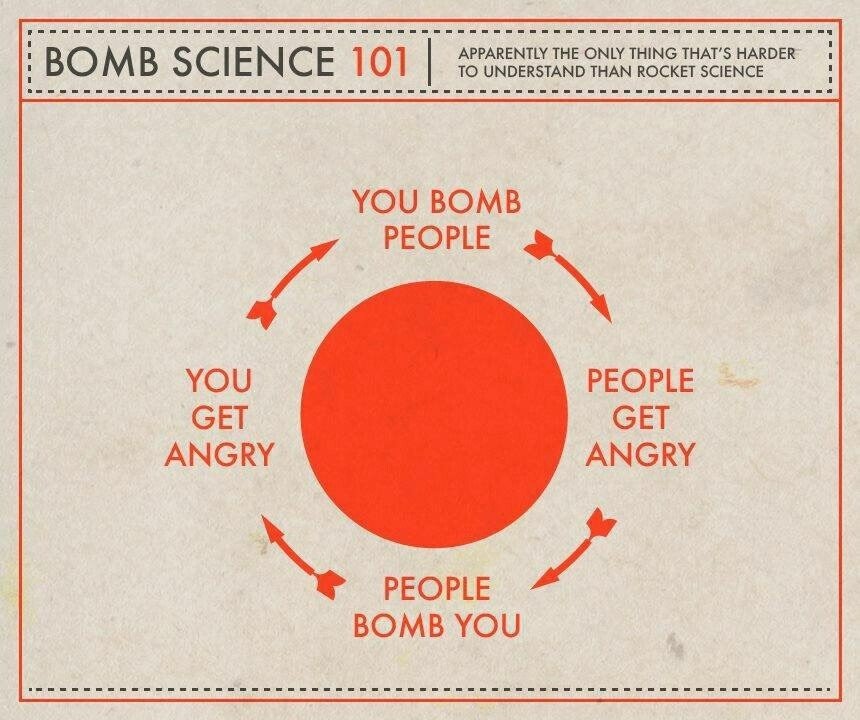
When the United States bombs another country, threatens its government, kills its people, occupies its territory or attempts to dictate its future, the consequences do not remain safely contained thousands of miles away.

They come home.

They come home in flag-draped coffins and shattered military families. They come home in retaliatory attacks on American bases and embassies. They come home through terrorist plots, cyber sabotage, disrupted shipping laneshigher energy pricesdepleted weapons stockpiles, and trillions of dollars in debt.

They come home through hacked water systemsvulnerable power grids, heightened domestic surveillance, militarized police and government demands that the American people surrender still more freedom in exchange for the promise of protection from dangers the government itself helped create.

This is blowback.

Blowback isn’t just about war. It’s about the consequences of the rash, heedless and heartless decisions made every day by the actors of the American police state—and the fact that it is “we the people” who will be paying the price for those terrible decisions for years to come.

President Trump’s war with Iran is only the latest reminder that no government can bomb, threaten and police the world indefinitely without eventually bringing the consequences home.

For months, the Trump administration has lurched between war and threatened war, massive bombing campaigns and aborted strikes, demands for surrender and claims that peace is imminent.

There appears to be no coherent plan for ending the conflict.

There is, however, a mounting bill—and it will be paid in American lives, American dollars, American security and American freedom.

This is what happens when a government appoints itself judge, jury, executioner and police officer to the world.

The government creates enemies faster than it can kill them.

It destabilizes one country, then uses the resulting chaos to justify intervening in another. It bombs in the name of peace, occupies in the name of freedom, surveils in the name of security, and retaliates against retaliation in an endless cycle of violence that serves the war machine while leaving ordinary people everywhere less safe.

We have seen this before.

Keep reading

In Gaza, the next generation of radicalization begins

“The lesson is not that you can win in urban warfare by protecting civilians. The lesson is that you can only win in urban warfare by protecting civilians,” Defense Secretary Lloyd Austin recently made headlines by warning.

“You see, in this kind of a fight, the center of gravity is the civilian population,” he said. “And if you drive them into the arms of the enemy, you replace a tactical victory with a strategic defeat.”

Austin’s remarks, made at the Reagan National Defense Forum in December, should be sobering for the sizable cohort of Israeli and Western officials and commentators who insist that a “military solution” to Hamas is the only way for Israel to ensure its long-term security. While the horrendous civilian death toll of Israel’s military campaign is regrettable, this line of thinking goes, the threat from Hamas means Israel has no choice but to prosecute the war until the group is eliminated, as long as it takes, and no matter the cost.

If it’s allowed to survive, it will simply choose another moment in the future to attack, and Israeli citizens will never know peace.

Yet Austin is only one prominent voice in recent months that has pointed out the faultiness of this logic, and reminded the world that when a state battling terrorism leaves a trail of human carnage in its wake, the resulting rage, bitterness and despair fuel the very problem it’s fighting, and many times over.

When Chairman of the Joint Chiefs of Staff Gen. Charles Q. Brown Jr. was asked directly if he feared that high civilian casualty numbers would create future Hamas members, he replied, “Yes, very much so.” “We’ll be fighting their sons in four or five years,” former Shin Bet chief Ya’akov Peri told the New York Times.

“Israel Is Fostering the Next Generation of Hatred Against Itself,” read the headline of a recent column by Haaretz’s Gideon Levy, as he warned readers to “look what hatred was sown in the hearts of almost all Israelis by one barbaric attack,” and consider what an even worse, prolonged slaughter might do to the Palestinian population. “These children will never forgive the soldiers. You’re raising another generation of resistance,” one Palestinian father, his young son killed by Israeli soldiers, told Levy.

Former UK Defense Minister Ben Wallace recently warned, with reference to the Troubles in Northern Ireland, “that radicalisation follows oppression” and that “a disproportionate response by the state can serve as a terrorist organisation’s best recruiting sergeant.”

Security services in the United States and around the world have already backed up these warnings. FBI Director Chris Wray cautioned last month that U.S. support for Israel’s war had led multiple terrorist organizations to call for attacks against Americans and the West, and had significantly “raised the threat of an attack” inside the United States.

That’s on top of advisories and intelligence findings by various U.S. government agencies warning of credible threats by groups like Al Qaeda and Hezbollah over U.S. support for the war. Both the German and British spy agencies have likewise sounded the alarm over the war potentially fueling militant radicalization, citing specific threats being made by jihadist groups and those sympathetic to them.

Keep reading

The Enduring False Narrative About the PULSE Massacre Shows the Power of Media Propaganda

On the fifth anniversary of the PULSE nightclub massacre in Orlando, numerous senators, politicians and activist groups commemorated that tragic event by propagating an absolute falsehood: namely, that the shooter, Omar Mateen, was motivated by anti-LGBT animus. The evidence is definitive and conclusive that this is false — Mateen, like so many others who committed similar acts of violence, was motivated by rage over President Obama’s bombing campaigns in Syria, Iraq and Afghanistan, and chose PULSE at random without even knowing it was a gay club — yet this media-consecrated lie continues to fester.

On Saturday, Sen. Cory Booker (D-NJ) falsely described the massacre as an “unspeakable act of hate toward the LGBTQ+ community.” Sen. Tammy Duckworth (D-IL) went even further, claiming “the LGBTQ+ community was targeted and killed—all because they dared to live their lives.” Her fellow Illinois Democrat, Sen. Dick Durbin, claimed forty-nine lives were lost due to “anti-LGBTQ hate” (he forgot the +). These false claims were compiled by the gay socialist activist Matt Thomas, who correctly objected: “the shooter literally picked PULSE at random from Google after security was too tight at the mall he went to first,” adding that while LGBT groups “are hopeless of course,” too much money and power is at stake for them to give up this self-serving fiction. But he asked, “Shouldn’t the bar be a little higher for senators?”

Keep reading