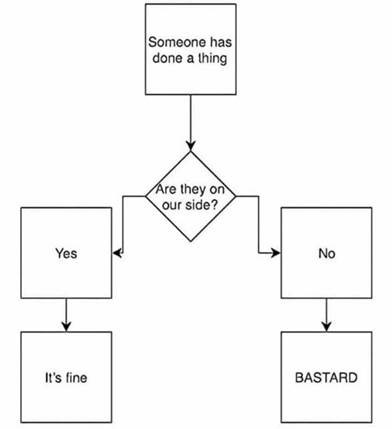
Partisan flowchart…

2020 Democrat nominee Joe Biden recently hosted an “Ask Me Anything” event on his Instagram page, allowing his followers to ask him questions in real time. The presidential candidate, however, did not appear to answer a single question.
Joe Biden announced that he would be answering questions from his followers during an “Ask Me Anything” event on Instagram — a virtual gathering in which followers are granted the opportunity to ask questions through Instagram Stories in the hopes of seeing the answer to their inquiry pop up later on the account’s Story page.
The chance to ask Biden questions in real-time through his Instagram Stories — which lasts 24 hours — came and went without a single question being answered by the former vice president.
A new report from Brown University’s Costs of War project has found that at least 37 million people have been displaced as a result of America’s so-called “war on terror” since 9/11, a conservative estimate of a number that may actually be somewhere between 48 million to 59 million.
That number, “at least 37 million”, happens by pure coincidence to be the exact same number of Americans reported to suffer from food insecurity because their government spends their wealth and resources killing and displacing people overseas.
This inconvenient revelation, which was actually reported on by The New York Times for once, is causing conniptions for all the right people, with The Washington Post’s neoconservative war propagandist Josh Rogin ejaculating, “The @nytimes should be ashamed for running this as ‘analysis.’ Blaming the U.S. for the displacement of 7 million Syrians is crazy and dishonest. Way to launder anti-American propaganda.”
Lawmakers have mandated a variety of COVID restrictions to stem the spread of the pandemic, but not all lawmakers have been willing to follow the rules.
Governors, mayors and state health departments have required that Americans wear masks, social distance, refrain from spending time in large groups, quarantine after traveling across state lines, stay home from church services and much more.
But many political leaders and members of their families have failed to comply with social distancing rules. Here’s a list of lawmakers who appeared to dodge coronavirus-related restrictions.
Less than a day after issuing new health guidelines that banned trick-or-treating and other Halloween activities, Los Angeles County public health officials walked back the decision Wednesday.
Citing an inability to maintain safe social distancing and the potential for gatherings beyond household members, county officials initially nixed trick-or-treating along with other Halloween traditions, including haunted houses and parades.
But Public Health Director Barbara Ferrer said Wednesday that the guidelines have been “slightly revised.”
Ferrer said the change distinguishes between activities originally prohibited under the health officer order from activities that are “not recommended.”
“This year, it’s just not safe to celebrate in the ways we usually do,” Ferrer said. “We are recommending that trick-or-treating not happen this year.”
The Department of Public Health previously said that because some of the traditional ways in which Halloween is celebrated do not allow contact with nonhousehold members to be minimized, it is important to identify safer alternatives.
“Trunk-or-treat” events involving car-to-car candy dispersal, which are sometimes held by churches or schools, also are not recommended under the revised order.
Houston-area health authorities are overstating the number of new Covid-19 cases as data teams struggle to work through a backlog of old test results in the third-largest U.S. county.
On an almost daily basis, Harris County Public Health releases a tally of what it calls “new cases” that a Bloomberg analysis found includes hundreds of diagnoses that are weeks or months old. On Tuesday, for example, more than 70% of the new cases disclosed actually were detected prior to this month and some dated as far back as June.
The confusion means authorities may be exaggerating the current severity of the outbreak — and were unknowingly understating the extent of the crisis in June and July, when hospitals were stretched to their limits. The situation also highlights the dilemma facing political leaders imposing mask mandates and other restrictions based on what they presume is accurate, timely data.





You must be logged in to post a comment.