
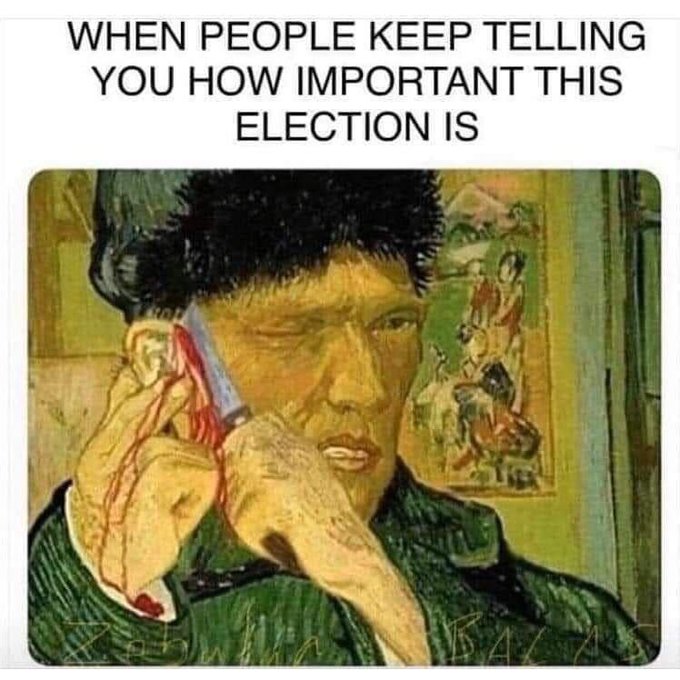
2020 elections be like…

Following in the footsteps of Facebook, which last month announced plans to launch its long-promised “oversight board” before Nov. 3, Twitter has announced that it’s planning a raft of measures, including making it more difficult for tweets to go viral ahead of the vote, to ensure that social media doesn’t contribute to any election day violence.
According to a blog post published around noon on Friday, one of the ‘speed bumps’ being implemented by twitter will prompt users to add a “comment” when they go to share – or retweet – a tweet. The move is designed to slow the rapid-fire retweeting of others” – a behavior that President Trump, one of the world’s most famous Twitter users, has occasionally exhibited.
Twitter’s recommendations and trends features will see “new curbs” added to try and prevent abuse.
“Twitter has a critical role to play in protecting the integrity of the election conversation, and we encourage candidates, campaigns, news outlets and voters to use Twitter respectfully and to recognize our collective responsibility to the electorate to guarantee a safe, fair and legitimate democratic process this November,” company officials said in a blog post – written by Vijaya Gadde, the Legal, Policy and Trust & Safety Lead at Twitter, and Kayvon Beykpour, its product lead – published at noon Friday.
Politicians, including President Trump, will be subjected to new restrictions if they start to share “falsehoods” according to Twitter. If they continue sharing “false” information – aka information that challenges the Democratic narrative – the accounts will be hit with “additional warnings and restrictions”.
One of the militiamen accused of plotting to kidnap Michigan Gov. Gretchen Whitmer railed that President Trump was a “tyrant” and called all government workers “your enemy.”
Video circulating on social media appears to show Brandon Caserta expressing his anti-government — and anti-Trump — views.
“Trump is not your friend, dude,” Caserta says, with an anarchist flag hanging behind him. “It amazes me that people actually, like, believe that when he’s shown over and over and over again that he’s a tyrant. Every single person that works for government is your enemy, dude.”
He also ranted about “getting robbed by government thugs for some made-up traffic violation” after receiving a traffic ticket.
U.S. military dogs might one day be equipped with augmented reality goggles that their human servicemember partners can remotely provide guiding commands through during dangerous rescue operations or explosive device hunts.
Seattle-based small business Command Sight produced a technological prototype that could enhance troops’ safety by enabling exactly that, and some say it could fundamentally transform how the U.S. military’s canines are deployed down the line. Having completed a phase I project developing the prototype via a Small Business Innovation Research, or SBIR, program steered by the Army Research Office, the company was selected for funding through phase II, to further refine the potential product.
“The military working dog community is very excited about the potential of this technology,” ARO senior scientist Dr. Stephen Lee said in an announcement published Tuesday. “[It] really cuts new ground and opens up possibilities that we haven’t considered yet.”
When it comes to heeding instructions from the people that lead them, military working dogs generally follow hand signals, laser pointers, or walkie talkies and cameras strapped to their own bodies—all of which can lead to confusion for the animals or risk of unwanted exposure for humans. But the new prototype offers human handlers the ability to see from the dog’s point of view, and a means to give commands while staying completely out of sight.
The World Health Organization has finally confirmed what we (and many experts and studies) have been saying for months – the coronavirus is no more deadly or dangerous than seasonal flu.
The WHO’s top brass made this announcement during a special session of the WHO’s 34-member executive board on Monday October 5th, it’s just nobody seemed to really understand it.
In fact, they didn’t seem to completely understand it themselves.
What’s strange is that a mental-health lobby that has spent years redefining mental illness to include more and more people, and spent years discussing the potential social causes of this supposed ‘crisis’, is strangely hesitant to criticise lockdown. This is despite the fact that lockdown forces us into circumstances pretty much guaranteed to increase anxiety, depression and debilitating mental illnesses
A major survey by Mind, the mental-health charity, has found that two thirds of adults and three quarters of young people with existing mental-health problems have experienced worsening mental health over the course of the pandemic. In addition, more than one in five adults with no previous experience of such problems described their mental health as poor or very poor. One in four of those who tried to access support was unable to get it from the NHS.
In early august, the first kids in America went back to school during the pandemic. Many of these openings happened in areas where cases were high or growing: in Georgia, Indiana, Florida. Parents, teachers, and scientists feared what might happen next. The New York Times reported that, in parts of Georgia, a school of 1,000 kids could expect to see 20 or 30 people arrive with COVID-19 during week one. Many assumed that school infections would balloon and spread outward to the broader community, triggering new waves. On social media, people shared pictures of high schools with crowded hallways and no masking as if to say I told you so.
Fear and bad press slowed down or canceled school reopenings elsewhere. Many large urban school districts chose not to open for in-person instruction, even in places with relatively low positivity rates. Chicago, L.A., Houston—all remote, at least so far.
It’s now October. We are starting to get an evidence-based picture of how school reopenings and remote learning are going (those photos of hallways don’t count), and the evidence is pointing in one direction. Schools do not, in fact, appear to be a major spreader of COVID-19.
 Hellbound and Down
You must be logged in to post a comment.