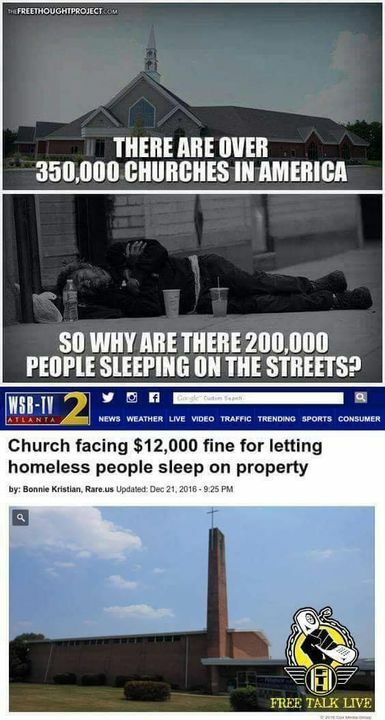
War on churches: Pennsylvania town cracks down on feeding the homeless

A lot of powerful people in this country think it’s really important to put religion in its place. They reduce the free exercise of religion to the freedom of worship, and they argue that faith should be strictly private. They also believe that a church building must be exclusively for worship and not for any of the other aspects of people living out their faith.

Pottstown, Pennsylvania, is a working-class town of 20,000 between Philadelphia and Reading. It has more than its share of poverty, which is why Christ Episcopal Church and Mission First Church run robust aid programs, especially during and after the pandemic. The churches give out free meals to the public once a week, provide counseling and mental health support, and hand out groceries, toiletries, and other staples for free.

But the Pottstown government is having none of it. According to local law, a church building can be used only for worship and “those accessory activities as are customarily associated” with worship. In June, a zoning officer sent a violation notice instructing the churches that they must cease their good deeds or go through the zoning hearing board to seek a variance.

“Civil action will commence with the Districts Justice if these violations are not corrected,” the zoning officer wrote in a letter.

Local governments have a long and storied history of stopping religious congregations from serving the poor. Mike Bloomberg wouldn’t let a synagogue donate bagels to homeless shelters. Dozens of other cities have outlawed feeding the homeless.

Pottstown’s actions against the churches are particularly striking because they don’t even involve a safety or food regulation. Instead, the town is attempting to weaponize the very definition of what a church building is in order to prevent worshippers from using it to follow the command of Jesus Christ: “When I was hungry, you fed me.”

“It is the opinion of this office that the use of the property has changed and, by definition, is more than that of a Church,” the zoning officer wrote. He included the zoning code’s definition of a church: “A building wherein persons assemble regularly for religious worship and that is used only for such purposes and for those accessory activities as are customarily associated therewith.”

It’s a horribly crimped view of what a church is, and it’s a view the churches’ leaders reject.

Keep reading

Indiana Woman Must Shut Down Business After County Officials Determine Her Farm Isn’t Zoned for Commercial Goat Yoga or Goat Snuggling

Since the beginning of the pandemic, Jordan Stevens has been running Indiana’s only full-time goat yoga operation on her farm in rural Hamilton County. She’s since been forced to stop offering that service by the planning officials who say her property isn’t zoned for goat yoga uses.

Her application for a zoning variance that would have legalized the business, Happy Goat Lucky Yoga, was also denied by the county. The expense of that process plus the added costs and hassle of not being able to run her business on her own property has Stevens, who suffers from multiple sclerosis, considering shutting down her goat yoga business entirely and applying for disability benefits.

“It sucks,” she tells Reason. “They take so much money from people who are already taxpayers and then we can’t even do the things we want to on our own property that aren’t even hurting anyone.”

Keep reading

Biden’s Infrastructure Bill Includes Making ‘Diverse’ Neighborhoods Across America Through Zoning Laws

The focus of  President Joe Biden’s $2.3 trillion infrastructure bill is allegedly to address aging infrastructure across the country, but the massive bill covers a vast amount of other spending, including money for “diversifying” neighborhoods.

This portion of Biden’s American Jobs Plan would change zoning laws to end single family home neighborhoods and allow for multiple unit “affordable” or low-income rental housing.

According to the White House Fact Sheet, the housing effort is “an innovative new approach to eliminate state and local exclusionary zoning laws, which drive up the cost of construction and keep families from moving to neighborhoods with more opportunities for them and their kids”:

“For decades, exclusionary zoning laws — like minimum lot sizes, mandatory parking requirements, and prohibitions on multifamily housing — have inflated housing and construction costs and locked families out of areas with more opportunities,” the fact sheet states. “President Biden is calling on Congress to enact an innovative, new competitive grant program that awards flexible and attractive funding to jurisdictions that take concrete steps to eliminate such needless barriers to producing affordable housing.”

In contrast to former President Donald Trump’s Housing and Urban Development’s (HUD) Opportunity Zones program that partnered the federal government with private sector investors to create less rental housing and increase home ownership, Biden’s plan uses tax breaks for state and local governments, the Fact Sheet states:

“[Biden] is calling on Congress to pass the innovative, bipartisan Neighborhood Homes Investment Act (NHIA). Offering $20 billion worth of NHIA tax credits over the next five years will result in approximately 500,000 homes built or rehabilitated, creating a pathway for more families to buy a home and start building wealth.”

Reuters reported on the shift from free markets to government control:

President Joe Biden is seeking to ease a national affordable housing shortage by pushing local governments to allow apartment buildings in neighborhoods that are currently restricted to single-family homes.

The $5 billion plan could inject the White House into a debate pitting older homeowners against younger workers seeking to gain a foothold in the most expensive U.S. cities, where many families spend a third or more of their income on housing.

The proposal, which would provide financial incentives to local governments that change zoning laws restricting many neighborhoods to single-family homes, is an example of the sort of broad social policy changes Democrats are including in Biden’s $2 trillion infrastructure bill.

Biden’s plan even designates which workers will benefit from this housing project — “put union building trade workers to work upgrading homes and businesses to save families money,” the Fact Sheet states.

Keep reading

Florida city fines woman more than $100K for parking incorrectly in her own driveway

Sandy Martinez and the Institute for Justice announced the lawsuit in a news conference Thursday, notifying the public that Martinez had been slapped with over a year’s worth of daily fines for the minor offense of parking her car partially on her front lawn in violation of town codes, WPTV-TV reported.

According to Section 6-30 of the Code of Ordinances of the Town of Lantana, “all off-street parking spaces, including driveways but not including parking spaces located in swale areas as permitted by section 17-34, shall be asphalt, concrete or block and shall be hard surfaced and in good repair in compliance with town codes.”

Martinez reportedly lives with her mother, her sister, and her three children — two of whom are now adults. Given the fact that, in total, the household contains four drivers, it is often the case that four vehicles need to be squeezed into the driveway as best they can. That predicament resulted in one of the four vehicles being parked partially on grass.

Martinez claimed that after she was first cited for the violation, she called the city, but an inspector never came to her residence. Then, more than a year later, she learned that she had been fined $250 a day for 407 days for the offense, totaling $101,750. On top of that, the city fined Martinez $65,000 more in fines for cosmetic violations, such as cracks in the driveway and a broken fence.

“I’ve been living here for 17 years now and I’m being fined over $160,000 for parking on my own property,” Martinez said during the press conference.

Keep reading

A woman who parked her tiny house on her parents’ property in New Hampshire was forced to move out after the local government said it was illegal

On August 22, 2019, O’Brien presented her case to the Hampton Falls Zoning Board of Adjustment. But the board denied her request, blocking her path to legalizing her tiny house.

The meeting notes said the board denied her request for a variance because it “would be contrary to the public interest because the structure is currently existing, therefore the modifications are not in compliance and should have been discussed prior to the particular building of the structure.”

Additionally, the board felt that the tiny house could diminish property values.

Keep reading