AI invents 40,000 chemical weapons in only six hours

A drug-developing Artificial Intelligence needed just six hours to come up with 40,000 potentially deadly chemical weapons, a fresh study has revealed.

The authors of the paper, published in Nature Machine Intelligence earlier this month, said they’d carried out the ‘thought experiment’ to figure out if artificial intelligence (AI) could be misused by evil actors. And the results their work produced have proven that the danger is real.

As part of the study, the usual data was given to the AI, but it was programmed to process it in a different way, looking for toxic combinations.

“In less than six hours after starting on our in-house server, our model generated 40,000 molecules that scored within our desired threshold,” the paper said.

It came up not just with the VX compound, which is one of the most dangerous nerve agents ever created, but also with some unknown molecules, “predicted to be more toxic.

Keep reading

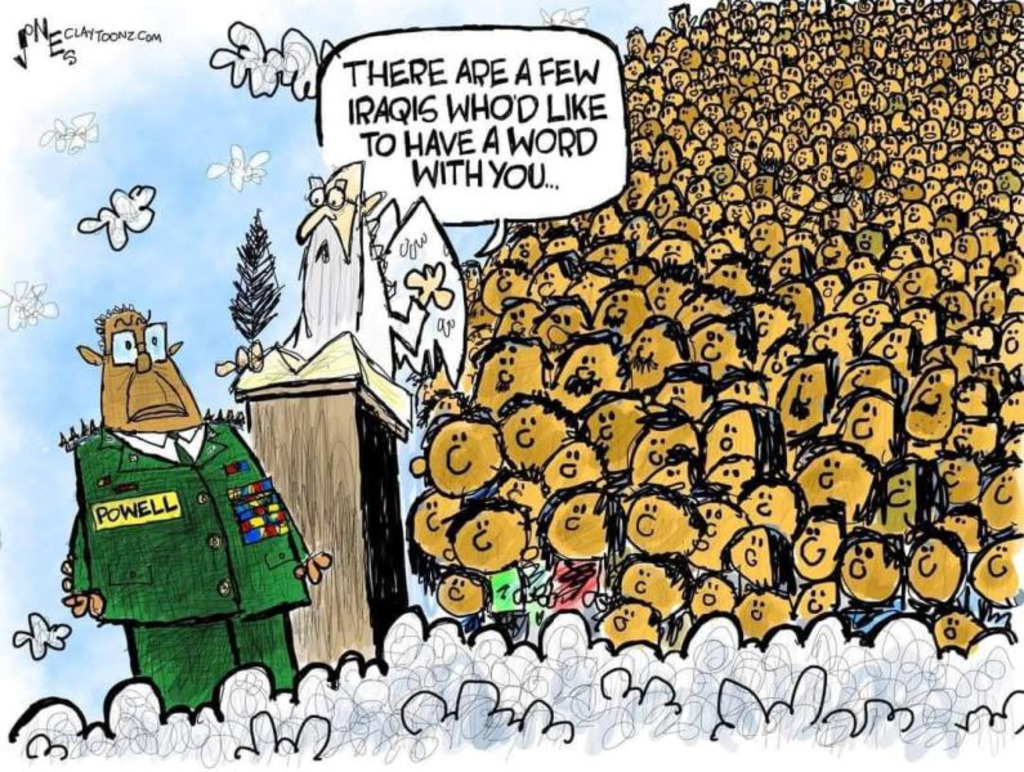
The Media’s Lies About Colin Powell’s Lies

Former Secretary of State and Joint Chiefs of Staff chair Colin Powell received virtually wall-to-wall adulation in corporate media coverage of his death last week.

In the New York Times (10/19/21), Bret Stephens called Powell “an exemplary military leader and presidential adviser.” Stephens’ Times colleague Maureen Dowd (10/23/21) said Powell was “the best America had to offer” and a “great man.” Theodore R. Johnson wrote in the same paper (10/21/21) that “we should take inspiration from Mr. Powell’s accomplishments.”

Powell led, as David Ignatius tells it in the Washington Post (10/18/21), an “extraordinary life of service,” characterized by “a sterling career of public service.” Like Ignatius, Peggy Noonan of the Wall Street Journal (10/21/21) lacked a thesaurus, describing Powell as “a great man” and one of “the great ones.” In another Journal piece, Paula Dobriansky (10/20/21) called him “a true inspiration and a model not only for military leaders and diplomats but all Americans,” a “hero of our time.”

This gratuitous fawning deflects readers from reckoning with Powell’s record. Consider the heinous acts the “great man” admitted to carrying out in Vietnam.  (See Consortium News7/8/96.) In his memoir, My American Journey, Powell said of his unit in Vietnam: “We burned down the thatched huts, starting the blaze with Ronson and Zippo lighters.” The “hero of our time” wrote:

Why were we torching houses and destroying crops?  Ho Chi Minh had said the people were like the sea in which his guerrillas swam…. We tried to solve the problem by making the whole sea uninhabitable. In the hard logic of war, what difference did it make if you shot your enemy or starved him to death?

Similarly, Powell’s “sterling career of public service” involved obstructing the truth of US war crimes in Vietnam. After the My Lai Massacre, when Powell was an Army major posted in Saigon, he was tasked with investigating a soldier’s letter describing US barbarism against the Vietnamese (Columbia Journalism Review4/3/09). Powell denied the charges, writing, “In direct refutation of this portrayal is the fact that relations between American soldiers and the Vietnamese people are excellent.”

Keep reading