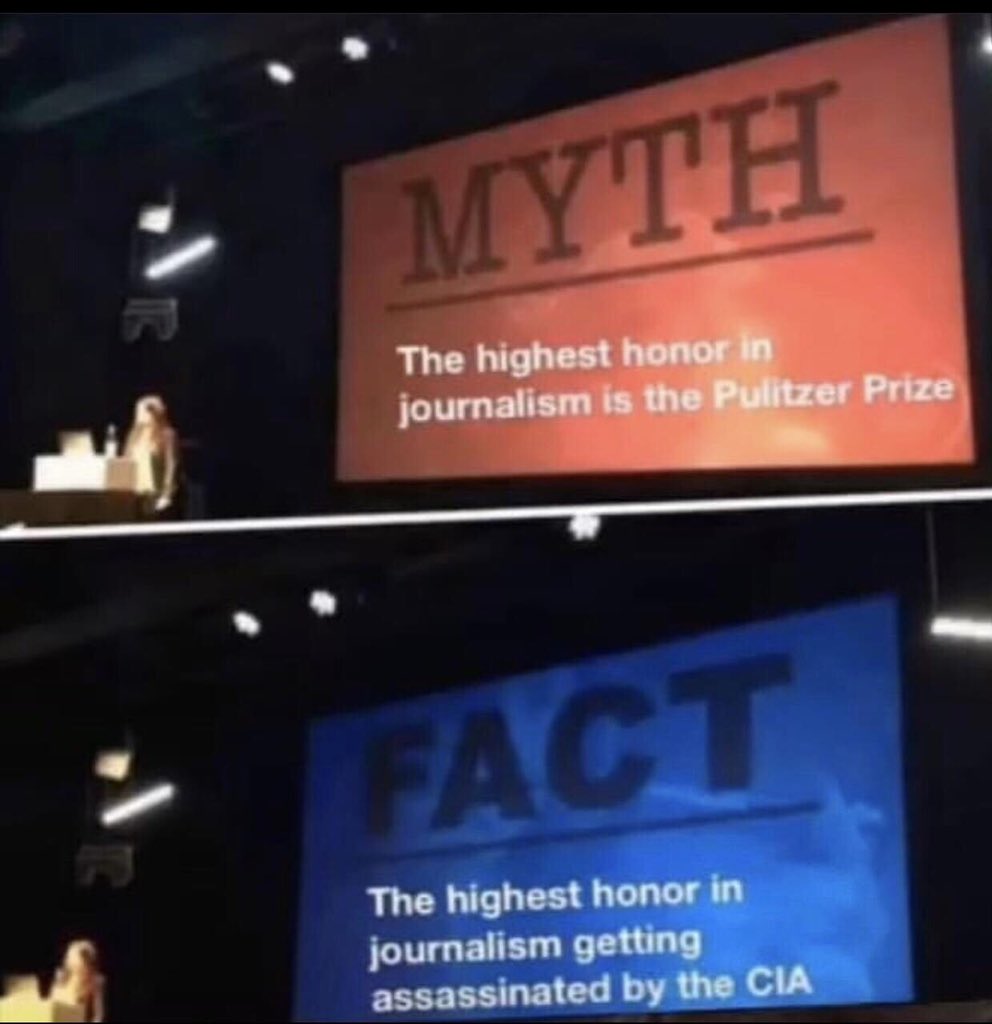
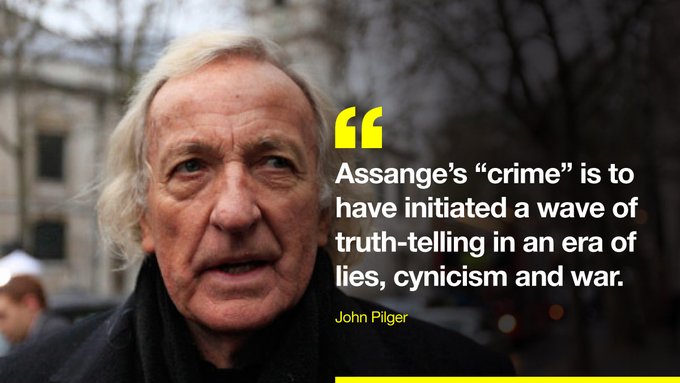
The real journalism prize…


None of the Bush or Obama administration officials who planned or executed the illegal war, nor any of the field commanders or even rank-and-file troops connected with any of the crimes revealed in the logs, were ever seriously punished.
The whistleblowers, on the other hand, suffered tremendously for exposing the truth. Both Manning and Assange were charged under the 1917 Espionage Act. Manning was convicted in 2013 and sentenced to 35 years in prison, although her sentence was commuted by President Barack Obama just before he left office in January 2017.
Assange is today imprisoned in Britain’s notorious Belmarsh Prison as he awaits possible extradition to the United States, where he faces up to 175 years behind bars, most likely in a supermax facility a former warden described as a “fate worse than death.”
Both Assange and Manning have suffered abuse that prominent human rights advocates have called torture.
Rep. Justin Amash threw his support Wednesday behind congressional resolutions calling for the U.S. government to abandon its cases against wanted leakers Edward J. Snowden and Julian Assange.
Mr. Amash, Michigan Libertarian, announced on Twitter that he signed on to become a co-sponsor of separate, similar resolutions urging the government to drop the charges facing the two secret-spillers.
Both resolutions were introduced by Rep. Tulsi Gabbard, Hawaii Democrat, and had already gained slight bipartisan support before Mr. Amash — the only registered Libertarian in Congress — joined in.

Craig Murray, the former British ambassador to Uzbekistan and longtime confidant of Julian Assange, has been fastidiously reporting on the Australian publisher’s extradition hearing to the United States. Yet few people have been reading it. This, according to Murray, is because of a deliberate decision by online media giants to downplay or suppress discussion of the case. On his blog, Murray wrote that he usually receives around 50 percent of his readers from Twitter and 40 percent from Facebook links, but that has dropped to 3 percent and 9 percent, respectively during the hearing. While the February hearings sent around 200,000 readers to his site daily, now that figure is only 3,000.
To be plain that is very much less than my normal daily traffic from them just in ordinary times. It is the insidious nature of this censorship that is especially sinister – people believe they have successfully shared my articles on Twitter and Facebook, while those corporations hide from them that in fact it went into nobody’s timeline,” he added.
Asked about the situation by former New York Times reporter Chris Hedges, Murray explained that
Anybody who is at all radical or takes any view of anything that is outwith the official establishment view gets used to occasional shadow banning, but I have never seen anything on this scale before.”
“90% of my traffic has just been cut off by what seems to be a general algorithm command of some kind to downplay Assange,” he added. “I think it is as simple as that.”

BY 2013, the Obama administration had concluded that it could not charge WikiLeaks or Julian Assange with crimes related to publishing classified documents — documents that showed, among other things, evidence of U.S. war crimes in Iraq and Afghanistan — without criminalizing investigative journalism itself. President Barack Obama’s Justice Department called this the “New York Times problem,” because if WikiLeaks and Assange were criminals for publishing classified information, the New York Times would be just as guilty.
Five years later, in 2018, the Trump administration indicted Assange anyway. But, rather than charging him with espionage for publishing classified information, they charged him with a computer crime, later adding 17 counts of espionage in a superseding May 2019 indictment.The alleged hacking not only didn’t happen, according to expert testimony, but it also couldn’t have happened.
The computer charges claimed that, in 2010, Assange conspired with his source, Chelsea Manning, to crack an account on a Windows computer in her military base, and that the “primary purpose of the conspiracy was to facilitate Manning’s acquisition and transmission of classified information.” The account enabled internet file transfers using a protocol known as FTP.
New testimony from the third week of Assange’s extradition trial makes it increasingly clear that this hacking charge is incredibly flimsy. The alleged hacking not only didn’t happen, according to expert testimony at Manning’s court martial hearing in 2013 and again at Assange’s extradition trial last week, but it also couldn’t have happened.
The new testimony, reported earlier this week by investigative news site Shadowproof, also shows that Manning already had authorized access to, and the ability to exfiltrate, all of the documents that she was accused of leaking — without receiving any technical help from WikiLeaks.
Now in its second week, Julian Assange’s extradition hearing at the Old Baily in London just heard explosive testimony based on previously reported revelations that the CIA had actively plotted to assassinate him, by either poisoning or via a kidnapping plot.
The testimony is part of the defense team’s attempt to frame the US extradition case as entirely political in nature, and not based on breaking US law, but also toward convincing the judge that the WikiLeaks founder would certainly face extreme and excessive punishment, which would be cause for Britain to block the extradition.
Though mainstream media has by and large ignored much of the bombshell testimony from the hearing since last week, this latest cloak-and-dagger type information detailing just how far US intelligence was willing to go is impossible to ignore.
Labeled the media “trial of the century,” WikiLeaks founder Julian Assange’s extradition hearing is currently taking place in London—although you might not have heard if you’re relying solely on corporate media for news. If extradited, Assange faces 175 years in a Colorado supermax prison, often described as a “black site” on US soil.
The United States government is asking Britain to send the Australian publisher to the US to face charges under the 1917 Espionage Act. He is accused of aiding and encouraging Chelsea Manning to hack a US government computer in order to publish hundreds of thousands of documents detailing American war crimes, particularly in Afghanistan and Iraq. The extradition, widely viewed as politically motivated, has profound consequences for journalists worldwide, as the ruling could effectively criminalize the possession of leaked documents, which are an indispensable part of investigative reporting.
WikiLeaks has entered into partnership with five high-profile outlets around the world: the New York Times, Guardian (UK), Le Monde (France), Der Spiegel (Germany) and El País (Spain). Yet those publications have provided relatively little coverage of the hearing.
Greenwald started with a tweet acknowledging that Assange’s plight, which includes the possibility of being extradited to the United States where he faces certain life in prison, has received “little media attention” ultimately because it doesn’t have an easy partisan angle.
“But another is that many liberals believe their political adversaries deserve to be in prison,” Greenwald stated, going on the offensive.
And that’s where the most famous founding journalist at The Intercept began going off on liberals’ exaggeration of what Trump represents and how he came to power:
“If you start from the premise that Trump is a fascist dictator who has brought Nazi tyranny to the US, then it isn’t that irrational to believe that anyone who helped empower Trump (which is how they see Assange) deserves to be imprisoned, hence the lack of concern about it,” Greenwald said.
You must be logged in to post a comment.