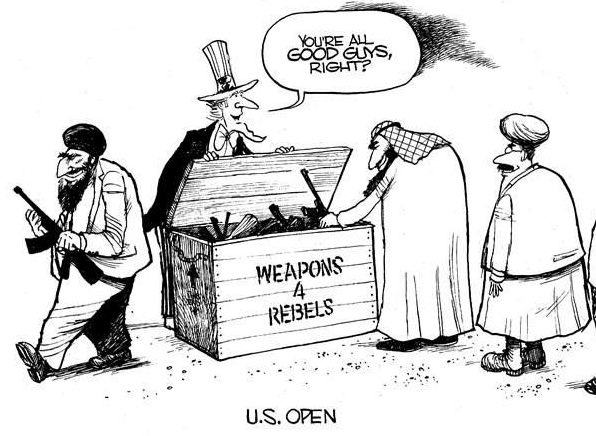
The war of terror…

A shocking exposé in The Intercept reveals CIA-backed death squads in Afghanistan have killed children as young as 8 years old in a series of night raids, many targeting madrassas, Islamic religious schools. In December 2018, one of the death squads attacked a madrassa in Wardak province, killing 12 boys, of whom the youngest was 9 years old. The United States played key roles in many of the raids, from picking targets to ferrying Afghan forces to the sites to providing lethal airpower during the raids. The Intercept reports this was part of a campaign of terror orchestrated by the Trump administration that included massacres, executions, mutilation, forced disappearances, attacks on medical facilities, and airstrikes targeting structures known to house civilians. “These militias … were established in the very early days of the Afghan War by CIA officers, many of whom had been brought back into the fold after the invasion of Afghanistan in late 2001 who had previously been working in Afghanistan during the 1980s,” says reporter Andrew Quilty. “This network of militias was set up and appear to be entirely under the control of the CIA but made up entirely of Afghan soldiers.”
IN THE DECADE since her historic transfer of secret military and diplomatic materials to WikiLeaks, Chelsea Manning has consistently and across party lines been condemned as a traitor. Less common, and absent entirely from the government’s efforts to imprison her, are allegations that her leak was an act of terrorism. But anti-terrorism training materials obtained by The Intercept show that the Pentagon is teaching defense workers exactly that.
Both civilian contractors and enlisted personnel are commonly required to complete JS-US007, a Pentagon course designed to “increase your awareness of terrorism and to improve your ability to apply personal protective measures,” according to Joint Knowledge Online, a Department of Defense education portal. JS-US007 covers a variety of grimly serious topics, from detecting roadside bombs to surviving active shooter scenarios and skyjackings. The training also covers so-called insider threat attacks, acts of terroristic violence in which members of a group strike the group itself, like the 2009 Fort Hood, Texas, shooting in which Army Maj. Nidal Malik Hasan shot and killed 13 individuals on the base, wounding 30 more. The Department of Homeland Security defines insider threat terrorism as “an unlawful use of force and violence by employees or others closely associated with organizations, against those organizations to promote a political or social objective.” Other definitions may differ on technicalities, but like other acts of terrorism, the unifying theme is the violence of the acts.




You must be logged in to post a comment.