Making an example…

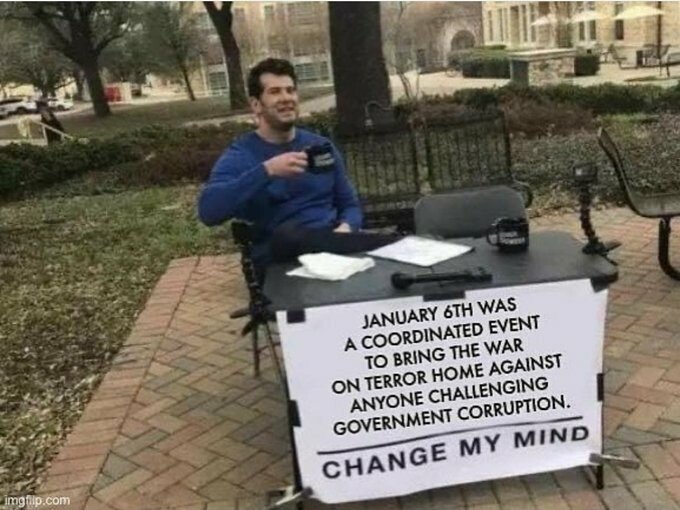
With the one-year anniversary of the Jan. 6 incursion into the United States Capitol less than a month away, three retired Army generals called on leaders to take preventive measures, including to “war game” a “post-election insurrection or coup” attempts.
“The potential for a total breakdown of the chain of command along partisan lines – from the top of the chain to squad level – is significant should another insurrection occur,” former Major Gen. Paul Eaton, former Brigadier Gen. Steven Anderson and former Major Gen. Antonio Tagubathe wrote in The Washington Post on Friday in an opinion column raising the disturbing prospect of the U.S. military training for a confrontation against fellow Americans.
The generals went on to write, “The idea of rogue units organizing among themselves to support the ‘rightful’ commander in chief cannot be dismissed.”
Their comments come in light of the Jan. 6 storming of the Capitol by a mob mostly made up of supporters of then-President Donald Trump seeking to overturn his defeat in the 2020 presidential election by disrupting the joint session of Congress assembled to count electoral votes that would formalize then-President-elect Joe Biden’s victory.
The incursion proved deadly for five people, including Ashli Babbit, 35, who died from a gunshot wound after being shot by a Capitol police officer while trying to climb through a door inside the Capitol near the House chamber.
The US Senate has passed its National Defense Authorization Act (NDAA) military spending bill for the fiscal year of 2022, setting the budget at an astronomical $778 billion by a vote of 89 to 10. The bill has already been passed by the House, now requiring only the president’s signature. An amendment to cease facilitating Saudi Arabia’s atrocities in Yemen was stripped from the bill.
“The most controversial parts of the 2,100-page military spending bill were negotiated behind closed doors and passed the House mere hours after it was made public, meaning members of Congress couldn’t possibly have read the whole thing before casting their votes,” reads a Politico article on the bill’s passage by Lindsay Koshgarian, William Barber II and Liz Theoharis.
The US military had a budget of $14 billion for its scaled-down Afghanistan operations in the fiscal year of 2021, down from $17 billion in 2020. If the US military budget behaved normally, you’d expect it to come down by at least $14 billion in 2022 following the withdrawal of US troops and official end of the war in Afghanistan. Instead, this new $778 billion total budget is a five percent increase from the previous year.
“Months after US President Joe Biden’s administration pulled the last American troops out of Afghanistan as part of his promise to end the country’s ‘forever wars’, the United States Congress approved a $777.7bn defence budget, a five percent increase from last year,” Al Jazeera reports.
“For the last 20 years, we heard that the terrorist threat justified an ever-expanding budget for the Pentagon,” Win Without War executive director Stephen Miles told Al Jazeera. “As the war in Afghanistan has ended and attention has shifted towards China, we’re now hearing that that threat justifies it.”
In 2021, it’s unfortunately not surprising to learn about routine federal surveillance of people who attract official attention. We live, after all, at a moment when freedom looks haggard and unloved even in liberal democracies and a record number of journalists are behind bars. That the practice of running people’s names through multiple government databases appears to be routine doesn’t bode well for the United States, let alone the world beyond.
“Documents obtained by Yahoo News, including an inspector general report that spans more than 500 pages” expose snooping by Customs and Border Protection’s (CBP) Counter Network Division, Jana Winter wrote in a December 11 report. “The division, which still operates today, had few rules and routinely used the country’s most sensitive databases to obtain the travel records and financial and personal information of journalists, government officials, congressional members and their staff, NGO workers and others.”
CBP agent Jeffrey Rambo was initially implicated for inquiries about Ali Watkins, a reporter at The New York Times. That included “pulling email addresses, phone numbers and photos from passport applications and checking that information through numerous sensitive government databases, including the terrorism watchlist.” But it quickly becomes apparent that he’s been hung out to dry for doing what he was told by means that are considered normal within the federal government.
“According to records included in the inspector general report, such vetting was standard practice at the division,” Winter adds.
Given the range of tools available to the feds, it’s not a shock that their use has become rote. What’s the point of having vast (if unreliable) databases on people’s activities if you’re not going to use them? To the databases, add geotagging data and information scraped from social media by contractors. Running background checks as a matter of course may be creepy, but it’s difficult to imagine it not becoming standard practice when that information is available at agents’ fingertips.
Fifteen lawmakers serving on House and Senate committees that shape U.S. military policy are profiting from investments in prominent defense contractors benefited by the very policies they influence, according to federal financial records analyzed by Business Insider this week.
Insider examined nearly 9,000 financial reports for every sitting member of Congress, as well as their top staffers, as part of a broader effort dubbed the Conflicted Congress project, which aims to identify possible conflicts of interest among lawmakers in Congress. Both Democrats and Republicans serving on the Armed Services committees have combined defense industry investments nearing $1 million as of 2020, and they’re continuing to invest and cash in.
Among the contractors that appeared in the committee members’ financial disclosures were Lockheed Martin Corp., Boeing Co., Raytheon Technologies Corp., Honeywell, and General Electric. Each company is known for spending millions to lobby the federal government in an effort to win lucrative government contracts and shape public policy.
Theodore Postol is one of the world’s leading authorities on warfare and weaponry. A physicist with a Ph.D. in nuclear engineering, he is Professor Emeritus of Science, Technology, and International Security at the Massachusetts Institute of Technology (MIT) and a former top policy adviser to the chief of naval operations.
During a career full of honors, he received the Leo Szilard Prize from the American Physical Society for “incisive technical analysis of national security issues vital for informing the public policy debate”; the Hilliard Roderick Prize from the American Association for the Advancement of Science; the Norbert Wiener Award from Computer Professionals for Social Responsibility for “uncovering numerous and important false claims about missile defenses”; and the Richard L. Garwin Award from the Federation of American Scientists “that recognizes an individual who, through exceptional achievement in science and technology, has made an outstanding contribution toward the benefit of mankind.”
Professor Postol was also a senior editorial board member of the Princeton-based Science & Global Security journal for more than 30 years—until he quit in protest over the journal’s refusal to publish an article he wrote that embarrassed the CIA and the U.S. government.
The article provided incontrovertible evidence that the murderous April 4, 2017, sarin gas attack on Syrian civilians was not the work of the Assad government but a false-flag operation by U.S.-funded jihadists designed to make it look like Assad was to blame.
The suicide rate among active-duty troops and veterans has outpaced the also-rising rate in the general population in recent years, but with so many risk factors inherent to military life, it’s difficult to pin down why.
There’s no one reason for it, according to a study released Monday by the Costs of War Project, and the way the Defense Department and VA track suicides might mean even their growing numbers are incomplete.
“The report notes that the increasing rates of suicide for both veterans and active duty personnel are outpacing those of the general population ― an alarming shift, as suicide rates among service members have historically been lower than suicide rates among the general population,” according to a news release.
Per researchers’ estimates, 30,177 Global War on Terror veterans have died by suicide, compared to 7,057 who have died while deployed in support of the Global War on Terror.
The media have largely ignored the explosive allegation made by a DOJ whistleblower about the counterterrorism targeting of outraged parents that appears to undercut sworn testimony from Attorney General Merrick Garland.
On Tuesday, a whistleblower revealed the FBI created a “threat tag” to aid in tracking alleged threats against school board officials, teachers, and staff as part of its implementation of a controversial memo issued by Garland last month.
An Oct. 20 internal email from the FBI’s criminal and counterterrorism divisions, released Tuesday by House Republicans, instructed agents to apply the threat tag “EDUOFFICIALS” to all investigations and assessments of threats directed specifically at education officials.
“The purpose of the threat tag is to help scope this threat on a national level, and provide an opportunity for comprehensive analysis of the threat picture for effective engagement with law enforcement partners at all levels,” the email stated.
The email also directs FBI agents to consider whether the criminal activity being investigated is in violation of federal law and what the potential “motivation” is behind it.
On this day in 2001, in response to the terrorist attacks of September 11, the Transportation Security Administration (TSA) was created in a demonstration that the Keystone Kops are always prepared to exploit a crisis. In the ensuing two decades, the TSA has proven itself skilled at harassing travelers and freaking out over pocketknives and water bottles while steadfastly failing at its assigned task of making air transportation any safer. The TSA, in short, is an awful example of government in action.
“On the morning of September 11, 2001, nearly 3,000 people were killed in a series of coordinated terrorist attacks in New York, Pennsylvania and Virginia,” the TSA summarizes in its official history. “The attacks resulted in the creation of the Transportation Security Administration, designed to prevent similar attacks in the future.”
The TSA launched with the passage of the Aviation and Transportation and Security Act on November 19, 2001. The new law nationalized passenger screening, which previously had been the responsibility of airlines. It’s not clear why anybody saw a need for the TSA, since it’s unlikely that a federal agency would have been any more successful than private contractors at predicting terrorists’ unprecedented use of aircraft as kamikaze weapons. It’s especially unlikely that the federal agency we actually got would have successfully diverted itself from confiscating play-doh to thwarting homicidal fanatics.
“The TSA is failing to defend us against the threat of terrorism,” security expert and frequent TSA critic Bruce Schneier pointed out in 2015. “The only reason they’ve been able to get away with the scam for so long is that there isn’t much of a threat of terrorism to defend against.”
“Terrorists are much rarer than we think, and launching a terrorist plot is much more difficult than we think,” Schneier added. “I understand this conclusion is counterintuitive, and contrary to the fearmongering we hear every day from our political leaders. But it’s what the data shows.”
The New York Times has published a very solid investigative report on a US military coverup of a 2019 massacre in Baghuz, Syria which killed scores of civilians. This would be the second investigative report on civilian-slaughtering US airstrikes by The New York Times in a matter of weeks, and if I were a more conspiracy-minded person I’d say the paper of record appears to have been infiltrated by journalists.
The report contains many significant revelations, including that the US military has been grossly undercounting the numbers of civilians killed in its airstrikes and lying about it to Congress, that special ops forces in Syria have been consistently ordering airstrikes which kill noncombatants with no accountability by exploiting loopholes to get around rules meant to protect civilians, that units which call in such airstrikes are allowed to do their own assessments grading whether the strikes were justified, that the US war machine attempted to obstruct scrutiny of the massacre “at nearly every step” of the way, and that the Air Force’s Office of Special Investigations only investigates such incidents when there is “potential for high media attention, concern with outcry from local community/government, concern sensitive images may get out.”
“But at nearly every step, the military made moves that concealed the catastrophic strike,” The New York Times reports. “The death toll was downplayed. Reports were delayed, sanitized and classified. United States-led coalition forces bulldozed the blast site. And top leaders were not notified.”
Journalist Aaron Maté has called the incident “one of the US military’s worst massacres and cover-up scandals since My Lai in Vietnam.”
 Hellbound and Down
You must be logged in to post a comment.