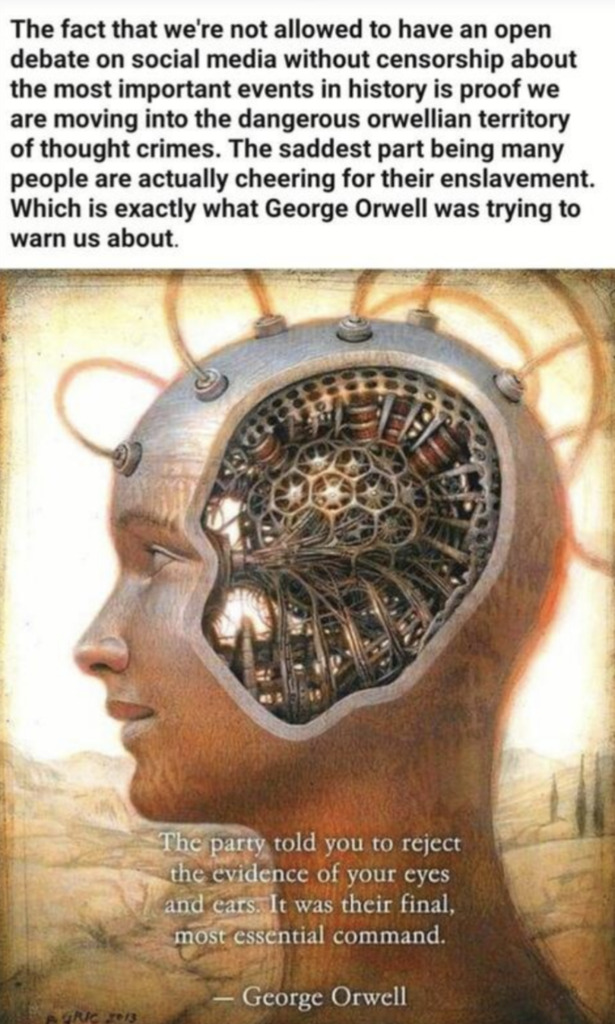
About that Facebook whistleblower…


TO WARD OFF accusations that it helps terrorists spread propaganda, Facebook has for many years barred users from speaking freely about people and groups it says promote violence.
The restrictions appear to trace back to 2012, when in the face of growing alarm in Congress and the United Nations about online terrorist recruiting, Facebook added to its Community Standards a ban on “organizations with a record of terrorist or violent criminal activity.” This modest rule has since ballooned into what’s known as the Dangerous Individuals and Organizations policy, a sweeping set of restrictions on what Facebook’s nearly 3 billion users can say about an enormous and ever-growing roster of entities deemed beyond the pale.
In recent years, the policy has been used at a more rapid clip, including against the president of the United States, and taken on almost totemic power at the social network, trotted out to reassure the public whenever paroxysms of violence, from genocide in Myanmar to riots on Capitol Hill, are linked to Facebook. Most recently, following a damning series of Wall Street Journal articles showing the company knew it facilitated myriad offline harms, a Facebook vice president cited the policy as evidence of the company’s diligence in an internal memo obtained by the New York Times.
But as with other attempts to limit personal freedoms in the name of counterterrorism, Facebook’s DIO policy has become an unaccountable system that disproportionately punishes certain communities, critics say. It is built atop a blacklist of over 4,000 people and groups, including politicians, writers, charities, hospitals, hundreds of music acts, and long-dead historical figures.
Apparently emboldened by a recent “Facebook whistleblower’s” congressional testimony and media tour, an op-end has surfaced on project-sindicate.org exploring how information could be further and more efficiently contained and obscured from users, beyond “old-fashioned” ways like censorship and downranking.
And Steven Hill, formerly of the Center for Humane Technology (CHT) – an outfit dedicated to “radically reimagining our digital infrastructure” – has an appropriately radical idea: introduce digital operating permits and “protect people” by not allowing more than 1,000 to see a particular post.
To make the idea somewhat palatable, it was introduced under the guise of a novel way of dealing with what everybody seems to agree needs to be dealt with: tech monopolies. But the tech monopoly horse has left the barn a long time ago, and it seems that a degree of regulation will now be needed to rein it in and then allow natural ways of dealing with monopolies – fair competition and innovation to take care of the problem.
But Hill thinks the way to make them less dominant is by making major social media sites’ audiences artificially smaller. And since an average person hardly communicates with 1,000 people “in real life” (notwithstanding that people’s digital lives have very much become a part of their “real” one), Hill doesn’t think that users would be “deprived” by this limitation.
But right away, the true nature of this extraordinarily dystopian idea reveals itself to be not to truly limit the power of tech monopolies, but to make sure that the message that does get out to a lot of people (so, more than 1,000 at a time) is very controlled.
Animal rights campaigners have repeatedly lobbied the world’s largest video sharing network to act and remove the videos. But a simple search of “torture baby monkey” still showed up hundreds of results this evening, Express.co.uk can reveal.
Some videos warned viewers that the video “may be inappropriate for some users” but still allows people to click through.
Among numerous videos available on the site this evening, one called “Tortured Primates” showed a monkey being electrocuted to death.
Another sickening clip was entitled “Terrified infant monkeys, ripped from their mothers’ arms” and showed an incredibly distressed baby primate being abused.
Meanwhile a third called “Monkeys Abused and Teased” had been live for two months and had garnered 40,000 views in that time.
Much is revealed by who is bestowed hero status by the corporate media. This week’s anointed avatar of stunning courage is Frances Haugen, a former Facebook product manager being widely hailed as a “whistleblower” for providing internal corporate documents to the Wall Street Journal relating to the various harms which Facebook and its other platforms (Instagram and WhatsApp) are allegedly causing.
The social media giant hurts America and the world, this narrative maintains, by permitting misinformation to spread (presumably more so than cable outlets and mainstream newspapers do virtually every week); fostering body image neurosis in young girls through Instagram (presumably more so than fashion magazines, Hollywood and the music industry do with their glorification of young and perfectly-sculpted bodies); promoting polarizing political content in order to keep the citizenry enraged, balkanized and resentful and therefore more eager to stay engaged (presumably in contrast to corporate media outlets, which would never do such a thing); and, worst of all, by failing to sufficiently censor political content that contradicts liberal orthodoxies and diverges from decreed liberal Truth. On Tuesday, Haugen’s star turn took her to Washington, where she spent the day testifying before the Senate about Facebook’s dangerous refusal to censor even more content and ban even more users than they already do.
There is no doubt, at least to me, that Facebook and Google are both grave menaces. Through consolidation, mergers and purchases of any potential competitors, their power far exceeds what is compatible with a healthy democracy. A bipartisan consensus has emerged on the House Antitrust Committee that these two corporate giants — along with Amazon and Apple — are all classic monopolies in violation of long-standing but rarely enforced antitrust laws. Their control over multiple huge platforms that they purchased enables them to punish and even destroy competitors, as we saw when Apple, Google and Amazon united to remove Parler from the internet forty-eight hours after leading Democrats demanded that action, right as Parler became the most-downloaded app in the country, or as Google suppresses Rumble videos in its dominant search feature as punishment for competing with Google’s YouTube platform. Facebook and Twitter both suppressed reporting on the authentic documents about Joe Biden’s business activities reported by The New York Post just weeks before the 2020 election. These social media giants also united to effectively remove the sitting elected President of the United States from the internet, prompting grave warnings from leaders across the democratic world about how anti-democratic their consolidated censorship power has become.
But none of the swooning over this new Facebook heroine nor any of the other media assaults on Facebook have anything remotely to do with a concern over those genuine dangers. Congress has taken no steps to curb the influence of these Silicon Valley giants because Facebook and Google drown the establishment wings of both parties with enormous amounts of cash and pay well-connected lobbyists who are friends and former colleagues of key lawmakers to use their D.C. influence to block reform. With the exception of a few stalwarts, neither party’s ruling wing really has any objection to this monopolistic power as long as it is exercised to advance their own interests.
Facebook, Messenger, Instagram, and WhatsApp are all down, but CEO Mark Zuckerberg has another headache: The personal data of 1.5 billion customers, scraped from his platform, is reportedly being offered for sale on the dark web.
User IDs, real names, email addresses, phone numbers, and locations are among the data of more than 1.5 billion Facebook customers that’s up for sale, according to a report on the cybersecurity news outlet Privacy Affairs on Monday. The going price has been quoted as $5,000 for a million names.
The data “appears to be authentic” and was obtained through “scraping” – getting the information that users set to ‘public’ or allow quizzes or other questionable apps or pages to access.
It’s the “biggest and most significant Facebook data dump to date,” according to the publication – about three times greater than the April leak of 533 million phone numbers. Facebook said at the time this was “old data” and the security vulnerability responsible had been patched back in 2019.
Privacy Affairs reported that one purported buyer was quoted the price of $5,000 for a million entries. Another user claimed they had paid the seller but had received nothing, and the seller had not yet responded. The samples of data provided to the unnamed “popular hacking-related forum” appeared to be real, the outlet said.
Facebook, Messenger, WhatsApp, and Instagram, all owned by Zuckerberg’s social media behemoth, were struck by a serious global outage that began on Monday. However, the data dump doesn’t appear to be related to the outage itself.

Fact checkers at Twitter and elsewhere furiously took to their keyboards yesterday in defense of America’s Big Pharma Covid profiteers. This time, the fact checkers circled the wagons around Pfizer, which is developing an expensive drug that serves a suspiciously similar function to the cheap, time-tested, generic drug ivermectin. This time, Twitter’s approved fact checkers trafficked in deception, misinformation, and carefully worded lies, as they so often do, in order to “debunk” an article from ZeroHedge.
Let’s dissect their work.
Here is what Twitter highlighted at the top of their “fact check”:
Pfizer is not developing a version of ivermectin to treat COVID-19, according to fact-checkers and medical professionals
A new oral drug being produced by Pfizer is not a repackaged version of the antibacterial medication often used to prevent parasites in animals, according to PolitiFact, Snopes and Full Fact. While the drugs share similar functions and effects, this does not mean they are identical or interchangeable, according to fact-checkers. Pfizer’s new oral drug “is not similar to that of an animal medicine and is not the same mechanism,” according to a statement from the company.
Further on down the page, Twitter deigned to tell us “What We Need to Know.” Thanks, Twitter!
What you need to know
– Pfizer told Snopes that the new drug is “designed to block the activity of the main protease enzyme that the coronavirus needs to replicate”
– Dr. Stephen Griffin, a virologist at Leeds Institute of Medical Research, told Full Fact that the two drugs “are extremely structurally different”
– Health agencies around the globe have declined to authorize ivermectin for the treatment of COVID-19, and studies on its potential use have been inconclusive, according to FactCheck.org
Here’s more from the Twitter-approved fact checkers, who we can obviously trust so much. They are overly fixated on the fact that ivermectin and the new Pfizer drug do not share the same chemical structures.
So, Twitter and our highly trusted “Fact Checkers” tell us that the two drugs are totally different, because they have a different chemical structure, which makes the Zero Hedge totally false, right? An open and shut case?
Below is my column in USA Today on the recent call by Sen. Elizabeth Warren (D., Mass.) for Amazon to steer readers to “true” books on climate change. It is the latest example of Democrat’s embracing a type of corporate governance model to carry out tasks barred to the government under the Constitution. Companies are now being asked to protect us from our own dangerous interests and inquiries. An array of enlightened algorithms will now watch over citizens to help them make good choices and read “true” things.
Two centuries ago, rulers sought to convince subjects that they should embrace the notion of “enlightened despotism,” living without rights under the beneficent watch of overlords. Holy Roman Emperor Joseph II summed up the idea with the maxim “everything for the people, nothing by the people.”
Today, we seem to be living in an age of enlightened corporate despotism, where social media and technology companies watch over what we read and what we discuss to protect us from ourselves.
That corporate governance model was on display this month when Sen. Elizabeth Warren, D-Mass., called on Amazon CEO Andy Jassy to use algorithms to steer readers away from books that spew “misinformation.”
Enlightened algorithms are already responsible for large-scale censorship across social media platforms that reach global audiences. They “stand the wall” as sentinels against dangerous ideas.
Warren argued that people were not listening to the enlightened views of herself and leading experts.
Instead, they were reading views of vaccine skeptics by searching Amazon and finding books, including “falsehoods about COVID-19 vaccines and cures, including those written by the most prominent spreaders of misinformation.”
Warren blamed Amazon for failing to limit searches or choices:
“This pattern and practice of misbehavior suggests that Amazon is either unwilling or unable to modify its business practices to prevent the spread of falsehoods or the sale of inappropriate products.”
In her letter, Warren gave the company 14 days to change its algorithms to throttle and obstruct efforts to read opposing views.
What was most striking about this incident is that Warren was eager for others to see her efforts to promote a form of censorship.

You must be logged in to post a comment.