MSNBC Regular Elie Mystal: Josh Hawley Is Trying to Get SCOTUS Nominee Ketanji Brown Jackson ‘Killed’

Saturday on MSNBC’s “Cross Connection,” The Nation’s Elie Mystal, a regular on MSNBC, accused Sen. Josh Hawley (R-MO) of trying to get Biden-appointed Supreme Court nominee Ketanji Brown Jackson “killed.”

He argued that Hawley’s opposition to Jackson, based on alleged leniency on sex offenders, was a ploy to put her in harm’s way.

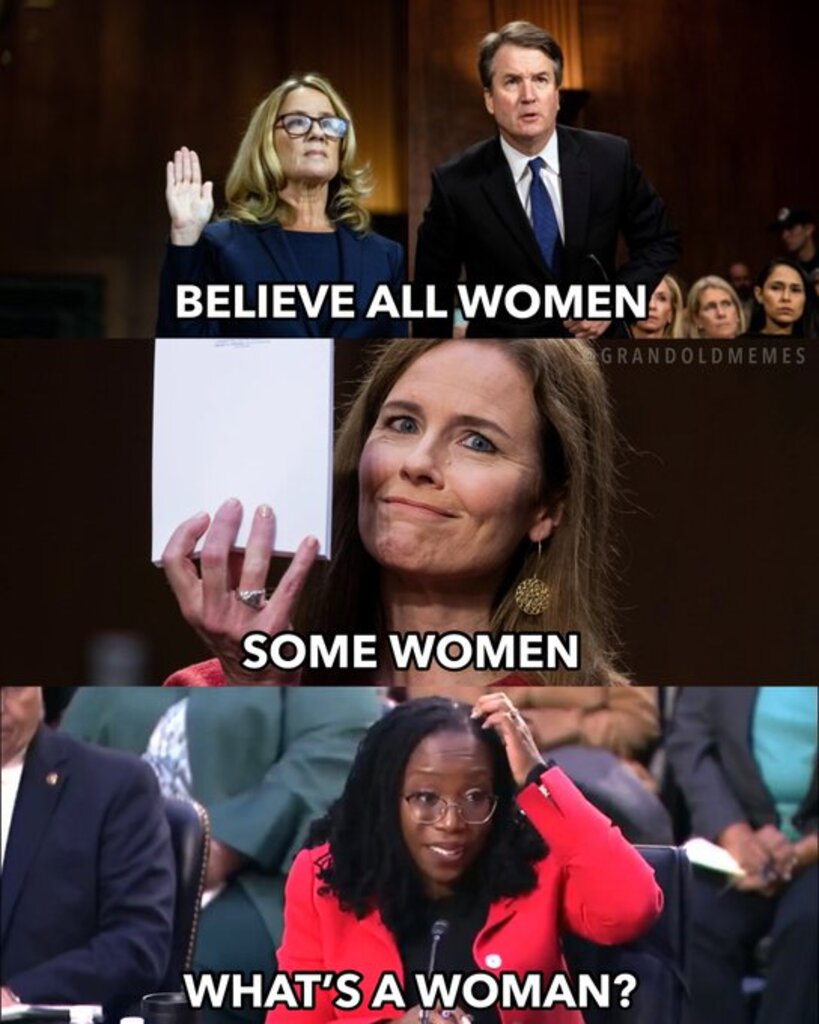
“[S]he is going to be confirmed, and she is going to be well-liked while she’s confirmed,” he said. “So them going to the mattresses against her is kind of a waste of their time. But I don’t want to let the Josh Hawley thing lie, because here’s, you know, like — here’s where I need the Democrats to step up — because when they try to smear her, I need the Democrats to get up there and defend her just as vociferously as Lindsey Graham defended alleged attempted rapist Brett Kavanaugh.”

Keep reading

SCOTUS Nominee Ketanji Brown Jackson’s Record on Sex Offenders Raises Concerns in the Senate

Judge Ketanji Brown Jackson’s judicial record is facing increasing scrutiny as the Senate confirmation hearings for President Biden’s nominee to replace retiring Justice Stephen Breyer draw closer, and one subset of the cases she handled has Senator Josh Hawley (R-MO) demanding answers.

In a thread posted on Wednesday evening, Hawley pointed out that during his review of Judge Jackson’s past decisions, speeches, and writings he “noticed an alarming pattern when it comes to Judge Jackson’s treatment of sex offenders, especially those preying on children.”

According to Hawley’s review, “Judge Jackson has a pattern of letting child porn offenders off the hook for their appalling crimes, both as a judge and as a policymaker,” and that pattern is one for which “[s]he’s been advocating…since law school.” As Hawley points out before listing several examples, Judge Jackson’s position “goes beyond ‘soft on crime'” and shows “a record that endangers our children.”

Keep reading

The Supreme Court Uses Twisted Logic to Protect US Agents Committing Torture

The Supreme Court declared last week that Americans have no right to learn the grisly details of CIA torture because the CIA has never formally confessed its crimes. The verdict symbolizes how the rule of law has become little more than a form of legal mumbo-jumbo to shroud official crimes. Why should anyone expect justice from a Supreme Court that covers up torture?

In 2002, the CIA captured Abu Zubaydah, a Palestinian radical, in Pakistan, mistakenly believing he was a kingpin with al-Qaeda. The CIA tortured him for years in Thailand and Poland. As dissenting Justice Neil Gorsuch noted, the CIA “waterboarded Zubaydah at least 80 times, simulated live burials in coffins for hundreds of hours,” and brutalized him to keep him awake for six days in a row. The CIA has admitted some of the details and Zubaydah’s name was mentioned more than a thousand times in a 683-page Senate report on the CIA torture regime released in 2014.

This case turned on the invocation of a holy bureaucratic relic of dubious origin—state secrets. As the court’s 6–3 ruling, written by Justice Stephen Breyer, noted, “To assert the [state secrets] privilege, the Government must submit to the court a ‘formal claim of privilege, lodged by the head of the department which has control over the matter.’” After a government agency claims the privilege, the court “should exercise its traditional “reluctance to intrude upon the authority of the Executive in military and national security affairs,” Breyer wrote. And the most important role for the Supreme Court nowadays is apparently to sanctify the privileges it has awarded federal agencies that committed crime sprees.

The court upheld a “state secrets” claim to block Zubaydah’s lawyers from serving subpoenas on the psychologist masterminds of the CIA torture program to learn the details of his interrogation in Poland. The court’s ruling also blocks Polish investigators seeking information about the crimes committed at a CIA torture site in their nation. 

Keep reading

Supreme Court Sees Nothing Wrong with Prolonged, Warrantless Spying of One’s Home by Police Using Hidden Cameras

The U.S. Supreme Court has refused to stop police from using hidden cameras to secretly and warrantlessly record and monitor a person’s activities outside their home over an extended period of time. In refusing to hear an appeal in Travis Tuggle v. U.S., the Supreme Court left in place a lower court ruling which concluded that no “search” in violation of the Fourth Amendment had occurred because the private activity recorded by the hidden surveillance cameras took place in public view. The Rutherford Institute and the Cato Institute had filed an amicus brief in Tuggle warning that without adequate safeguards in place, there would be no turning back from the kinds of intrusions posed by such expansive, ever-watching surveillance technology capable of revealing intimate details of a person’s life.

Jim Harper with TechLaw at the University of Arizona College of Law assisted The Rutherford Institute and the Cato Institute in advancing the Fourth Amendment privacy arguments in Tuggle.

“Unfortunately, we are steadily approaching a future where nothing is safe from the prying eyes of government,” said constitutional attorney John W. Whitehead, president of The Rutherford Institute and author of Battlefield America: The War on the American People. “As the Seventh Circuit Court of Appeals recognized, ‘Foreseeable expansion in technological capabilities and the pervasive use of ever-watching surveillance will reduce Americans’ anonymity, transforming what once seemed like science fiction into fact.’”

Keep reading

Stephen Breyer’s Retirement Is Good News for the Fourth Amendment

When President Bill Clinton tapped Stephen Breyer to fill a vacancy on the U.S. Supreme Court in 1994, he told the country that Breyer would be a justice who would “strike the right balance between the need for discipline and order, being firm on law enforcement issues but really sticking in there for the Bill of Rights.”

The news of Breyer’s impending retirement at the close of the Supreme Court’s current term gives us an opportunity to weigh Clinton’s words against Breyer’s record. Alas, the former president proved to be only half right. Breyer was certainly “firm” in his deference toward law enforcement. But that same judicial deference often led Breyer to do the opposite of “sticking in there for the Bill of Rights” when major Fourth Amendment cases arrived at SCOTUS.

Take Navarette v. California (2014). At issue was an anonymous and uncorroborated 911 phone call about an allegedly dangerous driver which led the police to make a traffic stop that led to a drug bust. According to the 5–4 majority opinion of Justice Clarence Thomas, “the stop complied with the Fourth Amendment because, under the totality of the circumstances, the officer had reasonable suspicion that the driver was intoxicated.” Law enforcement won big and Breyer signed on.

The deficiencies of that judgment were spelled out in a forceful dissent by Justice Antonin Scalia. “The Court’s opinion serves up a freedom-destroying cocktail,” wrote Scalia, who was joined in dissent by Justices Ruth Bader Ginsburg, Sonia Sotomayor, and Elena Kagan. “All the malevolent 911 caller need do is assert a traffic violation, and the targeted car will be stopped, forcibly if necessary, by the police.” That disturbing scenario, Scalia wrote, “is not my concept, and I am sure it would not be the Framers’, of a people secure from unreasonable searches and seizures.” Breyer was apparently untroubled by that Fourth Amendment–shredding scenario.

Keep reading

PolitiFact Slams Liberal Justice Sotomayor For Claiming 100K Kids In ‘Serious Condition’ With COVID

PolitiFact slammed liberal Supreme Court Justice Sonia Sotomayor for claiming during oral arguments over the Biden administration’s vaccine mandate on Friday that more than 100,000 children were in “serious condition” due to the coronavirus.

“We have over 100,000 children, which we’ve never had before, in serious condition, and many on ventilators” due to coronavirus, Sotomayor said.

PolitiFact rated the statement as “False,” writing in-part:

While the number of coronavirus-positive pediatric hospitalizations has risen with the spread of the omicron variant, Sotomayor’s number was way off.

At the time she made this comment, federal data showed that fewer than 5,000 coronavirus-positive children were in the hospital. In fact, fewer than 83,000 children have been hospitalized for COVID-19 — cumulatively — since August 2020.

There are over 100,000 cases among children, but scientists say that few of those are severe.

Keep reading

“Many on Ventilators” – Justice Sotomayor Falsely Claims Over 100,000 Children in Serious Condition Because of Covid

The US Supreme Court on Friday is considering a halt on Joe Biden’s vaccine mandates that affect more than 80 million Americans.

The highest court of the land began hearing oral arguments on two of Joe Biden’s vaccine mandates.

The Biden regime mandated all companies with 100+ employees to either test workers or prove they are vaccinated through a loophole issued by OSHA.

Biden also mandated healthcare workers at places receiving Medicaid and Medicare funding to prove they are vaccinated.

During oral arguments on Friday, Supreme Court justice Sonia Sotomayor falsely claimed that over 100,000 children are in serious condition because of Covid.

“Many are on ventilators,” Sotomayor said.

This is a lie.

The CDC on Friday said 4 in 100,000 children admitted to hospitals are infected with Covid.

The children are in the hospital with Covid, not necessarily because of Covid and they are less likely to need ventilators:

More than four in 100,000 children aged 4 years or younger admitted to hospitals were infected with the coronavirus as of Jan. 1 — double the rate reported a month ago, and about three times the rate this time last year.

Children infected with the variant are still at much less risk of becoming severely ill than adults, and even young children seem less likely to need ventilators than those admitted during previous surges, experts said.

“We have not yet seen a signal that there is any increased severity in this age demographic,” Dr. Rochelle Walensky, the C.D.C.’s director, told reporters at a news briefing on Friday. She noted that similar worries about the Delta variant had proved to be unfounded.

“The Supreme Court should quickly issue a public correction to this incorrect information.” Judicial Watch president Tom Fitton said.

Keep reading