
Those bastards!


The Department of Health and Human Services (HHS) Secretary and radical pro-abortion activist Xavier Becerra shut down the National Institutes of Health (NIH) ethics board overseeing human fetal tissue research. Under President Donald Trump, the advisory board had the authority to block fetal research proposals on ethics grounds.
In April, at President Joe Biden’s direction, HHS also reversed the Trump administration’s policy prohibiting funding for intramural research using human fetal tissue. The decision gave the “best and brightest” government researchers and agencies license to use the skin, brains, liver, and eyeballs of aborted children for taxpayer-funded research. In essence, the Biden administration is allowing for taxpayer-funded harvesting of aborted babies, and now it has abolished any sort of ethical oversight.
In response, Republican Sen. Roger Wicker of Mississippi, as well as Rep. Blaine Luetkemeyer and Sen. Vicky Hartzler, both of Missouri, are leading a letter signed by more than 100 congressional Republicans on Wednesday demanding Becerra reinstate the ethics board and the policy banning funding from going to fetal tissue research. The lawmakers are asking the Biden administration to instead “embrace more avenues for research that employ ethical, non-fetal alternatives.”
The news that the Biden administration is shutting down the fetal harvesting ethics board comes in the wake of shocking details about how federal agencies traffic aborted babies. The U.S. Food and Drug Administration (FDA) bought organs such as livers, brains, and eyeballs of dismembered babies for hundreds of dollars apiece from Advanced Bioscience Resources, one of the country’s largest fetal tissue trafficking firms. Firms such as Advanced Bioscience Resources work as the middleman between the federal government and Planned Parenthood, the country’s largest abortion provider.
The FDA pays $2,000 per individual baby, adding up to $12,000 per box of harvested organs. The FDA also requested late-term aborted babies, buying body parts from children up to 24 weeks old (babies can generally survive outside the womb as early as 22 weeks).
Most disturbing, the FDA requested organs from baby boys for “very important and … challenging” surgeries to create humanized mice. Moreover, it was uncovered that FDA employees would be joining Advanced Bioscience Resources associates at a “Humanized Mice Workshop” in Zurich in 2016.
The Center for Medical Progress reported in May that grants from the Anthony Fauci-led National Institute of Allergy and Infectious Diseases at the National Institutes of Health were funding fetal tissue experiments that included stitching the scalp of a killed 5-month-old in utero child onto the back of a lab rat.
Pointing to these examples, Republican lawmakers said in their letter that the restrictions on the use of human fetal tissue in 2019 “were instituted because of glaring abuses that came to light.”
A few days ago, the Wall Street Journal held an event called the “Tech Health Conference.” During the event, one reporter had a question for the head of Google’s “Health Division,” a man called David Feinberg.
Why, the reporter asked, was Google censoring searches for information about the possibility that COVID had escaped from a laboratory in China? Feinberg began by admitting the premise of the question. Yes, Google was in fact hiding information from its users, he effectively conceded. But it was for their own good. According to Feinberg, Google didn’t want to, “lead people down pathways that we would find to be not authoritative information.” Authoritative information. You’ve heard that phrase a lot in the last year, and phrases like it. “Authoritative information” is the opposite of “misinformation” — or worse, a “conspiracy theory.”
It’s really important. All you’re allowed to see is authoritative information. So it’s worth knowing in this and many other cases, what is it? And where exactly did Google get its so-called “authoritative information.” In this case, it came from a group led by a noted man of science called Peter Daszak. If the name sounds familiar, Peter Daszak is the person who almost single-handedly stopped virtually all public speculation about the lab leak early in the pandemic. Daszak did this in one swoop by organizing a letter to The Lancet — one of the top scientific publications — stating as fact that there was no possibility the coronavirus could have come from the lab in Wuhan. No chance. Many people believed him and they stopped looking. It was in The Lancet, after all. Almost no one asked why Peter Daszak might be saying this.
We now know the answer: Peter Daszak himself was funding research on bat coronaviruses in Wuhan, using U.S. taxpayer dollars, supplied by Tony Fauci. According to one grant Fauci approved, Daszak was authorized to conduct quote, “virus infection experiments across a range of cell cultures from different species and humanized mice.”
Why humanized mice? Well, because they mimic humans. Daszak and his collaborators wanted to make viruses more infectious to people. He didn’t hide this. In December 2019, Daszak appeared on a podcast on YouTube — which is owned by Google — to brag about how easy it is to manipulate bat coronaviruses.
During the last ice age, huge masses of ice covered the northern U.S., Canada, northern Europe and northern Asia. All that ended around 12,000 years ago, but we could be closer to another one than you think now that the National Oceanic and Atmospheric Administration (NOAA) has received funds from congress for a controversial geoengineering project that aims to cool our planet.
David Fahey, the director of NOAA’s Earth System Research Laboratory Chemical Sciences Division, reportedly told staff that the federal government wished to examine the science behind geoengineering, something he described as a “Plan B” for climate change. Along with $4 million in funding, he was given the go-ahead to study two methods of geoengineering.
The first approach entails injecting sulfur dioxide or another aerosol into the stratosphere to shade the planet from more intense sunlight. This concept is modeled after what occurs naturally when volcanic eruptions emit huge clouds of sulfur dioxide that have the effect of cooling the earth. In the second approach, an aerosol of sea salt particles would be used to enhance the power of low-lying clouds over the ocean to serve as shade.
A male rat in China has given birth by Caesarean section after a ‘vile’ experiment that involved joining it to a female rat and transplanting a uterus.
Scientists from the Naval Medical University in Shanghai said the experiment may have ‘a profound impact on reproductive biology.’
They did not spell out the implications for humans but it comes after studies exploring the possibility of transplanting a uterus into transgender women.
The team joined a male and female rat together by attaching their skin and sharing their blood, then transplanting a uterus into the male and implanting embryos into both male and female rats.
The embryos were allowed to develop to term, that is 21.5 days, with ten successful pups out of 27 ‘normal’ embryos in the male delivered by Caesarean section.
Those went on to live into adulthood and were able to reproduce, suffering no wider ill effects to heart, lung or liver, the team explained.
The scientists said: ‘A mammalian animal model of male pregnancy was constructed by us.’ However, PETA’s Senior Science Policy Advisor, Emily McIvor, called the study ‘frankenscience’ and ‘vile’.
Researchers at Technion—Israel Institute of Technology, Technische Universität Darmstadt, and IBM Research Europe have recently proposed a new strategy to simultaneously achieve microscale hydrodynamic cloaking and shielding. While the idea of cloaking or shielding objects has been around for some time now, in contrast with other previously developed methods the technique they proposed allows physicists to dynamically switch between these two states.
“When we started with our research, we were aware of work in this direction that is based on porous metamaterials,” Steffen Hardt, who led the research team at TU Darmstadt, told Phys.org. “Our idea was that you do not need such metamaterials if you can inject momentum in a region around the object to be cloaked/shielded. Effectively, this means that you superpose the external flow field by some tailor-made local flow field. As a result, the total flow field (external and local one) comes out such that cloaking or shielding is achieved.”
As part of their previous studies, the researchers developed methods to locally inject momentum using what is known as electroosmotic flow (i.e., motion of liquids typically induced by an applied voltage across a porous material or other fluid conduits). The key objective of their new study was to demonstrate a new method to cloak/shield objects in a fluid flow and make this functionality real-time adaptive, as previously proposed approaches based on metamaterials are not.
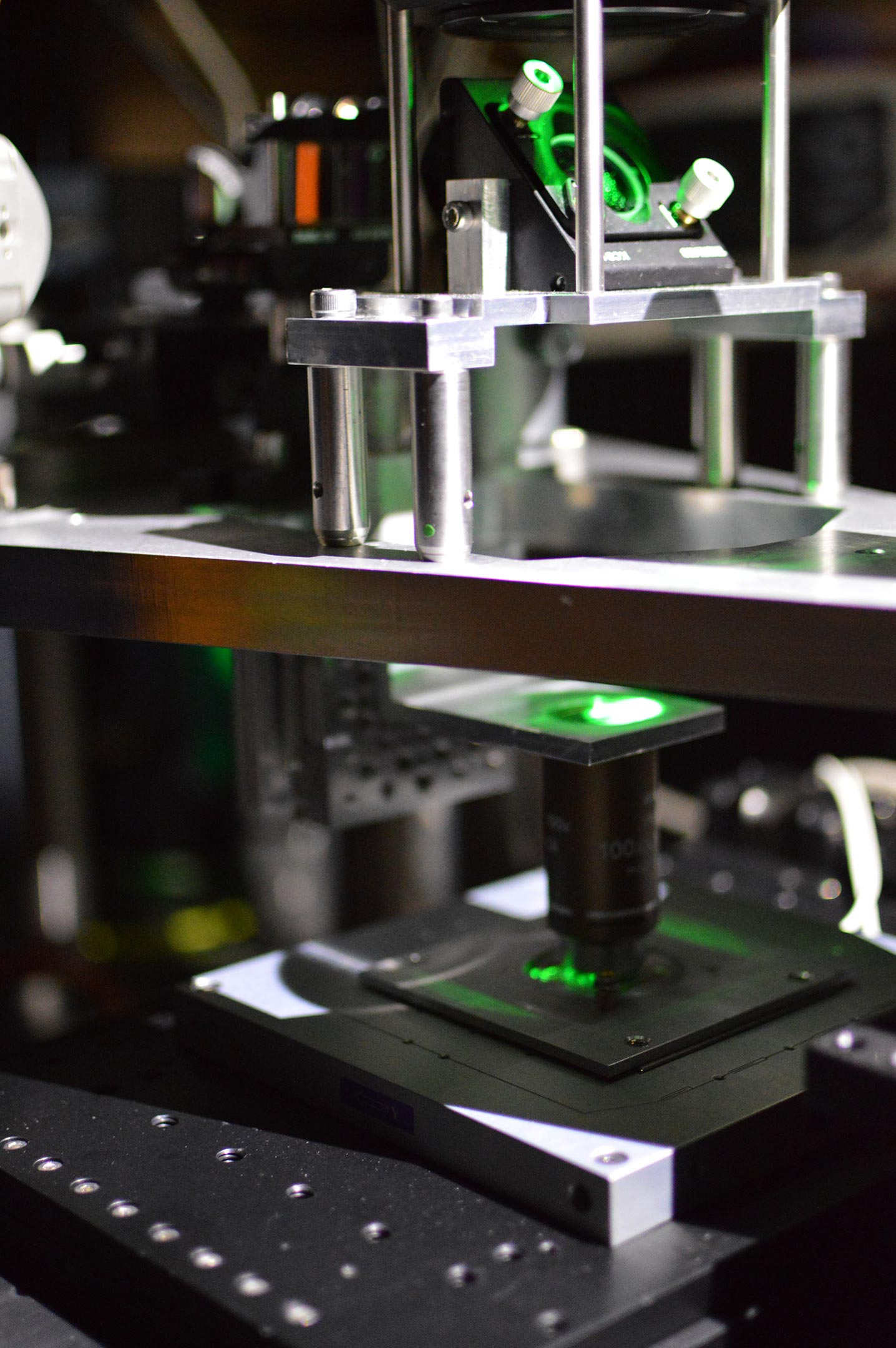
In a major scientific leap, University of Queensland researchers have created a quantum microscope that can reveal biological structures that would otherwise be impossible to see.
This paves the way for applications in biotechnology, and could extend far beyond this into areas ranging from navigation to medical imaging.
The microscope is powered by the science of quantum entanglement, an effect Einstein described as “spooky interactions at a distance.”
UQ’s quantum microscope, ready to zero in on previously impossible-to-see biology. Credit: The University of Queensland
Professor Warwick Bowen, from UQ’s Quantum Optics Lab and the ARC Centre of Excellence for Engineered Quantum Systems (EQUS), said it was the first entanglement-based sensor with performance beyond the best possible existing technology.
“This breakthrough will spark all sorts of new technologies — from better navigation systems to better MRI machines, you name it,” Professor Bowen said.
“Entanglement is thought to lie at the heart of a quantum revolution. We’ve finally demonstrated that sensors that use it can supersede existing, non-quantum technology.
A lot has changed on Earth in just the last few decades, but for a recently revived microscopic creature, it has tens of thousands of years to catch up on.
In a new study published this week in the journal Current Biology, researchers report the surprising survival story of a bdelloid rotifer, a tiny freshwater creature that is common all over the world. The multicellular animals can only be seen under a microscope, but they are capable of surviving through drying, freezing, starvation and low oxygen.
Now, researchers have learned that these animals are not only resilient, but they can persist for extreme lengths of time — at least 24,000 years — in Siberian permafrost. Earlier evidence suggested they could survive for only a decade.
“Our report is the hardest proof as of today that multicellular animals could withstand tens of thousands of years in cryptobiosis, the state of almost completely arrested metabolism,” study author Stas Malavin said in a statement.
The Soil Cryology Lab in Pushchino, Russia used a drilling rig to collect the minuscule organism from nearly a dozen feet below one of the most remote Arctic locations. Researchers then deduced its age using radiocarbon dating.
After the organism thawed, it was capable of reproducing asexually using a process called parthenogenesis. Repeating the freezing and thawing process dozens of times, researchers found that the animal innately performs a process to protect its cells and organs from the formation of ice crystals at extremely low temperatures.
A new material made from carbon nanotubes can generate electricity by scavenging energy from its environment.
MIT engineers have discovered a new way of generating electricity using tiny carbon particles that can create a current simply by interacting with liquid surrounding them.
The liquid, an organic solvent, draws electrons out of the particles, generating a current that could be used to drive chemical reactions or to power micro- or nanoscale robots, the researchers say.
“This mechanism is new, and this way of generating energy is completely new,” says Michael Strano, the Carbon P. Dubbs Professor of Chemical Engineering at MIT. “This technology is intriguing because all you have to do is flow a solvent through a bed of these particles. This allows you to do electrochemistry, but with no wires.”
In a new study describing this phenomenon, the researchers showed that they could use this electric current to drive a reaction known as alcohol oxidation — an organic chemical reaction that is important in the chemical industry.
Strano is the senior author of the paper, which appears today (June 7, 2021) in Nature Communications. The lead authors of the study are MIT graduate student Albert Tianxiang Liu and former MIT researcher Yuichiro Kunai. Other authors include former graduate student Anton Cottrill, postdocs Amir Kaplan and Hyunah Kim, graduate student Ge Zhang, and recent MIT graduates Rafid Mollah and Yannick Eatmon.
 Hellbound and Down
You must be logged in to post a comment.