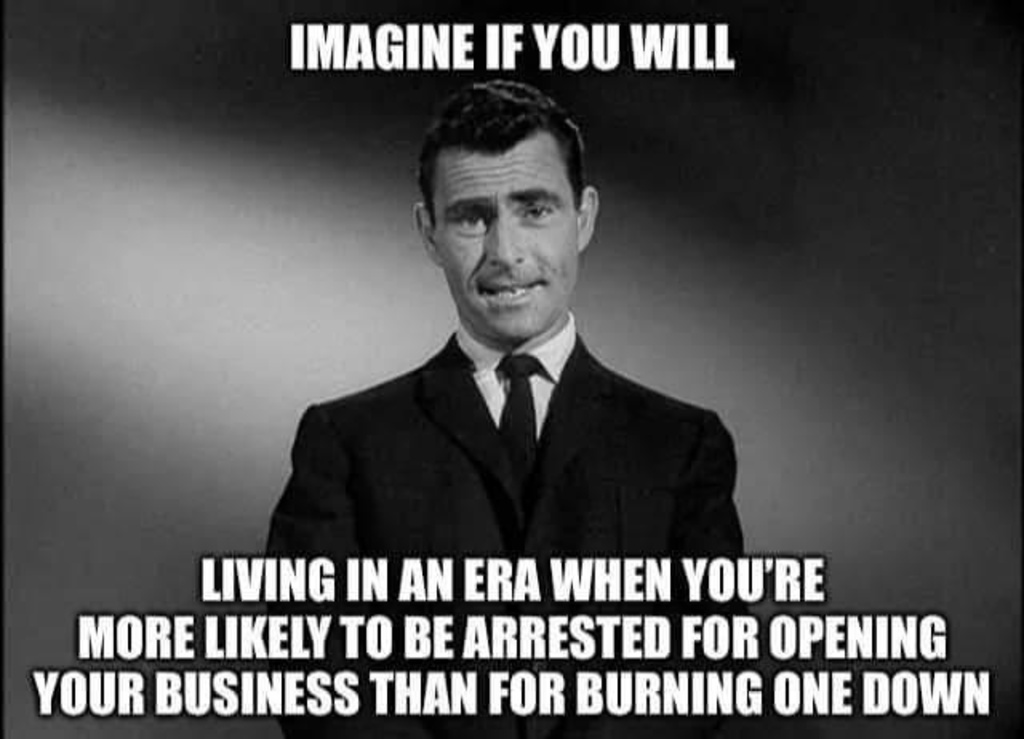
Rod’s on fire…

The term blue privilege came about in this country after people began paying attention to the crimes committed by police officers and the subsequent lack of accountability they face when committing them. Over the years, TFTP has reported on countless cases of murdering, raping, child molesting, and rights violating cops escaping accountability for their actions with little to no jail time. In some instances, they aren’t even fired for murdering unarmed innocent fathers, crawling on their knees, begging for their lives.
Continuing in the trend, in a case out of Vermont, a St. Albans police officer has received repeated hefty doses of blue privilege over his alleged crimes. In April of last year, he was arrested for allegedly breaking into a woman’s home, beating her up, throwing her down a flight of stairs, and burning her repeatedly with a cigar. For good measure, he took his father along with him — who was also arrested for his role in the incident.
Despite these grim allegations, after Officer Zachary Pigeon, 29, and his father Allen Pigeon, 56, each pleaded not guilty to five charges: simple assault, kidnapping, obstructing justice, burglary, and unlawful restraint and they were released without bail and walked out of the courtroom. In December, despite the evidence in the case against them, the charges were thrown out.
The cop’s privilege was even extended by his own department who issued nothing but praise for him after the arrest.
“There is nothing, nothing whatsoever in his file that would show up as a red flag or an indicator of any of the things that I have now heard that he is alleged to have done,” St. Albans Police Chief Gary Taylor said. “We went all through it. He polygraphed twice– and there is nothing.”
Now, the privilege goes a step further and any mention of the incident is effectively being scrubbed out of official existence.
Last week President Biden signed an executive order to rejoin the Paris Climate Accords. This was a mostly symbolic gesture, as the same alarmism being pushed prior to the agreement in 2016 is still being pushed now while nation-states like China are still ignoring it. Now Biden administration climate envoy John Kerry, under fire for boarding a private jet to Iceland to accept a climate award, is telling the United States and the world that the conditions of the Paris agreement are ‘inadequate’.
As the global climate elite push eating bugs and staying home to save the Earth on the masses, it’s worth posing the question: what will be adequate? With the Global Economic Forum in Davos approaching in April, we’re going to start hearing terms such ‘Climate Equity’ and ‘Climate Reset’ (a play on the WEF’s Great Reset) more frequently. We’ll probably also start to hear calls for climate lockdowns. I know, right now that sounds completely preposterous, but don’t these kooky ideas always find a way to bleed into the mainstream? Fifteen Days to Slow the Sun!
The possibility of climate lockdowns is already being floated by some of our greatest thinkers. They see a confluence of global crises as an opportunity. The perfect storm caused by COVID-19 and the resulting global economic meltdown offers a chance to take what they see as bold and dramatic action to save the planet. The Biden administration will certainly use the consequences of COVID to push through some green legislation, but just as before, it will not be enough in the eyes of progressives. There must always be more.
Mariana Mazzucato, an author and a professor in innovative economics at the University of London, raised the prospect of climate lockdowns in MarketWatch last September:
‘Under a “climate lockdown”, governments would limit private-vehicle use, ban consumption of red meat, and impose extreme energy-saving measures, while fossil-fuel companies would have to stop drilling. To avoid such a scenario, we must overhaul our economic structures and do capitalism differently.’
The idea of ‘doing capitalism differently’ is the driving rhetorical motivation behind the World Economic Forum’s Great Reset (another term for the implementation of global Marxism).
If a docile baby moose walked up to your door and allowed you to pet and feed it without causing any disturbance, this would be an amazing moment. In the social media age, many people would film it and then upload that video online. This is exactly what 43-year-old Angel Bunch did over the weekend. But her amazing moment with nature would end in her arrest and a dead moose — killed by the police.
Bunch posted the video on Saturday and, apparently, one of her “see something, say something” neighbors was alarmed over the video of Bunch giving a carrot to a baby moose while petting it. So, they reported her to the police, who quickly showed up.
A spokesperson for the Alaskan State Troopers, Austin McDaniel explained that feeding a moose, even a baby one, creates a public health risk.
“When Alaska Wildlife Troopers responded to Bunch’s residence the moose showed no apparent fear of humans and walked up to the Wildlife Trooper when he arrived,” McDaniel said over email to the Anchorage Daily News. “This moose appeared thin and showed signs that it had been fed by humans for some time.”
Because it relied on humans for food, the moose was deemed a threat and targeted for extermination.
“When humans feed wildlife it causes them to stop searching and feeding on their own in nature and rely solely on humans for food,” McDaniel wrote. “When their human food source stops the animal can become aggressive towards other humans as it looks for food from them.”
While this is certainly possible, bears, which pose a threat as well, are often times simply tranquilized and moved to other areas of the state when they become too dependent on humans. This could have been done with the moose.


The military-industrial complex is doubling down on its crusade against free expression, warning that the First Amendment should no longer be tolerated because it threatens “national security.”
Citing the Jan. 6 “insurrection” against the United States Capitol as proof, Divya Ramjee and Elsa B. Kania, writing for the Pentagon’s Defense One blog, contend that all online free speech needs to be filtered by a Ministry of Truth in order to prevent the type of “disinformation and incitements to violence” that led to the Capitol false flag attack.
U.S. military officials revealed the staggering figure on February 4th.
The deployments – which even saw National Guardsmen be relegated to sleeping in parking garages – was part of the Democratic Party ploy to capitalize on the events of January 6th and ensure no one could make it near Joe Biden’s inauguration. Democrats on Capitol Hill were afraid Biden and Harris would attract such small crowds they decided to close the National Mall in its entirety instead, citing COVID and national security concerns.
As reported by the Associated Press:
“The deployment brought troops in from all 50 states and four territories as law enforcement agencies tried to lock down the Capitol for the inauguration of the President Joe Biden. Thousands of Guard members poured into the nation’s capital and were stationed across the city to block traffic and protect lawmakers and landmarks. Officials said the nearly $500 million includes the costs of transporting Guard troops from their states to Washington, their salaries and benefits, as well as housing and other essentials.”
The sum is expected to cover the National Guard’s cost through mid-March, as 5,000 to 7,000 troops are expected to stay in the area until then.
From January 7th to March 14th, the expected end date of the guard’s deployment, the cost averages out to roughly $7,500,000 per day.

 Hellbound and Down
You must be logged in to post a comment.