Flashback ’97: Sen. Biden Says NATO Expansion Would Spark War With Russia

In 1997, then-Senator Joe Biden (D-Del.) warned that the expansion of the North Atlantic Treaty Organization (NATO) would result in “vigorous and hostile” action by Russia in Europe.

“I think the one place where the greatest consternation would be caused in the short term, for admission – having nothing to do with the merit and preparedness of the countries coming in – would be to admit the Baltic states now, in terms of NATO-Russian, US-Russian relations,” Biden said during an event held by the Atlantic Council, NATO’s de facto think tank.

“And if there was ever anything that was going to tip the balance, were it to be tipped, in terms of a vigorous and hostile reaction, I don’t mean military, in Russia, it would be that,” he continued, adding that Russia would be pushed into an alliance with China and even Iran.

At the time of Biden’s remarks, the Czech Republic, Hungary, and Poland were actively seeking to join NATO.

They later did join NATO in 1999.

Notably, ex-Russia ambassador William Burns – now Joe Biden’s CIA director – admitted in a 2008 security cable leaked by WikiLeaks that NATO expansion to Ukraine would result in a war with Russia and a civil war in Ukraine.

Keep reading

A Surprising Explanation Of Russia’s Invasion From A Former Top-Level CIA Official

surprising op-ed in MSNBC arguing that Russia’s invasion of Ukraine was likely “preventable” if the US and NATO had merely tried to take a path of muscular diplomacy and potential compromise appears to have slipped passed the mainstream media censors and gate-keepers. 

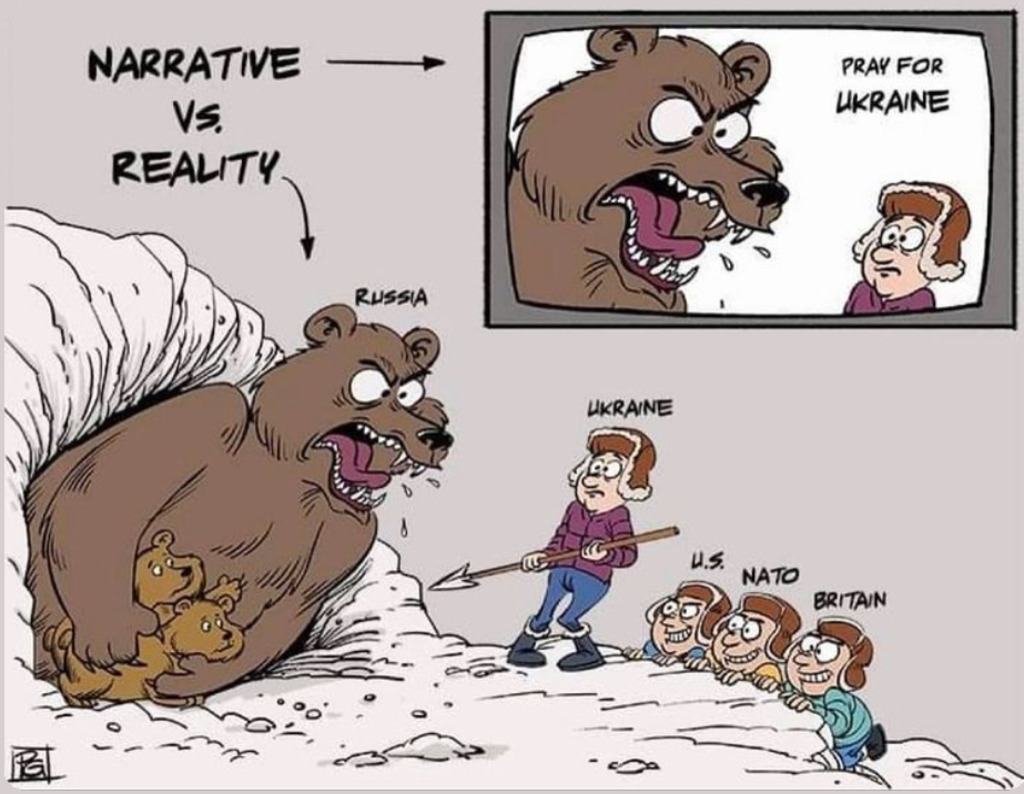
Since the start of the Thursday Feb.24 invasion, the prevailing narrative concerning Russia’s motives has been largely limited to an ultra-simplistic hollywoodwesque story that goes something like this: one day a big bully and monster named Putin decided he wanted to invade and kill people in a neighboring country, and that he further wants to “resurrect the old Soviet Union”. 

But in a refreshingly realist op-ed piece, MSNBC political columnist Zeeshan Aleem exposed the self-serving Washington narrative which was intended more for the consumption of masses as false. Aleem points to a much more complex and nuanced reality, reminding the public of what should be obvious to any student of history – that the top diplomats and US officials who oversaw post-Soviet negotiations with Russia over Europe’s security order in the 1990’s knew full well that if NATO ever got expanded up to Russia’s borders, it would be suicide. It was predicted decades ago that war would be triggered in such a scenario.

Keep reading

Experts Warned For Years That NATO Expansion Would Lead To This

It makes sense that they would have to do this. After all, if westerners were to get it into their heads that this whole terrible war could have been avoided by simply solidifying a policy of neutrality for Ukraine and issuing a guarantee that it would never be added to NATO, they would begin asking why this did not happen. NATO powers had no interest in adding Ukraine to the alliance anyway, so it doesn’t really make sense to refuse to make such low-cost concessions if the only alternative is mass military slaughter. I mean, unless your goal was to provoke mass military slaughter to advance your own geostrategic objectives.

So they work hard to present the narrative that the invasion has nothing to do with NATO at all, and occurred solely because Putin is an evil madman who hates freedom and wants to destroy democracy. Most western analysis goes no deeper than this.

Keep reading

Ukraine as Game Board

Washington cares less about Ukrainian independence and sovereignty than Russia.  Its primary interest in the territory is its location right next to Russia; its other interests lie in the resources and markets a Ukraine under US influence offers.  Of course, the latter also helps explain Russia’s determination not to let NATO assimilate Kyiv and the country it is the capitol of.  If Washington was truly interested in the independence of the Ukrainian people, it would call for a resolution granting autonomy to the eastern Donbass region of Ukraine, where a war for that region’s secession from Ukraine has been waging since at least 2014 when the US/NATO sponsored color rebellion overthrew the elected government in Kyiv.  It is that US-leaning government that Washington wants to preserve; a government first installed by US and NATO intelligence that may represent Ukrainian hopes, but certainly does not represent Ukrainian independence.  Only the Ukrainian people can determine that and their voice is both muffled and mixed.  Democratic socialists, unabashed capitalists looking towards the EU, families with old money stolen from the people after the dissolution of the Soviet Union, fascists whose legacy includes killing thousands of Jews and collaborating militarily with the Nazis, and millions of workers and farmers—these are the people of Ukraine.  In my mind it is the last demographic which should have the greatest say in their nation’s future.  However, if the rest of the world is any indication, their voice is the last to be heard.

Keep reading

NATO as Religion

The US/NATO/Ukraine/Russia controversy is not entirely new.  We already saw the potential of serious trouble in 2014 when the US and European states interfered in the internal affairs of Ukraine and covertly/overtly colluded in the coup d’état against the democratically elected President of Ukraine, Viktor Yanukovych, because he was not playing the game assigned to him by the West. Of course, our media hailed the putsch as a “colour revolution” with all the trappings of democracy.

The 2021/22 crisis is a logical continuation of the expansionist policies that NATO has pursued since the demise of the Soviet Union, as numerous Professors of international law and international relations have long indicated — including Richard Falk, John Mearsheimer, Stephen Kinzer and Francis Boyle.  NATO’s approach implements the US claim to have a “mission” to export its socio-economic model to other countries, notwithstanding the preferences of sovereign states and the self-determination of peoples.

Although the US and NATO narratives have been proven to be inaccurate and sometimes deliberately mendacious on numerous occasions, the fact is that a majority of citizens in the Western World uncritically believe what they are told.  The “quality press” including the New York Times, Washington Post, The Times, Le Monde, El Pais, the NZZ and FAZ are all effective echo chambers of the Washington consensus and enthusiastically support the public relations and geopolitical propaganda offensive.  I think that it can be said without fear of contradiction that the only war that NATO has ever won is the information war.  A compliant and complicit corporate media has been successful in persuading millions of Americans and Europeans that the toxic narratives of the Ministries of Foreign Affairs are really true. We believe in the myth of the “Arab Spring” and “EuroMaidan”, but we never hear about the right of self-determination of peoples, including the Russians of Donetsk and Lugansk, and what could easily be called the “Crimean Spring”.

Often I ask myself how this is possible when we know that the US deliberately lied in earlier conflicts in order to make aggression appear as “defense”.  We were lied to in connection with the “Gulf of Tonkin” incident, the alleged weapons of mass destruction in Iraq.  There is abundant evidence that the CIA and M15 have organized “false flag” events in the Middle East and elsewhere.  Why is it that masses of educated people fail to take some distance and question more?  I dare postulate the hypothesis that the best way to understand the NATO phenomenon is to see it as a secular religion.  Then we are allowed to believe its implausible narratives, because we can take them on faith.

Keep reading

NATO’s ‘Space Policy’ Outlines Readiness to Jointly Respond to Attacks in Space

NATO on Monday made public its official “overarching Space Policy” that outlines how it would protect its members from space attacks, citing threats from potential adversaries.

The U.S.-led alliance said its collective defense principles will be extended to outer space in response to developments made at last year’s Brussels Summit.

“At the 2021 Brussels Summit, Allies agreed that attacks to, from, or within space present a clear challenge to the security of the Alliance, the impact of which could threaten national and Euro-Atlantic prosperity, security, and stability, and could be as harmful to modern societies as a conventional attack. Such attacks could lead to the invocation of Article 5. A decision as to when such attacks would lead to the invocation of Article 5 would be taken by the North Atlantic Council on a case-by-case basis,” the document states.

Article 5 of NATO’s founding treaty states that an attack on any one of the 30 allies will be considered an attack on them all. Until now, it has only applied to more traditional military attacks on land, sea, or in the air, and more recently in cyberspace.

Considering that members have recognized that space is essential to NATO’s deterrence and defense, NATO will consider a range of potential options, for council approval, across the conflict spectrum to deter and defend against threats to or attacks on allies’ space systems, it said.

Keep reading

Behind NATO’s ‘cognitive warfare’: ‘Battle for your brain’ waged by Western militaries

NATO is developing new forms of warfare to wage a “battle for the brain,” as the military alliance put it.

The US-led NATO military cartel has tested novel modes of hybrid warfare against its self-declared adversaries, including economic warfare, cyber warfare, information warfare, and psychological warfare.

Now, NATO is spinning out an entirely new kind of combat it has branded cognitive warfare. Described as the “weaponization of brain sciences,” the new method involves “hacking the individual” by exploiting “the vulnerabilities of the human brain” in order to implement more sophisticated “social engineering.”

Until recently, NATO had divided war into five different operational domains: air, land, sea, space, and cyber. But with its development of cognitive warfare strategies, the military alliance is discussing a new, sixth level: the “human domain.”

2020 NATO-sponsored study of this new form of warfare clearly explained, “While actions taken in the five domains are executed in order to have an effect on the human domain, cognitive warfare’s objective is to make everyone a weapon.”

“The brain will be the battlefield of the 21st century,” the report stressed. “Humans are the contested domain,” and “future conflicts will likely occur amongst the people digitally first and physically thereafter in proximity to hubs of political and economic power.”

Keep reading

Countering cognitive warfare: awareness and resilience

The Alliance faces a range of challenges in emerging domains of conflict. These domains can arise from the introduction of new and disruptive technologies. The domains of space and cyber, for example, came out of developments in rocket, satellite, computing, telecommunications, and internetworking technologies. The increasingly widespread use of social media, social networking, social messaging, and mobile device technologies is now enabling a new domain: cognitive warfare.

In cognitive warfare, the human mind becomes the battlefield. The aim is to change not only what people think, but how they think and act. Waged successfully, it shapes and influences individual and group beliefs and behaviours to favour an aggressor’s tactical or strategic objectives. In its extreme form, it has the potential to fracture and fragment an entire society, so that it no longer has the collective will to resist an adversary’s intentions. An opponent could conceivably subdue a society without resorting to outright force or coercion.

The aims of cognitive warfare can be limited, with short time horizons. Or they can be strategic, with campaigns launched over the course of decades. A single campaign could focus on the limited aim of preventing a military manoeuver from taking place as planned, or to force the alteration of a specific public policy. Several successive campaigns could be launched with the long-term objective of disrupting entire societies or alliances, by seeding doubts about governance, subverting democratic processes, triggering civil disturbances, or instigating separatist movements.

Keep reading