Rishi Sunak unveils crackdown on ‘worrying’ child vaping epidemic and announces kids aged 14 and under will NEVER be able to buy cigarettes under new ban

Rishi Sunak today unveiled bold plans to stamp out the child vaping epidemic and ban kids aged 14 and under from ever legally being able to buy cigarettes. 

The proposed law will annually raise the age of legal purchase of tobacco from the current 18 by one additional year every 12 months.

It will see England follow in the footsteps of New Zealand, which last year adopted the same policy for everyone born after 2009. Under the Prime Minister’s proposed plan, the Government will stick to the same age threshold.

Thinktanks and smoking rights groups reacted with anger to the ban, labelling it as ‘hideously illiberal and unconservative’.

However, health groups and cancer charities lauded the announcement and said it would save thousands of lives from cancer.  

The PM also announced a crackdown on vaping amongst children promising to look at banning child-friendly flavours and packaging that encourage kids to pick up the habit. Disposable devices are also in the firing line.

Keep reading

Cops and Reporters Are Still Hyping the Halloween Threat Posed by Strangers With Cannabis Candy

It’s October, which means it is time for alarmist cops and credulous reporters to start warning parents about the purported menace of cannabis edibles in trick-or-treat bags. KSNT, the NBC affiliate in Topeka, Kansas, got a jump on that annual rite last month, when it amplified a “community advisory” from the St. Mary’s Police Department about “THC-infused gummies and snacks marketed to children ahead of the holidays.”

That framing is misleading in at least two ways. First, it assumes that producers of marijuana edibles that resemble popular candy brands are targeting children, who cannot legally buy such products even in states where adults can, as opposed to nostalgic grownups with a sweet tooth. Second, it implies that nefarious adults are apt to distribute THC treats on Halloween, requiring extra vigilance by parents who already worry about the danger allegedly posed by needles, glass shards, or poison that might be lurking in their kids’ candy hauls.

The KSNT story features a photograph of cannabis candy made in California, where medical marijuana was legalized in 1996, followed by recreational marijuana in 2016. At a glance, the package looks a lot like cherry-flavored Airheads Xtremes, a blatant trademark violation that surely is cause for concern at Perfetti Van Melle, which makes the genuine article. But the package carries several clues that the product is not intended for children. The front includes a “medicated candy” descriptor, along with a state-mandated cannabis label and a statement of THC content. A label on the back warns: “Contains Cannabis, A Schedule I Controlled Substance. Keep out of Reach of Children.”

KSNT nevertheless describes the product as “disguised THC candies.” Citing police, it says “the THC edibles are very dangerous in the hands of children and are disguised as popular brands such as Air Heads, Fruit Gushers, Sour Skittles, Sour Patch Kids, Buzzy Peaches and Cherry Blasters.” The implication is that the manufacturers want to trick kids into getting high, although it’s not clear why that would be a sensible business strategy. And while the reference to “the holidays” implies that the risk of dangerous confusion is especially acute around Halloween, the article cites no evidence to support that premise.

That’s par for the course with Halloween-related warnings about cannabis edibles, which police departments and news outlets have been issuing for many years despite a dearth of actual incidents involving malicious distribution of such products to children. “Doctors are warning about the risks of dangerous drugs being mistaken for candy,” WLS, the ABC affiliate in Chicago, reported last year. “Those incidents increase around Halloween, especially now with some drugs looking more and more like colorful treats.”

Keep reading

Despite Debunking, Rainbow Fentanyl Myths Continue

In 2022, fears erupted over “rainbow fentanyl,” brightly colored fentanyl pills that were said to be designed by drug traffickers to lure innocent children into taking opioids. Parents were warned to be on the watch for the pills—especially in their children’s Halloween candy stash.

A warning from the Drug Enforcement Agency (DEA) released last August warned that the increasing presence of brightly colored pills “appears to be a new method used by drug cartels to sell highly addictive and potentially deadly fentanyl made to look like candy to children and young people.”

“Rainbow fentanyl—fentanyl pills and powder that come in a variety of bright colors, shapes, and sizes—is a deliberate effort by drug traffickers to drive addiction amongst kids and young adults,” added DEA Administrator Anne Milgram.

However, it was startlingly easy to debunk panic over rainbow fentanyl. As it turns out, drug dealers have plenty of willing adult customers. So why would these they try to lure children, a customer base with no money of their own? And why would dealers give away valuable stock to do so?

“I’m skeptical that [dealers] would try to target children where there is not an existing market,” Sally Satel, an addiction psychiatrist and resident fellow at the American Enterprise Institute, told Reason‘s Lenore Skenazy in 2022. Considering the high risk of overdose in children, Satel added that “few would survive and come back for more.”

Just as there are adult reasons for vape companies to sell flavored vape pods, which were the subject of another panic, there are adult reasons for dealers to color their fentanyl—namely, to “brand [their] stuff.”

Keep reading

Washington U. Prof: AI Girlfriends Are Ruining a Generation of Men

The rise of AI girlfriends is ruining an entire generation of young men by fostering a silent epidemic of loneliness, according to Washington University Professor of Data Science Liberty Vittert.

There are now apps that offer virtual girlfriends for men who want an AI lover to talk to them, allow them to live out their sexual fantasies, and learn, through data, exactly what they like, according to a op-ed written by Washington U. professor Liberty Vittert and published by the Hill.

These apps reportedly have millions of users, who are able to choose the physical attributes and personalities of their virtual girlfriends.

Some of the artificial lovers are even based on real people. One online influencer, for example, created an AI bot of herself and gained over 1,000 users in less than a week. She believes the AI girlfriend version of herself can generate $5 million a month.

Keep reading

Texas Dept. of Health and Human Services Refuses to Answer Questions About Anti-Porn Law’s Mandatory ‘Warnings’

The Texas Department of Health and Human Services has declined to confirm or deny whether the “health warnings” mandated by the state’s recent anti-porn age verification law are supported by any official documentation or statement produced by that office.

As XBIZ reported, the Republican-authored HB 1181 was passed by the Texas legislature with bipartisan support in May and will go into effect September 1.

The new Texas age verification law — part of a state-by-state campaign by religious conservatives and anti-porn activists to outlaw all sexual material online — compels adult websites to post pseudoscientific anti-porn propaganda disclaimers declaring that “pornography is potentially biologically addictive, is proven to harm human brain development, desensitizes brain reward circuits, increases conditioned responses and weakens brain function.”

HB 1181 is a much-augmented version of Louisiana’s age verification law and its many copycats, and echoes the debunked “porn addiction” language of faith-based anti-porn groups.

XBIZ asked the Press Office of the Texas Department of Health and Human Services if the department could provide any documentation or statement pertaining to those warnings, and clarify whether the language of the warnings has its basis in any documentation or statement produced by the Texas Department of Health and Human Services.

After requesting several days to provide a reply to the query, Press Officer Tiffany Young declined to answer, deflecting the questions with an invitation to contact “the authors of this bill for information about how it originated.”

XBIZ also contacted Texas Department of Health and Human Services Chief of Staff Kate Hendrix and the bill’s main sponsor, Rep. Matt Shaheen (R), but received no reply to the same questions.

Keep reading

Southwest Airlines Falsely Accuses Mom of Trafficking Biracial Daughter

A woman is suing Southwest Airlines after flight staff accused her of trafficking her child. Mary MacCarthy was flying with her 10-year-old daughter, “MM,” in 2021 when Southwest Airlines staff called the Denver Police Department and reported her as a suspected child trafficker.

MacCarthy is white, and her daughter is biracial. In a lawsuit against Southwest, MacCarthy alleges that she was suspected of trafficking her own daughter “for no reason other than the different color of her daughter’s skin from her own.”

“There was no basis to believe that Ms. MacCarthy was trafficking her daughter,” states the complaint, filed August 3 in the U.S. District Court for the District of Colorado, “and the only basis for the Southwest employee’s call was the belief that Ms. MacCarthy’s
daughter could not possibly be her daughter because she is a biracial child.”

MacCarthy and her daughter wouldn’t be the first multiracial family to find themselves facing human trafficking allegations at the airport. We keep hearing about flying families or couples falsely accused of being involved in trafficking because they don’t appear to be the same race or ethnicity.

It’s happened with interracial couples and with parents of mixed-race or adopted children. Cindy McCain, wife of the late Sen. John McCain, infamously fabricated catching a child trafficker when she reported to police a woman traveling with a child who was “a different ethnicity” from her.

This situation isn’t occurring in a vacuum. It comes amidst a decades-long moral panic about sex trafficking generally and child sex trafficking in particular. The panic has taken many forms, including the Department of Homeland Security encouraging War on Terror–style citizen surveillance campaigns (“if you see something, say something”) to stop trafficking; states requiring airports to post human trafficking hotline numbers and awareness signs; and government-sponsored programs to train airline and airport staff to spot alleged signs of trafficking.

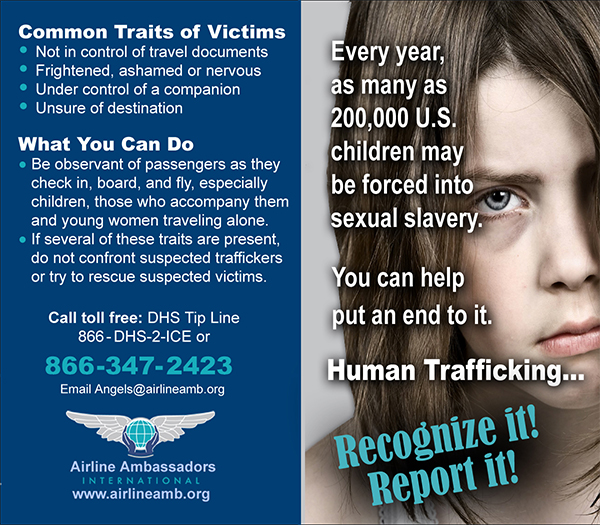
Most of the “signs” these people are trained to spot are nonsense—impossibly vague or broad. For instance, Airline Ambassadors International trains airline and airport staff (using a training program approved by Homeland Security) to keep an eye on “children, those who accompany them, and young women traveling alone” and people who seem “nervous.” Training materials also tend to tell people to go with their gut instincts. Unsurprisingly, this leads to a lot of racial profiling, with ill-informed instincts about what a family “should” look like coming into play.

The wider campaign to “stop sex trafficking” via vigilance on airplanes and at airports is itself based on the faulty idea that human trafficking (a category that includes both labor trafficking and sex trafficking) is mostly done by brazen cabals of international traffickers ushering victims into the U.S. and Americans victims out, or shipping victims around the country. But in the U.S., labor trafficking tends to be concentrated in specific industries and to involve various forms of worker exploitation more than the covert importation of human beings. And in the sex trades, exploitation tends to take place at a much smaller scale, with individuals or small groups—often people the victim knows—perpetuating it. It also tends to take place in the communities people live in or with victims and traffickers traveling by car, not using commercial airlines.

Keep reading

Sunday School Scapegoats: How D&D And Heavy Metal Became Targets For Satanic Panic

The Satanic Panic started in 1980 with a book, Michelle Remembers, co-written by Michelle Smith and her psychiatrist (and future husband) Lawrence Pazder. Claiming to be the true tale of Michelle’s childhood – as remembered through the now-discredited practice of recovered memory therapy – Michelle said that she was abused by the Church of Satan, starting at the age of five. Among her claims were that she witnessed human sacrifices, was rubbed with blood and body parts of those sacrificed, tortured, and forced to take part in a non-stop, 81-day ritual in an underground room in a cemetery that summoned Satan, removed visual evidence of the abuse she had undergone, and hidden the memories until “the time is right.”

Almost immediately, the debunking began. Most notably, during the alleged 81-day ritual, Michelle still attended school and showed no signs of abuse. Michelle was unable to identify any of the hundreds of alleged participants in the ritual, except for her mother. There was no historical record of a car accident as described in the book. Pazder also never attempted to contact the police to investigate any of the alleged crimes Michelle “remembered.” Despite this, Pazder and Smith became celebrities in their “field.” Pazder was used as a consultant in the McMartin preschool trials, and Smith appeared on Oprah Winfrey’s daytime talk show. Michelle Remembers was used in training material for law enforcement and social workers.

Keep reading

David Stockman On The Parallels Between The COVID Hysteria And The Salem Witch Trials

It would not be going too far to say that the eruption of irrationality and hysteria in America during the COVID-19 period of 2020-2021 most resembled not 1954, when Senator McCarthy set the nation looking for communist moles behind every government desk, or 1919, when the notorious raids of Attorney General Mitchell were rounding up purported Reds in their tens of thousands, but the winter of 1691-1692. That’s when two little girls—Elizabeth Parris and Abigail Williams of Salem, Massachusetts—fell into the demonic activity of fortune-telling, which soon found them getting strangely ill, having fits, spouting gibberish, and contorting their bodies into odd positions.

The rest became history, of course, when a malpracticing local doctor claimed to have found no physical cause for the girls’ problems and diagnosed them as being afflicted by the “Evil Hand,” commonly known as witchcraft. Other ministers were consulted, who agreed that the only cause could be witchcraft and since the sufferers were believed to be the victims of a dastardly crime, the community set out to find the perpetrators.

Within no time, three witches who were famously accused —the Parris’ slave, Sarah Good, an impoverished homeless woman and Sarah Osborne, who had defied conventional Puritan society. Many more followed, and as the hysteria spread, hundreds were tried for witchcraft and two dozen hanged.

But there is a lesson in this classic tale that is embarrassing in its verisimilitude. Namely, one of the best academic explanations for the outbreak of seizures and convulsions which fueled the Salem hysteria was a disease called “convulsive ergotism”, which is brought on by ingesting rye grain infected with a fungus that can invade developing kernels of the grain, especially under warm and damp conditions.

During the rye harvest in Salem in 1691 these conditions existed at a time when one of the Puritans’ main diet staples was cereal and breads made of the harvested rye. Convulsive ergotism causes violent fits, a crawling sensation on the skin, vomiting, choking, and, hallucinations—meaning that it was Mother Nature in the ordinary course working her episodically unwelcome tricks, not the “Evil Hand” of a spiritual pathogen, which imperiled the community.

Keep reading

Satanic panic is making a comeback, fueled by QAnon believers and GOP influencers

On June 1, David Leavitt, the prosecuting attorney for Utah County, stood behind a lectern in his windowless Provo office before a gaggle of reporters. Wearing a gray suit and an exasperated look, he wanted to make something categorically clear: Neither he nor his wife were guilty of murdering or cannibalizing young children.

It was, by all accounts, a strange declaration from the progressive Republican prosecutor, a Mormon and younger brother of a former Utah governor, Mike Leavitt, who had earned a name for himself by prosecuting a well-known polygamist in 2001. But David Leavitt was up for re-election, Utah County voters would start casting ballots the next week, and the allegations, ridiculous as they may have sounded, had started to spread online and throughout the community. 

Some of Leavitt’s most high-profile political opponents were willing to at least wink at the allegations against him: Utahns for Safer Communities, a political action committee opposing Leavitt’s re-election, posted his news conference to YouTube with the caption, “Wethinks He Doth Protest Too Much,” and on their website, the group wrote that Leavitt “seems to know more than he says.” 

Leavitt lost the election, most likely not just because of the allegations against him but because of his liberal style of prosecution in a deeply conservative county where opponents labeled him as “soft on crime.” But the allegations’ impact on Leavitt was clear. After decades of serving as a city and county attorney with grander plans for public office, Leavitt now doesn’t think he’ll run again. 

“The cost is too high,” he said recently in an interview from his home.

Leavitt’s experience is one of a spate of recent examples in which individuals have been targeted with accusations of Satanism or so-called ritualistic abuse, marking what some see as a modern day version of the moral panic of the 1980s, when hysteria and hypervigilance over protecting children led to false allegations, wrongful imprisonments, decimated communities and wasted resources to the neglect of actual cases of abuse.

While the current obsession with Satan was boosted in part by the QAnon community, partisan media and conservative politicians have been instrumental in spreading newfound fears over the so-called ritualistic abuse of children that the devil supposedly inspires, sometimes weaving the allegations together with other culture war issues such as LGBTQ rights. Those fears are powering fresh accusations of ritual abuse online, which are amplified on social media and by partisan media, and can mobilize mobs to seek vigilante justice. 

Keep reading

No Treats, Only Tricks: Republicans Try to Ruin Halloween With Fake Rainbow Fentanyl Threat

A group of Republican senators has released a video warning parents that Mexican drug cartels have begun targeting children by disguising fentanyl as candy, despite actual experts claiming its bogus.

The public service announcement, a portion of which was aired on Fox News Friday morning, said that “by working together and being on high alert this Halloween, we can help put an end to the drug traffickers that are driving addiction.” 

Halloween this year falls exactly 8 days before the November midterms, and what better way is there to drive home your tough-on-crime, war on drugs-electoral messaging than to convince parents that the cartels are in the house down the block and are handing out synthetic opioids to your kid? 

“Rainbow fentanyl comes in a variety of bright colors, shapes, and sizes, including pills powder and blocks that resemble sidewalk chalk,” said Louisiana Senator Bill Cassidy. “Even just handling these pills or powders…can kill a person,” added Senator Steve Daines (R-Mon.), alluding to the myth that touching fentanyl can cause an overdose. 

Nebraska Senator Deb Fisher warned that “according to the DEA, these pills are a deliberate effort by drug traffickers to drive addiction amongst kids and young adults.”

However, experts, who at this point are exasperated at the “poisoned Halloween candy” myth’s yearly resurgence, are again reiterating that drug dealers are not handing out narcotics to children en masse. In fact, the use of colors is typically a way for producers to distinguish their products from other manufacturers and to make them identifiable to existing consumers, not a way to market them to children. Mariah Francis, a Resource Associate with the National Harm Reduction Coalition, criticized the GOP lawmakers misrepresentation of the ways drugs circulate in communities. “Drug markets are based off profit gain and profit margins,” explained Francis. Drug dealers “are not making money giving free fentanyl tablets […] to small children.”

Keep reading