
Although President Joe Biden has been known to angrily confront reporters for what he considers overly harsh questions, the legacy media have taken it remarkably easy on the president and his family. While the media have circled hungrily around every potential charge facing Allen Weisselberg and remain focused on the Trump family, they have ignored multiple scandals facing Joe Biden, his son, and his brother. Here are just a few…
Tag: media
Media manipulation…


The Horrifying Rise Of Total Mass Media Blackouts On Inconvenient News Stories
Two different media watchdog outlets, Media Lens and Fairness & Accuracy In Reporting (FAIR), have published articles on the complete blackout in mainstream news institutions on the revelation by Icelandic newspaper Stundin that a US superseding indictment in the case against Julian Assange was based on false testimony from diagnosed sociopath and convicted child molester Sigurdur Thordarson.
FAIR’s Alan MacLeod writes that “as of Friday, July 2, there has been literally zero coverage of it in corporate media; not one word in the New York Times, Washington Post, CNN, NBC News, Fox News or NPR.”
“A search online for either ‘Assange’ or ‘Thordarson’ will elicit zero relevant articles from establishment sources, either US or elsewhere in the Anglosphere, even in tech-focused platforms like the Verge, Wired or Gizmodo,” MacLeod adds.
Sociopaths at Time Magazine Want to Banish Air Conditioning
Far-left Time Magazine, one of the country’s chief conspiracy theorists pushing the Climate Change Hoax, openly advocates having air-conditioning banished.
In a lengthy piece of hysterical, anti-science scare-mongering that tries to turn the greatest life-saving, quality of life-improving invention since penicillin into a racist (that’s not a joke) villain, Time comes right out and says it — and naturally does so from its air-conditioned offices (I don’t link junk science):
The troubled history of air-conditioning suggests not that we chuck it entirely but that we focus on public cooling, on public comfort, rather than individual cooling, on individual comfort. Ensuring that the most vulnerable among the planet’s human inhabitants can keep cool through better access to public cooling centers, shade-giving trees, safe green spaces, water infrastructure to cool, and smart design will not only enrich our cities overall, it will lower the temperature for everyone. It’s far more efficient this way.
To do so, we’ll have to re-orient ourselves to the meaning of air-conditioning. And to comfort. Privatized air-conditioning survived the ozone crisis, but its power to separate—by class, by race, by nation, by ability—has survived, too. Comfort for some comes at the expense of the life on this planet.
It’s time we become more comfortable with discomfort. Our survival may depend on it.
Okay, number one: fuck you. Number two: fuck you. Number three: Climate Change, Global Warming, or whatever they’re calling it today, is a hoax. Climatologists, scientists, and other so-called experts are 0-44 with their alarmist climate predictions, so let me assure you that if you try to take my air conditioning away based on fake prediction number 45, things are going to get ugly. Real ugly. Number four: Did I mention, fuck you?
Unmasked…

Sudden Shift in COVID-19 Lab Leak Narrative ‘Mysterious’: Evolutionary Biologist
The sudden shift in narrative over the possibility that COVID-19 could have emerged from a lab in Wuhan, China, is mysterious and contingent to “just how corrupt our system has become,” according to evolutionary biologist Bret Weinstein.
Weinstein, biologist and co-host of the DarkHorse Podcast, has since last year explored the possibility that COVID-19 could have emerged from a laboratory. He told Epoch TV’s “American Thought Leaders” program (episode premiering on Sat. July 3) that the fact that the hypothesis is now receiving widespread recognition from the international community is “completely mysterious.”
“My channel was very early on this topic, and it was quite clear to many of us, starting with the tremendous coincidence of this virus having emerged first in Wuhan, where there is a biosafety level four lab studying these very viruses and enhancing them,” said Weinstein. “It was quite clear that there was at least a viable hypothesis that needed to be discussed.
Weinstein, a visiting fellow at the James Madison Program at Princeton University, said that before the narrative surrounding the COVID-19 lab leak theory gained traction, those who did discuss it were stigmatized, demonized and “portrayed as everything from racist to reactionary.”
“All we were doing was following the evidence,” Weinstein continued. “The change in that story was, I have to say, completely mysterious.”
Rumsfeld Remembered as ‘Complex,’ ‘Energetic’—Not as Killer of Multitudes
One thing you won’t find in corporate media obituaries of Donald Rumsfeld is any estimate of how many people died in the wars he was in charge of launching.
You do see occasional references to the US troops he sent to their deaths—as in the AP‘s obit (6/30/21):
Defiant to the end, Rumsfeld expressed no regrets in his farewell ceremony, at which point the US death toll in Iraq had surpassed 2,900. The count would eventually exceed 4,400.
And in the New York Times (6/30/21):
Mr. Rumsfeld, more than four years out of office, still expressed no regrets over the decision to invade Iraq, which had cost the United States $700 billion and 4,400 American lives.
But the Afghan and Iraqi lives lost as the result of the wars Rumsfeld managed—which by the most careful estimates outnumbered the US dead by a factor of a hundred or more (PLOS Medicine, 10/15/13; Lancet, 10/12/06)—simply go unmentioned. This, of course, greatly facilitates the job of the obituary writer, who is required to present every deceased member of the Washington establishment as a complicated, ultimately lovable character, regardless of the scale of their crimes.
Or as the Washington Post (6/30/21) put it: “Mr. Rumsfeld was more complex and paradoxical than the public caricature of him as a pugnacious, inflexible villain would suggest.”
The “Conspiracy Theory” Charade
Biden’s “National Strategy for Countering Domestic Terrorism” report last week declared that “enhancing faith in American democracy” requires “finding ways to counter the influence and impact of dangerous conspiracy theories.” In recent decades, conspiracy theories have multiplied almost as fast as government lies and cover-ups. While many allegations have been ludicrously far-fetched, the political establishment and media routinely attach the “conspiracy theory” label to any challenge to their dominance.
According to Cass Sunstein, Harvard Law professor and Obama’s regulatory czar, a conspiracy theory is “an effort to explain some event or practice by reference to the machinations of powerful people, who have also managed to conceal their role.” Reasonable citizens are supposed to presume that government creates trillions of pages of new secrets each year for their own good, not to hide anything from the public.
In the early 1960s, conspiracy theories were practically a non-issue because 75 percent of Americans trusted the federal government. Such credulity did not survive the assassination of John F. Kennedy. Seven days after Kennedy was shot on November 22, 1963, President Lyndon Johnson created a commission (later known as the Warren Commission) to suppress controversy about the killing. Johnson and FBI chief J. Edgar Hoover browbeat the commission members into speedily issuing a report rubberstamping the “crazed lone gunman” version of the assassination. House Minority Leader Gerald Ford, a member of the commission, revised the final staff report to change the location of where the bullet entered Kennedy’s body, thereby salvaging Hoover’s so-called “magic bullet” theory. After the Warren Commission findings were ridiculed as a whitewash, Johnson ordered the FBI to conduct wiretaps on the report’s critics. To protect the official story, the commission sealed key records for 75 years. Truth would out only after all the people involved in any coverup had gotten their pensions and died.
The controversy surrounding the Warren Commission spurred the CIA to formally attack the notion of conspiracy theories. In a 1967 alert to its overseas stations and bases, the CIA declared that the fact that almost half of Americans did not believe Oswald acted alone “is a matter of concern to the U.S. government, including our organization” and endangers “the whole reputation of the American government.” The memo instructed recipients to “employ propaganda assets” and exploit “friendly elite contacts (especially politicians and editors), pointing out… parts of the conspiracy talk appear to be deliberately generated by Communist propagandists.” The ultimate proof of the government’s innocence: “Conspiracy on the large scale often suggested would be impossible to conceal in the United States.”
However, the CIA did conceal a wide range of assassinations and foreign coups it conducted until congressional investigations in the mid-1970s blew the whistle. The New York Times, which exposed the CIA memo in 1977, noted that the CIA “mustered its propaganda machinery to support an issue of far more concern to Americans, and to the C.I.A. itself, than to citizens of other countries.” According to historian Lance deHaven-Smith, author of Conspiracy Theory in America, “The CIA’s campaign to popularize the term ‘conspiracy theory’ and make conspiracy belief a target of ridicule and hostility must be credited…with being one of the most successful propaganda initiatives of all time.” (In 2014, the CIA released a heavily-redacted report admitting that it had been “complicit” in a JFK “cover-up” by withholding “incendiary” information from the Warren Commission.)
The Johnson administration also sought to portray critics of its Vietnam War policies as conspiracy nuts, at least when they were not portraying them as communist stooges. During 1968 Senate hearings on the Gulf of Tonkin incident, Defense Secretary Robert McNamara denounced the “monstrous insinuations” that the U.S. had sought to provoke a North Vietnamese attack and declared that it is “inconceivable that anyone even remotely familiar with our society and system of government could suspect the existence of a conspiracy” to take the nation to war on false pretenses. Three years later, the disclosure of the Pentagon Papers demolished the credibility of McNamara and other top Johnson administration officials who indeed dragged America into the Vietnam War on false pretenses.
Media Applaud the New Cold Wars—but Could US Be More Aggressive, Please?
US media are fixin’ for a fight with China, Russia—or both. Commentary on the recent G7 and NATO summits, as well as President Joe Biden’s meeting with Russian President Vladimir Putin, was replete with examples of news outlets alternately praising the Biden administration for ramping up new cold wars with China and Russia, and criticizing it for not being even more aggressive. As it propagandized about the US supposedly fighting for democracy, this coverage betrayed a total indifference to the potential costs of these hostilities.
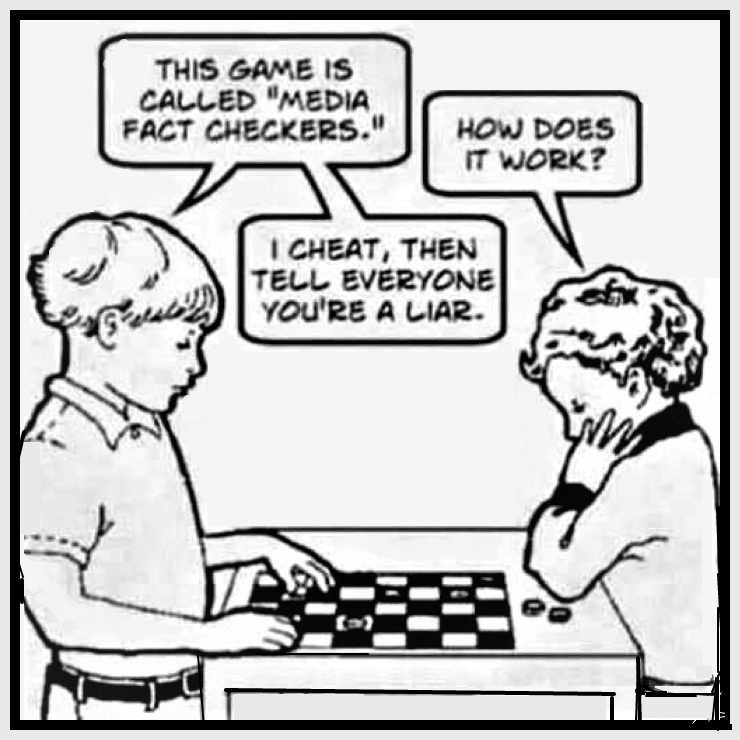
Let’s play a game…
 Hellbound and Down
You must be logged in to post a comment.