Phrenology fun…


With legal recreational and medical cannabis now available in so many different US states, it is easy to get the impression that the war on cannabis users is over.
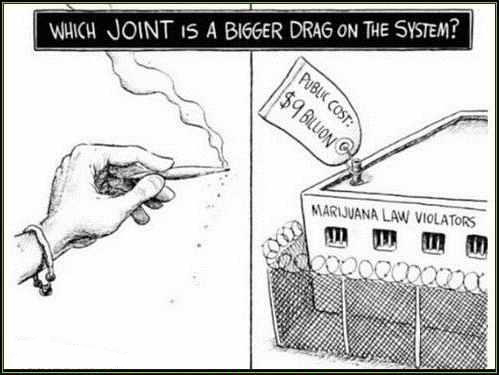
However, cannabis users still represent a significant portion of the people who are filling jails and courthouses throughout the country.
According to the FBI’s recent Uniform Crime Report, more people were arrested for cannabis possession last year than for all violent crimes put together.
The data showed that 545,602 people were arrested in the US for cannabis-related crimes last year. Meanwhile, just 495,871 people were arrested for violent crimes.
Nebraska’s Supreme Court just ruled that a previously approved measure to legalize medical marijuana is “unconstitutional” and therefore cannot appear on the state’s election ballot in November. This is, of course, anti-democratic and infuriating, but let’s take a look at how this happened.
First off, Nebraska Gov. Pete Ricketts is an idiot. Just last week he declared, “There is no such thing as medical marijuana.” Ricketts proclaimed this falsehood as the leader of a state where 77 percent of residents support legalizing cannabis for medicinal purposes.
Now on to the nitty gritty. Last July, the activist group Nebraskans for Medical Marijuana (NMM) collected more than enough signatures to qualify a medical weed bill to be included on the November election ballot.
Then, on August 28 the Secretary of State made it official: Nebraskans could decide for themselves whether or not to legalize medical marijuana by voting on Nebraska Medical Cannabis Constitutional Amendment (NMCCA).
Three days later, however, Sheriff Terry Wagner filed a lawsuit to block the measure, claiming it overstepped constitutional boundaries by covering too many topics for a single initiative. A state court initially tossed out the challenge. Yesterday, however, Sheriff “No-Pot” won.
The Nebraska Supreme Court declared that it agreed with Sheriff Wagner — a man who puts people in jail for possessing and using cannabis. With only two justices dissenting, the Supremes formally removed the proposal from the ballot.

A planned House vote on a bill to decriminalize the possession of marijuana was canceled on Thursday under pressure from law enforcement lobbyists and other pro-prohibition special interests.
The expected floor vote on the Marijuana Opportunity Reinvestment and Expungement (MORE) Act would have been the biggest accomplishment yet for cannabis reformers, but the effort has been postponed until after Election Day, Politico reports. Democrats have gotten weak-kneed about a bill that they once saw as a major criminal justice reform.
Indeed, it would have been. The MORE Act, sponsored by Rep. Jerry Nadler (D–N.Y.), would remove cannabis from the schedules of the Controlled Substances Act and make that change retroactive, effectively expunging any federal marijuana offenses and convictions. The bill also orders federal courts to lift all sentences for people currently locked up due to a marijuana conviction.
As Reason‘s Jacob Sullum explained when the bill was introduced last year, the MORE Act was in many ways superior to other marijuana legislation, because it “completely deschedules marijuana rather than moving it to a lower schedule or making exceptions to the ban for state-legal conduct, and it seeks to lift the burdens that prohibition has imposed on people caught growing, distributing, or possessing cannabis, a vital project that too often has been treated as an afterthought.”
This year, the bill had collected more than 100 co-sponsorships in the House—it even had support from three Republicans—and appeared on track to pass the lower chamber. Even though the bill was expected to die in the Senate, that House vote would have been historic.
Unfortunately, cop lobbyists seem to have convinced House Democratic leaders that it would also be a liability. A coalition of law enforcement special interests and other proponents of the drug war sent a letter to congressional leaders last week warning about the potential dangers associated with legalizing and “commercializing” marijuana.
That, combined with vague fears about how Republicans might weaponize the legalization vote for negative ads in swing districts, was apparently enough to convince Democrats to scuttle the vote.
A stop for an alleged traffic violation turned into a nightmare for a 74-year-old grandmother when the police officer conducting the stop claimed to have smelled a plant. Because the police state claims the authority to violate innocent grandmothers over plant smells, the officers involved will face no punishment and now the taxpayers will be held liable instead.
Phyllis Tucker, 74, is now suing the city of Jamestown and Fentress County, claiming the city police and county sheriff departments have illegal policies involving the use of strip searches, according to News Channel 5.
Tucker tells reporters that the incident which unfolded earlier this year has left her and her family traumatized, and rightfully so. According to the lawsuit, Tucker was forced to pull down her pants and remove her bra in the parking lot of a fast food restaurant as bystanders watched.
“If it wasn’t for my mother, I would never go back to Jamestown, never, and I wouldn’t advise anybody else to go through there either,” Tucker said.
Tucker was visiting her mother that night. She had her grandson, his girlfriend, and an infant in her car when a cop pulled them over and claimed to smell weed on her grandson’s girlfriend, Kira Smith, 19.
Instead of simply letting this family go, who had harmed absolutely no one, the cop escalated the situation to what amounts to a public roadside sexual assault — all to search for a plant.
According to the lawsuit, officers from the Jamestown police and the Fentress County Sheriff’s Department strip searched the two women in public view. According to the suit, Smith was ordered to “pull her pants down to her knees” and Tucker was told to remove “her blouse and bra” “exposing her breasts to the public.”
“I just started crying and was humiliated. I didn’t know if there was somebody who was going on the street that was seeing me with my top off,” Tucker said.
The lawsuit states the forcing both men and women to strip on the side of the road is a common practice by law enforcement in Frentress County.
“It is the custom of Frentress County to conduct these type of strip searches,” said attorney Wesley Clark who represents Tucker and Smith.
News Channel 5 reports that Clark also represents two other women who say there were pulled over in Fentress County in July, “stripped completely nude and searched” including being told to “squat” and “cough” while flashlights inspected their “genital areas,” according to the lawsuit.
In that case officers found no drugs and the women left with a ticket for an “improper tag.”
“To argue that it’s appropriate to strip women naked on the side of a public highway in search of marijuana is completely insane,” Clark said.
We agree. Nevertheless, it continues to happen all across the country in spite of marijuana being legal in some form in over half the states.
You must be logged in to post a comment.