New York cannabis farms have nowhere to sell a combined 300,000 pounds of weed, valued at $750 million, as delays continue for dispensaries in the state

Hundreds of thousands of pounds of marijuana are currently sitting idly on New York cannabis farms without a single legal recreational dispensary in the state open and ready to sell the product.

An estimated 300,000 pounds of weed are becoming a growing concern for farmers who planted the crop in spring 2021 in hopes of cashing in on the drug’s legalization in New York state. The lot is valued at about $750 million based on the average wholesale value of $2,500 per pound, according to Bloomberg.

Today, the legal recreational cannabis market is stalled as applicants for the first 150 individual retail licenses and 25 nonprofit licenses are still waiting to hear back from the Office of Cannabis Management, per Bloomberg.

Although players in the industry are waiting for the green light from the state, Melany Dobson — CEO of New York-based Hudson Cannabis — told Bloomberg it’s not the only thing holding her and others back.

“It’s an unclear path to market,” Dobson said. “We’ve been told again and again that dispensaries will open before the end of the year. I’ve acted as though that’s our single source of proof, so we’re prepared for that.”

The clock is ticking for the freshly harvested pounds of pot as farmers work to extend its shelf life in preparation for the still-to-come legal dispensaries.

“Old cannabis starts to have a brownish glow,” Dobson said. 

She continued: “We’re trying to retain as much quality as possible. And rushing it into the finished product bags is not the way to do that.”

Keep reading

Cannabis found in ancient Israeli temple called ‘revolutionary’ discovery

Holy smokes!

Archaeologists have discovered cannabis residue on artifacts in a temple in southern Israel, marking the first known use of hallucinogenic drugs in the Jewish religion, reports the Associated Press.

The study, which was published Friday in the Tel Aviv: Journal of the Institute of Archaeology of Tel Aviv University, notes that the “revolutionary” findings from an eighth-century BC shrine at Tel Arad suggest “the use of mind-altering substances as part of cultic rituals in Judah.”

“Here, the official state religion of the kingdom of Judah was using this substance,” study author Eran Arie said of the psychotropic samples, which were found on two limestone altars. The synagogue was first unearthed in the 1960s at the Tel Arad excavation site near Jerusalem, however, archaeologists hadn’t identified the ancient marijuana until now.

Chemical analysis also revealed that the hashish was likely burned atop dried animal droppings.

However, it’s unlikely that the ancient Hebrews were smoking pot to get stoned. Yossi Garfinkel, an archaeology professor from Hebrew University, postulated that they took various mind-altering substances, including opium and wine “to get into ecstasy and connect with God.”

The marijuana milestone marks the “first time we see psychoactive substances in Judahite religion,” according to Arie, who hopes the discovery will shed more light on how ancient Israelites conducted worship.

Keep reading

‘Squad’ Members Urge Biden to Extend Marijuana Pardons to Illegal Aliens, Allow Deported People to Come Back

Reps. Alexandria Ocasio-Cortez, Ilhan Omar, and Jesús G. “Chuy” García have sent a letter to President Joe Biden asking him to include illegal aliens in his marijuana pardons.

The far-left lawmakers also called on Biden to “prioritize decriminalizing and rescheduling marijuana and reopening the immigration cases of those who were deported for marijuana-related offenses.”

“We write to commend you on your administration’s decision to pardon thousands of people convicted of marijuana possession under federal law and to review how marijuana is classified in the United States,” the letter began. “The decision is an essential step for our country’s promise of justice for all. Therefore, it is of utmost importance that the Administration pardon all simple marijuana possession offenses – regardless of immigration status.”

The lawmakers continued, “Using the power of the pardon is a constitutional imperative and a critical tool in rectifying the compounding racial injustices of draconian drug policies.”

Keep reading

Washington Has Been Much More Successful Than California in Displacing the Black Market for Pot

new report indicates that Washington, which legalized recreational marijuana in 2012, has been much more successful at displacing the black market than California, where voters approved legalization in 2016. In a 2021 survey by the International Cannabis Policy Study (ICPS), 77 percent of Washington cannabis consumers reported buying “any type of marijuana” from a “store, co-operative, or dispensary” in the previous year, while 17 percent said they had obtained pot from a “dealer.”

The share of Washington consumers who report buying marijuana from a “store, co-operative, or dispensary” is higher than the average for states that have legalized recreational use, which was 57 percent in 2021, according to a nationwide ICPS survey. Washington’s Liquor and Cannabis Board (LCB) paid for the ICPS report on cannabis consumption in that state, and the ICPS has not published California-specific survey data. But calculations based on estimated total consumption and legal sales suggest that the black market accounts for somewhere between two-thirds and three-quarters of marijuana purchased in California.

California’s striking failure to shift consumers from illegal to legal dealers is largely due to a combination of high taxes, onerous regulations, and local retailing bans. While Washington has a relatively high retail marijuana tax (37 percent, plus standard sales taxes), in other respects the state has made it easier for licensed suppliers to compete with illegal sources.

2022 study from Reason Foundation (which publishes Reason) notes that local restrictions in California have created “massive cannabis deserts” where “consumers have no access to a legal retailer within a reasonable distance of their home.” Washington has more than three times as many legal dispensaries per capita as California.

Keep reading

Biden’s Marijuana Pardons Did Not Free a Single Federal Prisoner or Deliver the Expungement He Promised

Edwin Rubis has served more than two decades of a 40-year federal prison sentence for participating in a marijuana distribution operation. Taking into account “good time” credit, he is not scheduled to be released until August 2032.

Rubis is one of about 3,000 federal prisoners whose cannabis-related sentences were unaffected by President Joe Biden’s mass pardon for low-level marijuana offenders. A protest at the White House today called attention to their predicament.

Biden’s October 6 proclamation applied only to U.S. citizens or legal permanent residents convicted of simple marijuana possession under the Controlled Substances Act or the District of Columbia Code, none of whom was still incarcerated. Although his pardons could benefit as many as 10,000 or so individuals, that represents a tiny percentage of all simple possession cases, which typically are charged under state law. And Biden’s action will not release a single federal prisoner.

According to a 2021 report from Recidiviz, “more than 3,000 individuals are
currently serving marijuana-related sentences in federal prison.” The report estimated that ending federal marijuana prohibition—a step that Biden has steadfastly resisted—would reduce the federal prison population by more than 2,800 over five years.

“Your recent executive order, while a great first step, did nothing to address the thousands of federal cannabis prisoners currently incarcerated in federal prison,” 16 drug policy reform groups noted in an October 10 letter to Biden. “While your recent executive order will help many, it will not release a single one of the nearly 2,800 federal cannabis prisoners.” Although “eighteen states and the District of Columbia have legalized cannabis,” the letter said, “there are thousands of Americans who are serving long-term prison sentences, including some life sentences, in federal facilities for conduct involving amounts of cannabis that are far less than what dispensaries routinely handle on a daily basis.”

The moral logic of Biden’s distinction between simple possession and other marijuana offenses is puzzling. He says marijuana use should not be treated as a crime. Yet he is willing to let individuals like Rubis languish in prison merely for helping people use marijuana, which today is recognized as a legitimate business in most states, 19 of which allow recreational as well as medical use.

Keep reading

Federal Bureaucrats Say We Can’t Reschedule Marijuana Because of How It’s Scheduled

Last week, President Joe Biden announced that he would pardon all Americans federally convicted of simple possession of marijuana. The announcement was a welcome, though limited, shift in the U.S. government’s seemingly unending war on drugs. Biden additionally called on governors to follow suit in their respective states and grant clemency to the vast majority of offenders convicted under state laws. He also encouraged Attorney General Merrick Garland and Secretary of Health and Human Services (HHS) Xavier Becerra to review marijuana’s classification under federal law.

But that shift may be easier said than done thanks to the age-old problem of federal bureaucracy.

Currently, marijuana is classified as a Schedule I substance, indicating “a high potential for abuse, no currently accepted medical use in treatment in the United States, and a lack of accepted safety for use under medical supervision.” In his announcement last week, the president noted that this puts it in the same category as heroin and a more restrictive category than fentanyl.

In 2015, the last time the government assessed marijuana’s classification, the Food and Drug Administration (FDA) and HHS recommended keeping it at Schedule I. The assessment included, among other factors, “the scientific literature on whether marijuana has a currently accepted medical use”—a tall order since Schedule I status makes it much more difficult to study in the first place.

The Washington Post reported today that “such an evaluation—the first initiated by a U.S. president—is made all the more difficult due to tight restrictions on research into marijuana.” Nora Volkow, director of the National Institute on Drug Abuse, a research institute within the National Institutes of Health, told the paper, “It’s something that we constantly communicate: We really need to figure out a way of doing research with these substances.”

In other words, as Scott Lincicome of the Cato Institute tweeted, the government “can’t research whether marijuana should remain a ‘Schedule I’ substance bc of govt restrictions on… researching Schedule I substances.”

Keep reading

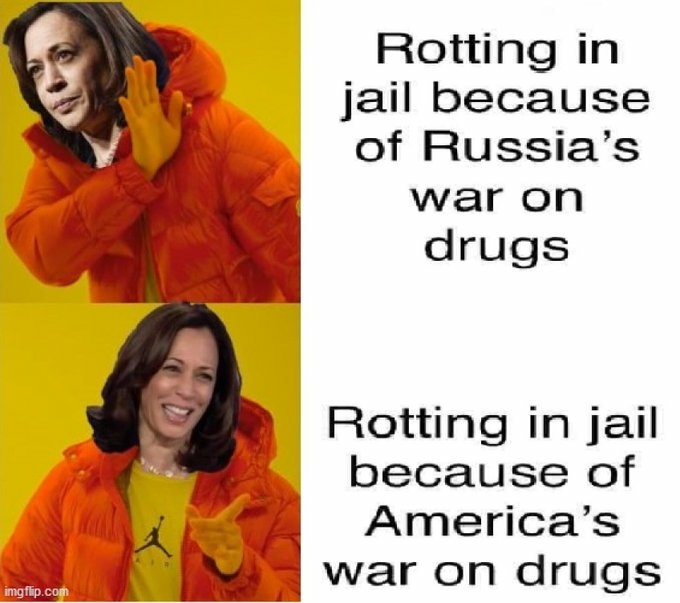
Kamala Harris Dragged For Saying No One Should Go To Jail For Smoking Weed

Critics ripped into Vice President Kamala Harris over the weekend as video circulated of her claiming that no one should go to jail simply for smoking marijuana.

Harris’ remarks came on the heels of President Joe Biden’s Thursday pronouncement declaring mass pardons for thousands who have past federal convictions on drug charges — and flew in the face of her record as a prosecutor in California.

“And speaking of the system of justice,” Harris began. “We are also changing — y’all might have heard that this week — the federal government’s approach to marijuana.”

As the crowd cheered, Harris continued, “Because the bottom line there is nobody should have to go to jail for smoking weed.”

San Francisco Republican Party Chairman John Dennis — who is challenging House Speaker Nancy Pelosi for her seat in Congress — called out the vice president in a tweet, saying, “Shameless. As California Attorney General Harris sent people to jail for …smoking weed.”

“The hypocrisy is staggering,” actor Matthew Marsden added.

U.S. Senate Candidate Mark Meuser (R-CA) pointed out: “Clearly, Kamala has forgotten her legacy in California.”

“REMINDER: Kamala Harris has sent at least 1,560 people to prison for marijuana-related offenses,” Steve Guest, special communications advisor to Senator Ted Cruz (R-TX) said.

Keep reading