Memory holin’…

A US District Judge in San Jose, California says she was “disturbed” over Google’s data collection practices, after learning that the company still collects and uses data from users in its Chrome browser’s so-called ‘incognito’ mode – and has demanded an explanation “about what exactly Google does,” according to Bloomberg.
In a class-action lawsuit that describes the company’s private browsing claims as a “ruse” – and “seeks $5,000 in damages for each of the millions of people whose privacy has been compromised since June of 2016,” US District Judge Lucy Koh said she finds it “unusual” that the company would make the “extra effort” to gather user data if it doesn’t actually use the information for targeted advertising or to build user profiles.

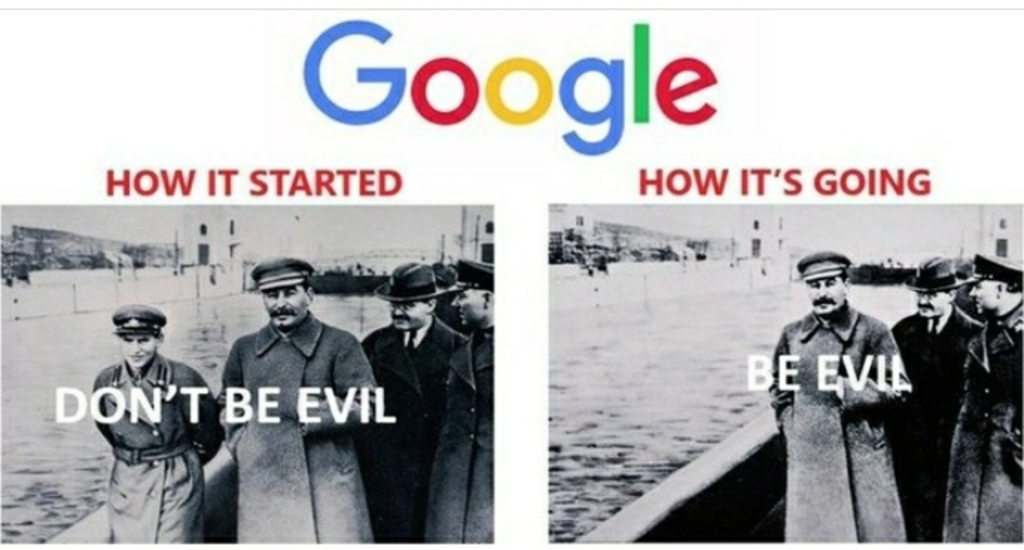
The United States Senate’s Homeland Security and Governmental Affairs saw two videos vaporized in Stalinist fashion because Youtube’s censor didn’t see them as fit for public consumption.
The Wall Street Journal reported on the disturbing, Chinese-level act of censorship, which is raising alarms about where this is all heading:
Google’s YouTube has ratcheted up censorship to a new level by removing two videos from a U.S. Senate committee. They were from a Dec. 8 Committee on Homeland Security and Governmental Affairs hearing on early treatment of Covid-19. One was a 30-minute summary; the other was the opening statement of critical-care specialist Pierre Kory.
It is interesting that one of the committee hearings relates directly to cheap drugs that might be used to treat COVID-19.
“At the December hearing, he presented evidence regarding the use of ivermectin, a cheap and widely available drug that treats tropical diseases caused by parasites, for prevention and early treatment of Covid-19,’ the Journal reported. “He described a just-published study from Argentina in which about 800 health-care workers received ivermectin and 400 didn’t. Not one of the 800 contracted Covid-19; 58% of the 400 did.”
Big Tech now seems fully committed to preventing transparency on public policy issues, even to the extent that it would ban videos from the U.S. Senate. That level of brazenness suggests that the corporations feel like they are untouchable. And beyond some lip service to holding these companies responsible, the U.S. government has thus far done nothing to challenge that assessment.
Google has quietly escalated censorship of its market-dominating search engine, adding a range of new topics where human moderators are allowed to manually penalize websites, suppressing them in search results.
If a website is affected by one of these manual acts of censorship, “some or all of that site will not be shown in Google search results,” according to the tech giant.
The list, published in full on Google’s support website, includes the following:
Publishers who have been hit with a manual action by Google will be able to appeal the decision by “fixing” whatever issue violated the policy and then submitting their website to Google for a review. Google states that it could take “several days or a week” for the tech giant to reach a final decision, leaving
Once upon a time, Google attempted to conceal its censorship of search. Alphabet CEO Sundar Pichai insisted, under oath before congress, that the company does not “manually intervene on any particular search result,” a statement that one of Google’s own former employees said was a lie.


A new lawsuit against Google filed on Thursday of last week raises interesting questions about whether or not the tech giant is “stealing Android users’ cellular data allowances though unapproved, undisclosed transmissions to the web giant’s servers”.
The suit, filed in US federal district court in San Jose by 4 plaintiffs aims to be certified as a class action. It alleges that Google is using Android users’ limited cellular data allowances to transmit information about the users unrelated to the use of Google services. The case surrounds “data sent to Google’s servers that isn’t the result of deliberate interaction with a mobile device”, according to The Register.
In other words, data transfers happening in the background, when the phone isn’t in use. The suit alleges that none of the four agreements accepted to participate in the Google ecosystem say anything about cell data transfers taking place in the background.
The suit states: “Google designed and implemented its Android operating system and apps to extract and transmit large volumes of information between Plaintiffs’ cellular devices and Google using Plaintiffs’ cellular data allowances.”
It continues: “Google’s misappropriation of Plaintiffs’ cellular data allowances through passive transfers occurs in the background, does not result from Plaintiffs’ direct engagement with Google’s apps and properties on their devices, and happens without Plaintiffs’ consent.”

There are few things as revealing as a person’s search history, and police typically need a warrant on a known suspect to demand that sensitive information. But a recently unsealed court document found that investigators can request such data in reverse order by asking Google to disclose everyone who searched a keyword rather than for information on a known suspect.
In August, police arrested Michael Williams, an associate of singer and accused sex offender R. Kelly, for allegedly setting fire to a witness’ car in Florida. Investigators linked Williams to the arson, as well as witness tampering, after sending a search warrant to Google that requested information on “users who had searched the address of the residence close in time to the arson.”
 Hellbound and Down
You must be logged in to post a comment.