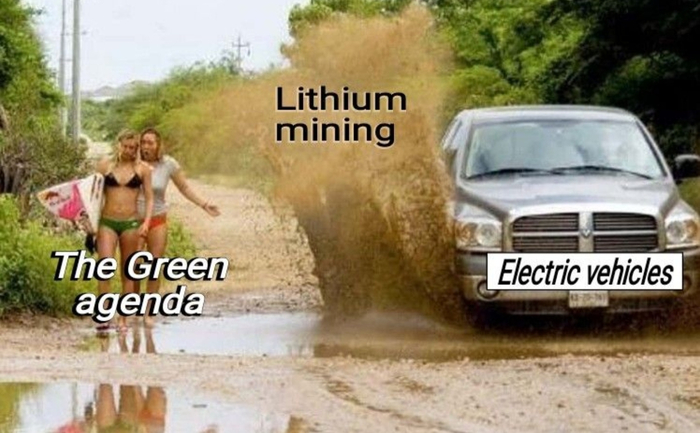
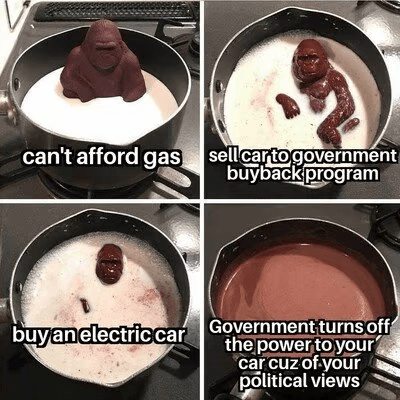
Biden demanding remote kill switch for your new car

The federal gov’t and silicon valley are looking to clamp down on your freedom of movement. Your ability to move about as you please does not fit with their goals for the future of our world. Automotive-related freedoms, including access to fuel, allow us to be free to move without the permission of silicon valley and the federal government. Automotive freedoms are not only hobby related; they are essential to preventing yet another step along the road to serfdom at the hands of woke corporations and federal bureaucrats.

Biden recently signed into law a requirement that all vehicles produced after 2026 be fitted with a remote kill switch. Electric vehicles are already equipped with this capability via internet-connected “superchargers.” These corporations can sell you a product for tens or even hundreds of thousands of dollars, then prevent you from using them. Worse yet, if the law is not challenged or repealed, these kill switches will have a “back door” that allows government agencies to shut your vehicle off remotely as well.

Keep reading

Washington State Is BANNING Non-Electric Cars by 2030

As 1984 gains a firmer grasp on the modern world, one recent bill has caused it to spread its reach even further: a bill inserted within Washington state’s $16.9 billion “Move Aside Ahead Washington” package. This new piece of paper, signed by Washington governor Jay Inslee on March 25, now makes it so that police will enforce all vehicles sold, purchased, or registered within the state to be electric vehicles by 2030.

Sec. 415. (1) A target is established for the state that all publicly owned and privately owned passenger and light-duty vehicles of model year 2030 or later that are sold, purchased, or registered in Washington state be electric vehicles.

(2) On or before December 31, 2023, the interagency electric vehicle coordinating council created in section 428 of this act shall complete a scoping plan for achieving the 2030 target.

According to Inslee, this bill will “create more efficient transportation options,” as he says that “Transportation is our state’s largest source of greenhouse gas emissions. There is no way to talk about climate change without talking about transportation.”

Inslee went on to add, “This package will move us away from the transportation system our grandparents imagined and towards the transportation system our grandchildren dream of.”

Keep reading

Legislation mandates residential buildings accommodate EV charging

Ameasure to require newly built residential buildings in Illinois to be electric vehicle capable is being criticized by some as government overreach.

House Bill 3125 passed the Illinois House on Thursday and would require home builders to make new and renovated structures meet certain wiring requirements to be able to charge electric vehicles.

Under the measure from state Rep. Robyn Gabel (D-Evanston), a certain number of spaces would also have to be “electric vehicle ready,” meaning they contain receptacles with the necessary voltage to install an EV charging station.

“We should be doing everything we can to cultivate an electric vehicle economy in this state, and this is one more way we can do that,” said state Rep. Mike Zalewski (D-Riverside).

State Rep. Tim Butler (R-Springfield) who notes that the Illinois Home Builders Association and Illinois Realtors are opposed to the legislation, believes the measure will drive up housing costs.

Keep reading

An Inconvenient Truth: EVs May Offer A “Negligible” CO2 Difference From ICE Vehicles

Are the carbon footprints of EVs really as drastically lower than that of internal combustion engine vehicles? When considering the amount of carbon and CO2 created from assembling lithium ion batteries, one firm thinks the difference could be “negligible”.

Such was the topic of a new blog post by natural resource investors Goehring & Rozencwajg (G&R), a “fundamental research firm focused exclusively on contrarian natural resource investments with a team with over 30 years of dedicated resource experience.”

The firm, established in 2015, posted a blog entry entitled “Exploring Lithium-ion Electric Vehicles’ Carbon Footprint” this week, where they call into question a former ICE vs. EV comparison performed by the Wall Street Journal and, while citing work performed by Jefferies, argue that there could literally be “no reduction in CO2 output” in some EV vs. ICE comparisons. 

Their analysis “details the tremendous amount of energy (and by extension CO2) needed to manufacture a lithium-ion battery.” Because a typical EV is on average 50% heavier than a similar internal combustion engine, the analysis notes that the “embedded carbon” in an EV (i.e., when it rolls off the lot) is therefore 20–50% more than an internal combustion engine.

Keep reading

BIDEN ENERGY SECRETARY LAUGHS AND SAYS ‘IF YOU DRIVE AN ELECTRIC VEHICLE, THIS WOULD NOT BE AFFECTING YOU’ AFTER REPORTER ASKS HOW THE GAS SHORTAGES WILL SPEED UP THE EFFORTS TO MOVE IN A ‘MORE RENEWABLE DIRECTION’

President Joe Biden’s Energy Secretary Jennifer Granholm appeared today at the White House’s daily press briefing to address the current gas shortages that are gripping parts of the nation.

In a clip that was shared by Newsbusters’ Curtis Houck, Granholm is asked how the shortages “will speed up the efforts… to move in a more renewable direction?”

“Yeah I mean, we are obviously all in on making sure that we meet the president’s goals of getting to 100% clean electricity by 2035 and net zero carbon emissions by 2050,” Granholm responded with a smile.

Granholm then flippantly added, with a laugh, “If you drive an electric car, this would not be affecting you, clearly.”

Houck said of the exchange, “Absolutely ghoulish. Never let a crisis go to waste!”

Keep reading

How Biden’s climate plan could limit you to eat just one burger a MONTH, cost $3.5K a year per person in taxes, force you to spend $55K on an electric car and ‘crush’ American jobs

President Joe Biden‘s ambitious plan to slash greenhouse emissions by 50 to 52 percent over the next decade could prompt sweeping changes that could affect how Americans eat, drive and heat their homes. 

Biden announced the goal to cut emissions by 2030, compared with 2005 levels, at the start of a two-day climate summit on Thursday. 

He vowed the plan, which would set the US on a path of a zero emissions economy by no later than 2050, would create jobs and boost economies. 

But he is yet to release any firm details on exactly how such a plan will affect the daily lives of ordinary Americans. 

He also hasn’t set out the price for reducing emissions.  

The plan immediately sparked criticism from Republicans and industry experts who argue it isn’t sustainable in the long run, will put jobs at risk and cause tax hikes for Americans.   

While Biden hasn’t released details on what life could look like for Americans, experts and recent studies have laid out what would need to change by 2030 to reach the goal. 

Keep reading

Biden Promoting Company Tied to Energy Secretary Jennifer Granholm

In the course of selling his infrastructure bill, Joe Biden has been promoting an electric battery company called Proterra. He has failed to mention that his energy secretary Jennifer Granholm is a major stakeholder in the company.

This is just the sort of crony-capitalism that Democrats and the media accused Trump of regularly.

Matthew Foldi reports at the Washington Free Beacon:

Biden to Showcase Business Tied to Energy Sec Granholm

Energy Secretary Jennifer Granholm owns up to $5 million in the electric battery and vehicle manufacturer President Joe Biden will promote on Tuesday as part of his push for a $1.9 trillion infrastructure bill.

Biden’s virtual visit to the electric battery producer Proterra comes days after Vice President Kamala Harris paid a visit to Thomas Built Buses, a North Carolina-based school bus company that counts Proterra as its main supplier of electric vehicles. The back-to-back White House visits to Granholm-connected companies risk at least the appearance of impropriety and demonstrate how lawmakers can use policy initiatives to pad their own wallets. Biden’s infrastructure package includes a $174 billion investment in the electric vehicle market, calls for the replacement of “50,000 diesel transit vehicles” in favor of electric alternatives, and creates a Clean Buses for Kids program that will “electrify at least 20 percent of our yellow school bus fleet.”

Granholm has taken a leading role in the administration’s forthcoming infrastructure package. The president in February tasked her with “identifying risks in the supply chain for high-capacity batteries, including electric-vehicle batteries, and policy recommendations to address these risks.”

Keep reading