Before Hormuz, There Was Suez: What Trump Can Learn From Eisenhower

Oman and Iran appear close to a temporary arrangement to reopen the Strait of Hormuz, potentially providing both an exit from the current round of fighting and the foundation for a more durable maritime order. Washington should welcome such an agreement – even if it acknowledges a degree of Iranian authority in administering traffic through the strait – because US interest dictates that open and non-discriminatory passage must be given priority over control.

The emerging formula would reportedly divide responsibility for the shipping lanes. Vessels entering the Persian Gulf would travel through waters administered by Iran, while outbound traffic would pass through an Omani-administered route. Iran would be notified of departing vessels and, while this has not yet been discussed, Tehran appears open to also ensuring that Oman would be notified of incoming traffic. Tehran and Muscat may collect and share fees for specified security and environmental services, although this sensitive issue has not yet been settled. The negotiations remain fluid, and any agreement is reportedly linked to the lifting of the American blockade on Iranian ports.

The arrangement would represent a slight climbdown by Tehran. Iran’s earlier position would have required traffic in both directions to pass through some portion of Iranian waters as well as Omani waters. That would have brought even ships already inside the Persian Gulf under an Iranian-administered transit system. The emerging division of lanes would give Oman primary responsibility for outbound shipping and limit the universe of vessels requiring Iranian approval or coordination.

If successful – and if Washington accepts it – the agreement could help end the present fighting. It remains unclear whether that would restore the previous American-Iranian memorandum of understanding or require a new framework. Nor does it in and of itself move the needle on two other major stumbling blocks: Iran’s demand for a regional ceasefire and Washington’s demands on Iran’s nuclear activities.

The Trump administration will likely receive strong pushback from hawkish elements in Washington and Israel who will complain over the arrangement’s de facto acceptance and legitimization of Iran (and Oman’s) management of the Strait.

But this critique is borne out of a confusion of what the US’s actual core interest in the Strait is: The free and predictable flow of commerce or preventing the ability of a hostile power to assert control.

The Trump administration has increasingly framed the objective as preventing Iran from “controlling” the strait. Yet the central American interest in strategic waterways has historically been less about who administers them than about whether ships can pass through them freely, predictably and without discrimination. Preventing a hostile state from acquiring coercive leverage has generally been a means of preserving passage, not an end that supersedes passage itself.

That hierarchy of interests matters. If reopening the strait requires acknowledging that Iran possesses some capacity to regulate traffic in waters along its coast, Washington should not reject an agreement merely because it fails to preserve the appearance of unqualified American dominance.

The Suez crisis provides the clearest example. In 1956, Egypt’s president, Gamal Abdel Nasser, nationalized the Suez Canal Company, displacing the British- and French-controlled corporation that had operated one of the world’s most important commercial arteries. Britain and France regarded nationalization not merely as an economic injury but as a strategic humiliation and, together with Israel, invaded Egypt.

President Dwight Eisenhower refused to support them. After rejecting the Anglo-French invasion, Eisenhower’s administration did not make restoration of British or international ownership a condition for accepting Egypt’s continued administration of the canal. Instead, Washington opposed the invasion and pressed for a diplomatic arrangement that would preserve international access. The applicable legal regime emphasized the canal’s free use by ships of all countries on equal terms, while leaving Egypt responsible for administering and defending the waterway.

Egyptian control was not the same as unrestricted Egyptian discretion. The distinction was crucial. Washington could accept Egyptian sovereignty over the canal while insisting that sovereignty be exercised within rules guaranteeing nondiscriminatory passage. The overriding American interest was not which flag flew over the canal authority, but whether the canal remained open under internationally accepted rules.


Keep reading

Eisenhower’s Dirty WWII Secret

A vast field is filled as far as the eye can see with miserable and gaunt men in remnants of military uniform. It’s May 1945 and the war in Europe has ended. By rights, these surrendered soldiers will be allowed to return to their families, but many will not leave this muddy ground alive. There is no food, no shelter, and no medicine. The Rheinwiesenlager (Rhine meadow camps) were the killing fields of one of the worst war crimes in modern history, committed by General Dwight Eisenhower and the US Army.

The cull of German troops was a closely-guarded secret until four decades after the war, when a Canadian researcher was writing a book on a French resistance hero. James Bacque found that his subject, Raou Laporterie, had been saved by a German soldier, Hans Goertz. In gratitude, in 1946, Laporterie got Goertz out of a French prison camp to work in his chain of drapery stores. Goertz told of mass deaths of inmates through lack of sustenance.

After pursuing leads in the French records, Bacque came to realise that Allied military leaders had ‘committed an appalling crime against humanity’. His investigation culminated in Bacque’s harrowing book Other Losses: The Shocking Truth Behind the Mass Deaths Of Disarmed German Soldiers And Civilians Under General Eisenhower’s Command (1989). The foreword to this expose was written by Ernest Fisher, a retired colonel of the US Army, and war historian noted for his book Cassino to the Alps. Fisher set the scene: –

‘Over most of the western front in April 1945, the thunder of artillery had been replaced by the shuffling of millions of pairs of boots as columns of disarmed German soldiers marched wearily towards Allied barbed wire enclosures. Scattered enemy detachments fired a few volleys before fading into the countryside and eventual capture by Allied soldiers.’

As Fisher explained, German soldiers did everything they could to evade capture by the Russians, who raped and pillaged as they advanced over eastern Germany:

‘The mass surrenders in the west contrasted markedly with the final weeks on the eastern front where surviving Wehrmacht units still fought the advancing Red Army to enable as many of their comrades as possible to evade capture by the Russians. This was the final strategy of the German High Command then under Grand Admiral Doenitz who had been designated Commander-in-Chief by Adolf Hitler.’

But crossing to the Allied side was not the sanctuary that the defeated Germans expected, due to the visceral hatred of Eisenhower. The supreme military commander, of Swedish-Jewish background, had wriiten in a letter to his wife ‘God, I hate the Germans’. In September 1944, in the presence of the British ambassador to Washington, Eisenhower proposed that the entire German general staff, all officers of the Gestapo and all leaders of the Nazi party from mayor upwards should be exterminated (around a hundred thousand men).

Fisher had met Bacque in Washington in 1987 where they uncovered evidence, deeply buried in national archives, of a systematic slaughter. ‘More than five million German soldiers in the American and French zones were crowded into barbed wire cages, many of them literally shoulder to shoulder. The ground beneath them became a quagmire of filth and disease. Open to the weather, lacking even primitive sanitary facilities, underfed, the prisoners soon began dying of starvation.’

Shockingly, more German soldiers died in the camps from April 1945 onwards than died in combat.

Keep reading

Eisenhower warned the World of the “danger that Public Policy could become the captive of a Scientific-Technological Elite” in 1961; but we didn’t listen

President Dwight D. Eisenhower’s farewell address to the American people, delivered on the 17th of January 1961, has gone down in history as a truly thought-provoking speech culminating in a warning about the internal threats and dangers facing the country.

Written in eloquent language that would be hard to imagine coming forth from the lips of the current American president or his predecessor, it was apparently prepared by Eisenhower and his brother months in advance, rather than at the last moment, which is what many people had assumed.

And while pretty much everyone in the world has focused on his clear warning about the dangers of an excessive accumulation of power in the hands of the “military-industrial complex”, few have paid attention to—much less been guided by—the second warning he gave, one which is far more relevant today, given the current unmitigated disaster being unleashed upon humanity globally.

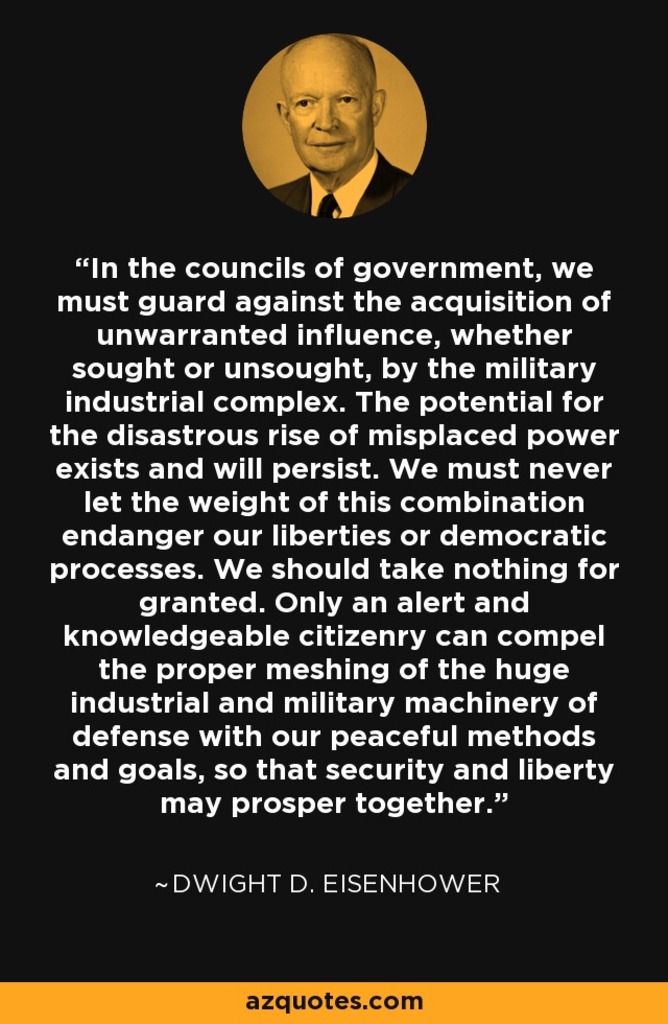
In the councils of government, we must guard against the acquisition of unwarranted influence, whether sought or unsought, by the military industrial complex. The potential for the disastrous rise of misplaced power exists and will persist.[i]

These are the words that have been quoted time and again to explain the JFK assassination, the inexorable rise of the arms lobby in Congress, the ever-increasing war-mongering that has characterised US foreign policy over the last half century, the trillions that have been spent on the military—both in the US and in client states abroad—and even the lost trillions that have disappeared into black budgets and the secret space programme. These explanations and conclusions are not altogether incorrect or misplaced.

In fact, they do help shed light on how American democracy became subverted, how and why the American people lost the ability to influence their future through elections, and how the American economy became bogged down and is now drowning in its own debt, since the US military-industrial complex has indeed been one of the main protagonists in all of these developments.

However, what we have seen over the last two and a half years—which is nothing less than a global coup d’état—suggests that Eisenhower’s warning, though completely correct and prescient, goes some way to explaining only the events of the decades following the assassination of John F. Kennedy and not the events of the last few years, such as the Covid-19 plandemic/scamdemic, the jabbing of billions of people across the world by a gene-editing bioweapon, the destruction of the West’s middle class, the relentless roll-out of digital tools and platforms to upend multiple aspects of daily living/human interaction, and the dramatic escalation in censorship and information manipulation to confuse and fool the populations of countries everywhere.

In all of these developments, the US military-industrial complex has not been the protagonist. Indeed, it too has been a victim — a victim of another group of conspirators which has surpassed it in terms of reach, effectiveness and evil intent. To understand the nature of this group, it is necessary to explore President Eisenhower’s speech further and spot the second dire warning he issued. Here it is:

… we must also be alert to the equal and opposite danger that public policy could itself become the captive of a scientific-technological elite.[ii]

Keep reading