Mosquitoes With Synthetic DNA Scheduled For California Release

In the mosquito breeding rooms of British biotech company Oxitec, scientists line up fresh eggs, each the size of a grain of salt. Using microscopic needles, the white-coated researchers inject each egg with a dab of a proprietary synthetic DNA.

For four days, Oxitec technicians care for the eggs, watching for those that hatch into wriggling brown larvae. Those “injection survivors,” as the company calls them, face a battery of tests to ensure their genetic modification is successful.

Soon, millions of these engineered mosquitoes could be set loose in California in an experiment recently approved by the federal government.

Oxitec, a private company, says its genetically modified bugs could help save half the world’s population from the invasive Aedes aegypti mosquito, which can spread diseases such as yellow fever, chikungunya and dengue to humans. Female offspring produced by these modified insects will die, according to Oxitec’s plan, causing the population to collapse.

“Precise. Environmentally sustainable. Non-toxic,” the company says on its website of its product trademarked as the “Friendly” mosquito.

Scientists independent from the company and critical of the proposal say not so fast. They say unleashing the experimental creatures into nature has risks that haven’t yet been fully studied, including possible harm to other species or unexpectedly making the local mosquito population harder to control.

Even scientists who see the potential of genetic engineering are uneasy about releasing the transgenic insects into neighborhoods because of how hard such trials are to control.

“There needs to be more transparency about why these experiments are being done,” said Natalie Kofler, a bioethicist at Harvard Medical Schoolwho has followed the company’s work. “How are we weighing the risks and benefits?”

Keep reading

More evidence Covid was tinkered with in a lab? Now scientists find virus contains tiny chunk of DNA that matches sequence patented by Moderna THREE YEARS before pandemic began

Fresh suspicion that Covid may have been tinkered with in a lab emerged today after scientists found genetic material owned by Moderna in the virus’s spike protein.

They identified a tiny snippet of code that is identical to part of a gene patented by the vaccine maker three years before the pandemic.   

It was discovered in SARS-CoV-2’s unique furin cleavage site, the part that makes it so good at infecting people and separates it from other coronaviruses.

The structure has been one of the focal points of debate about the virus’s origin, with some scientists claiming it could not have been acquired naturally.  

The international team of researchers suggest the virus may have mutated to have a furin cleavage site during experiments on human cells in a lab.

They claim there is a one-in-three-trillion chance Moderna’s sequence randomly appeared through natural evolution. 

But there is some debate about whether the match is as rare as the study claims, with other experts describing it as a ‘quirky’ coincidence rather than a ‘smoking gun’. 

Keep reading

CDC finally admits, casually, that covid nasal “testing” swabs were used to sequence people’s genomes for analysis

The nation’s top “public health” agency has casually admitted that Wuhan coronavirus (Covid-19) nasal swabs are being used to sequence people’s genomes, and not necessarily to test for covid.

According to the U.S. Centers for Disease Control and Prevention (CDC), many of the cotton swab sticks that are being jammed up people’s nasal cavities and processed with a fraudulent PCR test are later collected and used by “scientists” to conduct “research” on people’s gene profiles. (Related: These same nasal swabs also punctured some people’s brain membranes, causing them to leak spinal fluid.)

“Remember that COVID-19 nose swab test you took? What happened to the swab? If it was processed with a PCR test, there’s a 10 percent chance that it ended up in a lab for genomic sequencing analysis,” the CDC announced on Twitter.

Keep reading

China Creating ‘Humanized Pigs’ with Gene Editing Then Infecting Them with Coronavirus

China’s state-run Global Times newspaper celebrated on Thursday the alleged discovery of a scientific process to create a “humanized pig” more susceptible to severe Chinese coronavirus cases, which scientists could infect and use for research.

The propaganda outlet attributed the scientific achievement to the Institute of Microbiology of the Chinese Academy of Sciences (IMCAS). The CAS, a research institution, is the world’s largest organization of its kind and a formal arm of the Chinese government. The Times published an illustrative figure on the development of “humanized” pigs that appears to have first surfaced in a study published in August that promoted the use of genetically modified pigs for Chinese coronavirus research based on how rapidly scientists could generate them and their heightened similarities with the human body.

The August study – published in Cell Discovery, a journal sponsored by the CAS, revealed that Chinese scientists had attempted to use CRISPR gene-editing technology to remove the genetic protective shields that make Chinese coronavirus not a significant threat to most pigs. CRISPR technology became the source of global controversy in 2018 after a Chinese scientist, He Jiankui, claimed to have used the method to genetically modify unborn baby twins to make them immune to HIV. The Communist Party sentenced He to three years in prison for conducting the human experiment without the full approval of the Party.

Keep reading

Government-approved Covid testing firm faces watchdog probe over plans to sell swabs with customers’ DNA for medical research

Covid-19 testing firm is under investigation after it said it planned sell DNA samples from customers to third parties for research.

The Information Commissioner’s Office (ICO), the UK’s data privacy watchdog, said it would ‘look carefully’ at information gathered about Cignpost Diagnostics over its plans to sell customers’ swabs.

The company, which was among the Covid test providers approved by the Government this year, had spoken of its plans to sell the sensitive medical data in order to ‘learn more about human health’. 

But those booking Covid tests with the firm, which trades as ExpressTest, were not clearly told their swabs could be sold to ‘collaborators’ working with the company or independently, including universities and private companies, for medical research.

They were instead asked to agree to a privacy policy which linked to another document outlining the firm’s ‘research programme’.  

It is not yet clear how many swabs Cignpost Diagnostics, which is reported to have delivered up to three million tests since it was founded in June, have kept or if any have been sold for research purposes.

Keep reading

23andMe collected people’s DNA under the guise of one purpose but will monetize it for another

Cynics will say that nothing says “trusted neighborhood doctor” quite like a company that is a cross between Big Pharma and Big Tech – but apparently Anne Wojcicki’s 23andMe wants to be perceived as having the characteristics of all three.

The company, best known for harvesting genetic data from millions of Americans via spit tests that produced questionably useful information to the customers, recently went public, and now the serious side of its business is emerging – using all that data to develop new drugs and usher in the era of a new kind of Big Pharma that relies on Big Tech strategies of collecting data and monetizing it.

It hasn’t exactly been a secret that this was the plan all along, as a report in Bloomberg now shows, citing Wojcicki’s early pitch to investors. This is not unlike what Wojcicki’s former husband, Sergey Brin, did with Google: it started out as a search engine, that once it had enough personal data harvested from users, became a massive advertising company.

Keep reading

Israel To Conduct COVID “Genetic Scanning” For All Inbound Air Passengers

The world’s most “ultra-vaxxed nation” Israel is continuing to struggle to keep its coronavirus infections down, despite enacting some of the most stringent rules and requirements on its population, including rolling out one of the earliest versions of a vaccine passport to visit public venues, which has to be “updated” each six months or so based on a booster shot timeline. 

Now Israel will go so far as to conduct “genetic scanning” for travelers arriving in the country. It’s considered a huge and experimental high tech step in screening inbound passengers for coronavirus infections at Ben Gurion International Airport in Tel Aviv.

Prime Minister Naftali Bennett made the announcement at a meeting of his cabinet on Sunday, confirming plans to eventually deploy it at Ben Gurion. “We are working on a scanning system for everyone who comes into Israel,” Bennett said. The statements were reportedly not intended to be made public, but were leaked to local Israeli media.

“Israel will thus become the radar for the virus,” he added. However, no further details on how the ‘genetic scanning’ will work were given, nor whether there might be an opt-out mechanism. Thus a Covid passport, which Israel calls its “green pass” – may be linked to an eventual regimen of forced genetic testing at international travel points.

The technology, which will no doubt be hugely controversial given privacy concerns, is being discussed as part of Israeli efforts to keep further Covid variants from entering the country, as The Times of Israel describes:

Bennett expressed support for Social Equality Minister Meirav Cohen, who had warned that “the next variant will come to Israel through Ben Gurion,” saying the proposed genetic testing would help prevent that from happening.

Conventionally since the start of the pandemic airports have often monitored passengers’ temperatures with a quick and simple thermometer scan of their foreheads, but Israeli health officials are now seeking a method which might given greater certitude over whether someone has the virus or not, and especially whether they are carrying a variant.

Keep reading

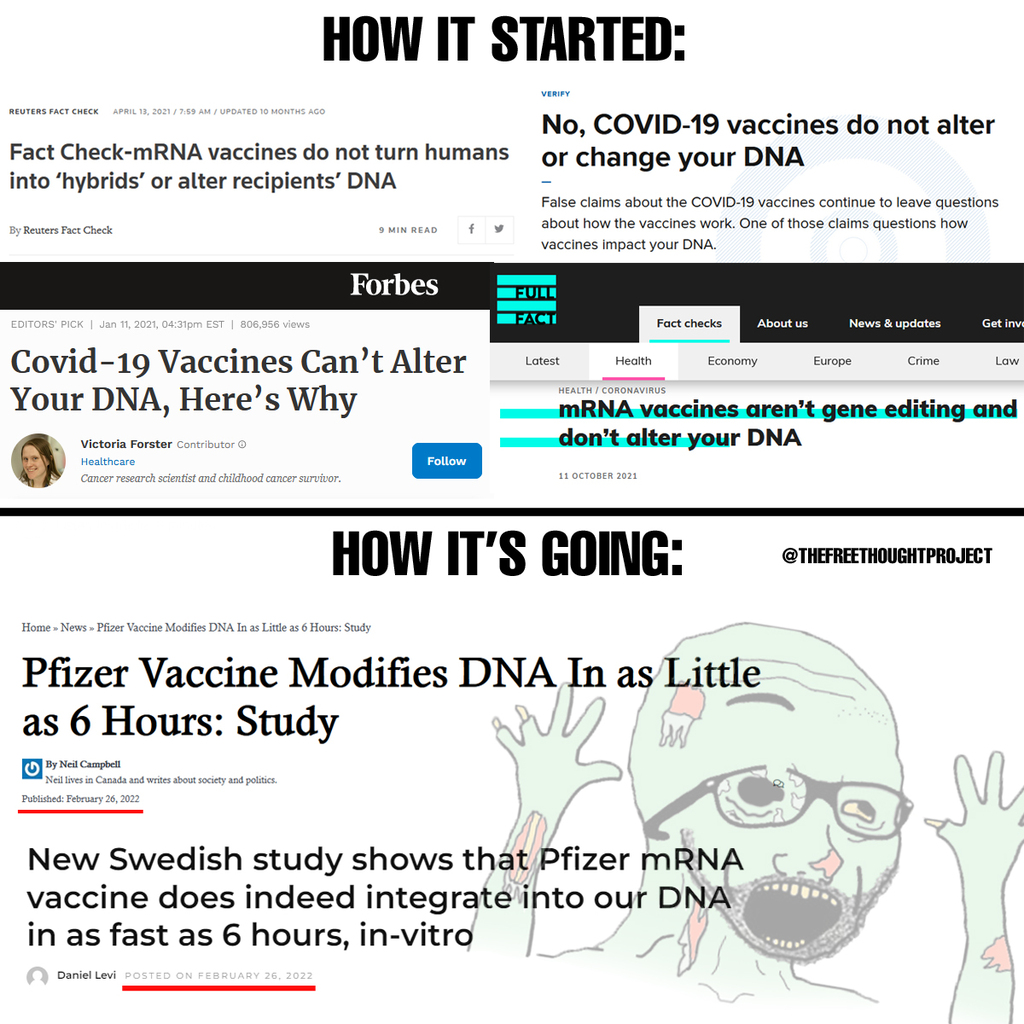
MIT & Harvard Study Suggests mRNA Vaccine Might Permanently Alter DNA After All

“The authors sought to answer how a PCR test is able to detect segments of viral RNA when the virus is presumably absent from a person’s body. They hypothesized that somehow segments of the viral RNA were being copied into DNA and then integrated permanently into the DNA of somatic cells”

In my previous blog, “Will an RNA Vaccine Permanently Alter My DNA?”, I laid out several molecular pathways that would potentially enable the RNA in an mRNA vaccine to be copied and permanently integrated into our DNA. I was absolutely not surprised to find that the majority of people claimed that this prospect was impossible; in fact, I was expecting this response – partly because most people don’t possess a deep enough understanding of molecular biology, and partly because of other implicit biases.

After all, we’ve been told in no uncertain terms that it would be impossible for the mRNA in a vaccine to become integrated into our DNA, simply because “RNA doesn’t work that way.” Well, this current research which was released not too long after my original article demonstrates that yes, indeed, “RNA does work that way”. In my original article, I spelled out this exact molecular pathway.

Specifically, a new study by MIT and Harvard scientists demonstrates that segments of the RNA from the coronavirus itself are most likely becoming a permanent fixture in human DNA. (study linked below). This was once thought near impossible, for the same reasons which are presented to assure us that an RNA vaccine could accomplish no such feat. Against the tides of current biological dogma, these researchers found that the genetic segments of this RNA virus are more than likely making their way into our genome. They also found that the exact pathway that I laid out in in my original article is more than likely the pathway being used (retrotransposon, and in particular a LINE-1 element) for this retro-integration to occur.

And, unlike my previous blog where I hypothesize that such an occurrence would be extremely rare (mainly because I was attempting to temper expectations more conservatively due to the lack of empirical evidence), it appears that this integration of viral RNA segments into our DNA is not as rare as I initially hypothesized. It’s difficult for me to put a number on the probability due to data limitations present in the paper, but based on the frequency they were able to measure this phenomenon in both petri dishes and COVID patients, the probability is much greater than I initially anticipated. Due to this current research, I now place this risk as a more probable event than my original estimation.

To be fair, this study didn’t show that the RNA from the current vaccines is being integrated into our DNA. However, they did show, quite convincingly, that there exists a viable cellular pathway whereby snippets of SARS-CoV-2 viral RNA could become integrated into our genomic DNA. In my opinion, more research is needed to both corroborate these findings, and to close some gaps.

That being said, this data can be used to make a conjecture as to whether the RNA present in an RNA vaccine could potentially alter human DNA. This is because an mRNA vaccine consists of snippets of the viral RNA from the genome of SARS-CoV-2; in particular, the current mRNA vaccines harbor stabilized mRNA which encodes the Spike protein of SARS-CoV-2, which is the protein that enables the virus to bind to cell-surface receptors and infect our cells.

This was thought near impossible. Based on this ground-breaking study, I would hope that the highly presumptuous claim that such a scenario is impossible will find its way to the trash bin labeled: “Things We Were Absolutely and Unequivocally Certain Couldn’t Happen Which Actually Happened”; although, I have a suspicious feeling that the importance of this study will be minimized in quick order with reports from experts who attempt to poke holes in their work. It’s important to add that this paper is a pre-print that is not peer-reviewed yet; but I went through all of the data, methods, and results, and I see very little wrong with the paper, and some gaps that need closing- but, at least from the standpoint of being able to answer the question: can RNA from the coronavirus use existing cellular pathways to integrate permanently into our DNA? From that perspective, their paper is rock-solid. Also, please take note that these are respected scientists from MIT and Harvard.

Quoting from their paper:

“In support of this hypothesis, we found chimeric transcripts consisting of viral fused to cellular sequences in published data sets of SARS-CoV-2 infected cultured cells and primary cells of patients, consistent with the transcription of viral sequences integrated into the genome. To experimentally corroborate the possibility of viral retro-integration, we describe evidence that SARS-CoV-2 RNAs can be reverse transcribed in human cells by reverse transcriptase (RT) from LINE-1 elements or by HIV-1 RT, and that these DNA sequences can be integrated into the cell genome and subsequently be transcribed. Human endogenous LINE-1 expression was induced upon SARS-CoV-2 infection or by cytokine exposure in cultured cells, suggesting a molecular mechanism for SARS-CoV-2 retro-integration in patients. This novel feature of SARS-CoV-2 infection may explain why patients can continue to produce viral RNA after recovery and suggests a new aspect of RNA virus replication.”

Why did these researchers bother to investigate whether viral RNA could become hardwired into our genomic DNA? It turns out their motive had nothing to do with mRNA vaccines.

Keep reading