
Pelosi says there shouldn’t be any debates between Biden and Trump

Speaker Nancy Pelosi (D-Calif.) said Thursday she doesn’t think there should be any presidential debates ahead of the November election, arguing Democratic presidential nominee Joe Biden shouldn’t “legitimize” a discussion with President Trump.

“I don’t think that there should be any debates,” Pelosi told reporters. “I do not think that the president of the United States has comported himself in a way that anybody has any association with truth, evidence, data and facts.”

“I wouldn’t legitimize a conversation with him nor a debate in terms of the presidency of the United States,” she added. 

“I think that he’ll probably act in a way that is beneath the dignity of the presidency,” she said, citing what she called his “disgraceful” actions during the 2016 debates with former Secretary of State Hillary Clinton

“He does that every day,” she added. “But I think he will also belittle what the debates are supposed to be about.”

Instead, Pelosi proposed that the candidates take separate stages and answer questions about their policies in a “conversation with the American people” instead of “an exercise in skulduggery.” 
Keep reading

Forget Russia, The Democrats and Republicans Have Openly Rigged the Election for Decades

The lesser of two evils is still evil.

The last time the American people were allowed to see more than two candidates for president on television was in 1992 when Ross Perot was allowed on stage with Democrat Bill Clinton and incumbent Republican President George H.W. Bush. Perot ran as an independent, financing his own campaign and shook up American politics. He received more than 19 million votes as a result of being allowed on that stage with Bush and Clinton.

Perot wound up with about 19% of the vote in an election that Clinton won by 6 points over Bush. The fact that Perot was able to garner so much support was a direct result of his presence in the national televised debates. Naturally, the idea of a third party stealing votes from one of the major parties is a threat to the establishment.

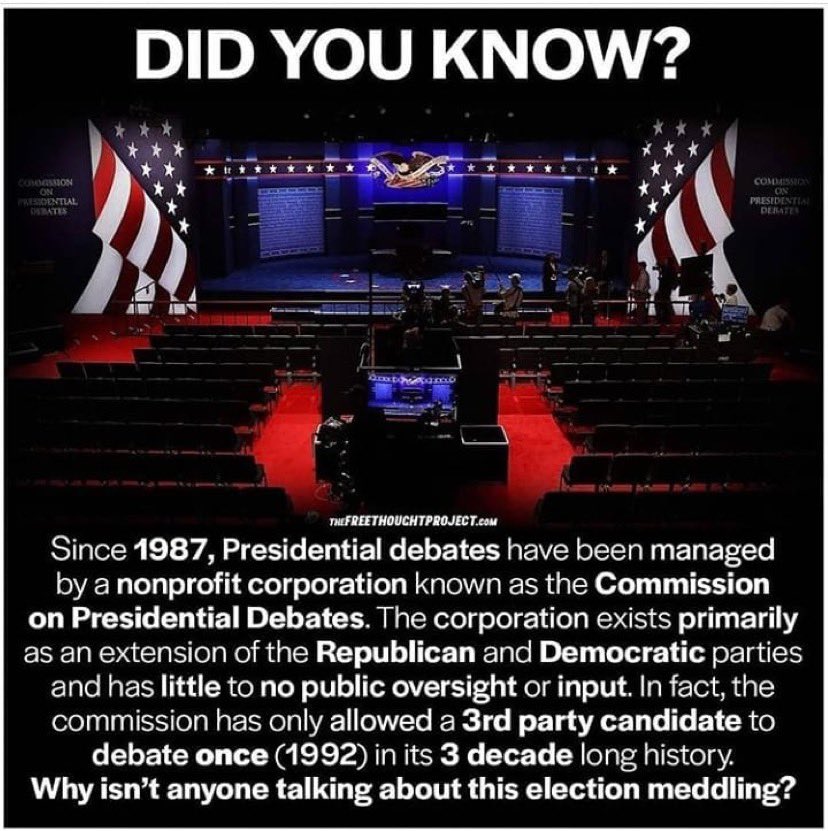
In 1987, Democrats and Republicans unanimously agreed to form the Commission on Presidential Debates (CPD) which is a nonprofit corporation established with bipartisan support. The CPD’s formation was directly recommended by the bipartisan National Commission on Elections to turn “over the sponsorship of presidential debates to the two major parties.”

The CPD was chaired by heads of the Democratic and Republican parties, Paul G. Kirk and Frank Fahrenkopf and at a press conference in 1987, they both had no problem admitting that this commission was formed to essentially exclude third party candidates.

Keep reading