The Motive for Nepal’s Revolution

The final straw for the revolution in Nepal was the government’s attempt to stifle free speech by banning social media platforms. These events did not take place because a few kids had their tablets taken away. Extreme government corruption ran rampant for years while the elite lived luxurious lifestyles in spite of the people they ruled over. The Nepalese government attempted to prevent the people from freely voicing their growing discontent, and then, when the people attempted to protest, the government murdered over 20 school-aged children in cold blood.

The media has poorly portrayed the cause of events by calling it the “Gen Z” revolution, sparked by a social media ban, which is entirely misleading, as the culprit was corruption and poverty. One in four citizens lives below the poverty line, with the average Nepali earning $1,400 USD annually. The poorest 20% spend around 67% of their income on food, and, much like most nations, in 2025, the majority is struggling to maintain the cost of living.

Keep reading

“Art Must Always Tell The Truth”

Popular artist Banksy created a graffiti mural in London depicting the current state of the UK censorship system using the courts to trample the rights of British citizens…

As ‘sundance’ writes at TheConservativeTreeHouse.comit did not take long for the authorities to cover the mural and eventually attempt to remove it.

I particularly like the fact the govt turned the CCTV camera, so they can monitor who might visit the scene of the criminal dissent.

Apparently, the British government doesn’t quite see the irony.

Keep reading

Online Safety Act: Ofcom’s super-complaints scheme will be used to censor “emerging online harms”

Introduction

Ofcom is a public corporation accountable to the UK Parliament.  It is the UK’s regulator for communications services.  It regulates the UK’s broadband, home phone and mobile services, TV, radio and video on demand services, oversees the universal postal service and looks after the airwaves used by wireless devices such as cordless phones, walkie-talkies and even some car keys and doorbells.

With the introduction of the Online Safety Act (“the Act”) in 2023, Ofcom became the regulator for online safety.  The aim is that Ofcom will become the online regulator not only in the UK but globally.

The Act gives Ofcom the powers they need to take appropriate action against all companies in scope, no matter where they are based, where services have relevant links with the UK. This means services with a significant number of UK users or where UK users are a target market, as well as other services which have in-scope content that presents a risk of significant harm to people in the UK.Online Safety Act: explainer, Department for Science, Innovation & Technology, UK Government, 24 April 2025

What are Super-Complaints?

A super-complaint is a formal mechanism established under the Online Safety Act that allows designated organisations to raise concerns about systemic issues affecting users of regulated online services.  Unlike individual complaints, super-complaints focus on broad, emerging trends or widespread problems across multiple platforms, rather than isolated incidents. 

Eligible entities, such as consumer protection bodies or organisations representing users, can submit these complaints to trigger a specific regulatory response from Ofcom.  The super-complaints regime is designed to complement Ofcom’s own research and horizon scanning, a forward-looking assessment of emerging risks and trends in digital services.

“The super-complaints regime, in line with the Act and recent Government regulations … will enable eligible entities to raise systemic issues that arise across services or, in exceptional circumstances, on one service, to our attention. We expect to consult on draft guidance for potential super-complainants in September 2025 and publish our final guidance in early 2026,” Ofcom’s roadmap to regulation of “online safety” states.

From November 2023 to 11 January 2024, the Government ran a public consultation on the eligible entity criteria and procedure for super-complaints.  The Government’s response to the consultation was published on 9 June 2025; the Ministerial Foreword by Baroness Maggie Jones stated:

The objective of the super-complaints regime is to ensure that eligible entities can make complaints to Ofcom, as regulator, to make them aware of existing or emerging online harms. This will also support Ofcom’s horizon scanning function, supporting Ofcom in taking an agile approach to regulating online harms.

Once approved by both Houses of Parliament, the super-complaints regime will come into force on 31 December 2025.Ministerial Foreword, Consultation Outcome: Super-complaints eligible entity criteria and procedural requirements: government response, UK Government, 9 June 2025

Keep reading

No, South Park, You Didn’t Need to Yank the Charlie Kirk Episode

Oh, c’mon, South Park. You didn’t need to do that. This current season featured an episode about Charlie Kirk and his activism, which was pretty funny, and it’s been pulled from rotation. Amy has more: 

According to the New York Post, the episode was quietly pulled and the network did not issue a statement, noting that “industry insiders” said the episode was “temporarily pulled” from rotation on Comedy Central. It is still available on Paramount+ with a subscription. 

The current season has been a bit Trump heavy, but the program has gone after everybody for years, from the hypocrisy surrounding hate crime legislation to steroid use in sports, political correctness, global warming, and other political figures; the program has tormented everyone. Also, Kirk loved the portrayal. He had a sense of humor, and conservatives can take a joke. 

Keep reading

Von der Leyen Unveils New EU Censorship Push, Online Digital ID Plans, in 2025 State of the Union Speech

European Commission President Ursula von der Leyen used her 2025 State of the Union speech to unveil a raft of new regulatory measures that introduce new challenges for digital rights and freedom of expression across the continent and the world.

Framed as measures for public health, democracy, and child protection, the Commission is pushing the EU deeper into institutionalized censorship and online regulation.

Addressing the European Parliament, von der Leyen declared she is “appalled by the disinformation that threatens global progress on everything from measles to polio.”

Citing fears of a global health crisis, she introduced a “Global Health Resilience Initiative,” which she said the EU would lead.

This initiative is expected to tie online speech more tightly to global health narratives, laying the groundwork for broader suppression of dissenting views under the label of medical misinformation.

Another centerpiece of her address was the so-called “European Democracy Shield,” a program that we’ve covered in great detail, intended to streamline and centralize the Commission’s censorship machinery under the banner of fighting “foreign information manipulation and interference.”

Framing the internet as a battlefield, she said: “Our democracy is under attack. The rise in information manipulation and disinformation is dividing our societies.”

Expanding on that framework, she announced the creation of a new institution, the European Centre for Democratic Resilience.

According to von der Leyen, this center will allow the EU to scale up its ability “to monitor and detect information manipulation and disinformation.”

But the agenda didn’t stop there. She introduced the Media Resilience Program, which she claimed would support “independent journalism and media literacy.”

In practice, however, such efforts often result in government-approved messaging being amplified, while dissenting outlets don’t get funded.

Von der Leyen pointed to declining local journalism in rural communities and claimed: “This has created many news deserts where disinformation thrives…This is why we will launch a new Media Resilience Program – it will support independent journalism and media literacy.”

Despite the existing Digital Services Act already mandating age verification (and therefore digital ID) online, von der Leyen floated a new, even more restrictive direction for internet access among young people.

Keep reading

Nepal’s PM quits and flees as his house is burned down by protesters who also chase finance minister through streets and attack him following outcry over social media ban

Nepal’s Prime Minister has resigned and fled after protesters burned down his house and chased his finance minister through the streets before attacking him, following public fury over a social media ban. 

Young Nepalis are leading angry protests across the country, with violence spreading in the capital and other cities. 

After enraged crowds torched KP Sharma Oli’s home, a new video footage has shown how Bishnu Prasad Paudel was pursued and set upon by a mob through the streets of Kathmandu.  

In the shocking clip, Paudel, 65, is seen sprinting down a road as dozens run after him. A protester coming from the other side leaps and kicks him, sending him crashing against a red wall.

The government official quickly gets up, stumbles, but starts running again before the video ends. Paudel, who doubles as the deputy prime minister of the country, has faced intense criticism since he began running Nepal’s economic affairs last year. 

Meanwhile, Oli, 73, stepped down a day after one of the bloodiest crackdowns in years left at least 19 dead. 

He had only begun his fourth term last year, following a coalition deal between his Communist Party and the centre-left Nepali Congress.

His departure came after three other ministers also resigned, even though the government had lifted the ban on social media. The country’s president, Ram Chandra Poudel, has now started the process of selecting a new leader. 

Keep reading

Censorship Concerns Surge As China Yanks Video Of Xi–Putin Organ Transplant Discussion

China’s state-owned broadcaster has rescinded international wire agency access to a hot mic video of Chinese and Russian leaders discussing longevity and organ transplants, an effort that shows the Chinese regime’s fear of attention on the topic, critics say.

The open mic exchange between Russian President Vladimir Putin and Chinese leader Xi Jinping took place in Beijing on Sept. 3, as the two leaders walked together ahead of a military parade commemorating World War II.

Xi at the parade told Putin that “these days at 70 you are still a child,” prompting Putin to remark that continued organ transplants could allow one to live younger and even reach immortality. Xi in response said that it is predicted that there’s a chance of humans living to 150 years old.

The conversation became global news and sparked discussions about the Chinese regime’s state-sanctioned forced organ harvesting, a taboo topic in China. CCTV has since taken down the livestream video that captured the exchange and removed the moment from replays.

CCTV also sent a letter through its lawyer to Reuters—which licensed the video through CCTV and edited it into a four-minute clip—requesting the news agency to remove the footage on the grounds that the clips Reuters published exceeded the agreed-upon scope.

CCTV lawyer He Danning claimed Reuters’ “editorial treatment applied to this material has resulted in a clear misrepresentation of the facts and statements contained within the licensed feed.”

Reuters withdrew the video and issued a “kill” notice to its clients on Sept. 5. The agency said it had earlier distributed the clip to more than 1,000 media clients around the world, including major international news broadcasters and TV stations.

In a statement, Reuters said it was removing the content because it no longer has the legal permission to publish this copyrighted material.

“We stand by the accuracy of what we published. We have carefully reviewed the published footage, and we have found no reason to believe Reuters longstanding commitment to accurate, unbiased journalism has been compromised,” Reuters stated.

According to the London-based China Tribunal, forced organ harvesting has taken place in China for years “on a significant scale,” and practitioners of the Falun Gong spiritual group are the primary victims. It said that persecuted religious minorities including Uyghurs are also potential targets. Since 1999, millions of Falun Gong practitioners have been incarcerated in prisons, labor camps, and other facilities, with hundreds of thousands tortured and untold numbers persecuted to death, according to the Falun Dafa Information Center.

Keep reading

Josh Hawley Proposes AI Regulations, Section 230 Repeal, and Digital ID Checks for Chatbots

Senator Josh Hawley (R-Mo.) is pushing for broad new regulations on artificial intelligence, including age verification for chatbot access, data ownership rights, and the full repeal of Section 230 of the Communications Decency Act.

While the proposals are framed as efforts to curb corporate overreach in the tech industry, they will ignite concern among digital rights advocates who warn that such measures could undermine online privacy and freedom of expression.

At the National Conservatism Conference, Hawley accused AI developers of building their systems by collecting and using copyrighted material without permission. “The AI large language models [LLMs] have already trained on enough copyrighted works to fill the Library of Congress 22 times over,” he said.

“Let me just put a finer point on that — AI’s LLMs have ingested every published work in every language known to man already.” He claimed that creators were neither consulted nor compensated.

In July, Hawley introduced the AI Accountability and Personal Data Protection Act, which would allow individuals to sue companies that use personal data without consent and would establish property rights over certain categories of digital information.

However, two key components of Hawley’s platform are raising some alarm. His call to repeal Section 230 has been criticized for potentially damaging the open internet.

Section 230 currently shields online platforms from legal liability for content created by users. Without it, many sites could be forced to preemptively remove user content out of legal risk, resulting in widespread over-moderation and silencing of lawful speech.

Keep reading

Reuters Withdraws Xi, Putin Longevity Video After China State TV Pulls Legal Permission to Use It

Reuters News on Friday withdrew a four-minute video containing an exchange between Russian President Vladimir Putin and Chinese lead Xi Jinping discussing the possibility that humans can live to 150 years old, after China state TV demanded its removal and withdrew the legal permission to use it.

The footage, which included the open mic exchange from the military parade in Beijing marking the 80th anniversary of the end of World War II, was licensed by the China state television network, China Central Television (CCTV).

The clips were edited by Reuters into a four-minute video and distributed to more than 1,000 global media clients including major international news broadcasters and TV stations around the world. Other news agency licensees of CCTV also distributed edits of the footage.

Reuters removed the video from its website and issued a “kill” order to its clients on Friday after receiving a written request from CCTV’s lawyer. The letter said the news agency exceeded usage terms of its agreement. The letter further criticized Reuters “editorial treatment applied to this material” but did not specify details.

Reuters said in a statement that it withdrew the videos because it no longer held the legal permission to publish this copyrighted material.

Representatives of CCTV and CCTV’s global arm, China Global Television Network, did not immediately reply to a request for comment. The Chinese embassy in Washington did not immediately reply to a request for comment.

The video and story of the Xi and Putin exchange were widely shared by broadcasters and on social media globally.

“The editorial treatment applied to this material has resulted in a clear misrepresentation of the facts and statements contained within the licensed feed,” wrote HE Danning, legal supervisor of CCTV News Agency, in the letter to Reuters on Friday.

“We stand by the accuracy of what we published,” Reuters said in its statement. “We have carefully reviewed the published footage, and we have found no reason to believe Reuters longstanding commitment to accurate, unbiased journalism has been compromised.”

Keep reading

FDA Official Pressures YouTube Into Removing a Channel For Posting His Own Vaccine Comments

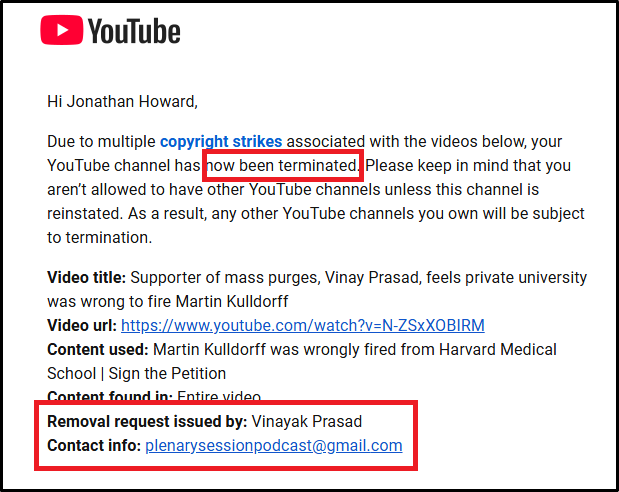
Last week, a top official with the Food and Drug Administration (FDA) apparently filed a bogus copyright claim to get a critic’s YouTube account taken down. This is an inappropriate act of censorship that, not long ago, conservatives would rightly have stood against.

“Jonathan Howard, a neurologist and psychiatrist in New York City, received an email from YouTube on Friday night, which stated that Vinay Prasad, who is the FDA’s top vaccine regulator, had demanded the removal of six videos of himself from Howard’s YouTube channel,” The Guardian reported this week. “Howard’s entire channel has now been deleted by YouTube, which cited copyright infringement.”

On his channel, Howard hosted videos of public health officials—including Prasad, Department of Health and Human Services Secretary Robert F. Kennedy Jr., and National Institutes of Health Director Jay Bhattacharya—making statements during the COVID-19 pandemic that turned out to be untrue or overly myopic. “I had accumulated about 350 videos, almost all of which were short clips of famous doctors saying absurd things,” Howard wrote in a blog post, “that herd immunity had arrived in the spring of 2021 and that RFK Jr. was an honest broker about vaccines, for example.” Howard is also critical of Prasad’s stance on vaccines, which Prasad now has the authority to regulate.

According to an email Howard posted, YouTube “terminated” his channel after “multiple copyright strikes” against his videos, and the “removal request” came from Prasad.

“Publishing someone else’s videos without modification or commentary is a clear copyright violation,” an FDA spokesperson told The Guardian. “The mission of Johnathan Howard was not medical transparency, but personal profit by grifting and stealing someone else’s intellectual property.”

“My YouTube channel had 256 subscribers and its videos were typically seen by dozens of people,” Howard wrote. “I never promoted the channel and made no money from it.” Besides, U.S. law allows for fair use of copyrighted material, which means someone can use protected content for purposes such as “criticism, comment, news reporting,” or “research” without the creator’s permission.

Howard is the author of the book We Want Them Infected, which criticized doctors and public health officials who advocated a herd immunity strategy for dealing with COVID-19. Howard says such warnings fed into anti-vaccine conspiracy theories. His YouTube channel collected videos of people who are now in charge of public health institutions, making what he feels were irresponsible claims during the pandemic.

But whether you agree with Howard or not, it is wrong and hypocritical for Prasad to silence his critics in this way.

Keep reading