Can you name one?


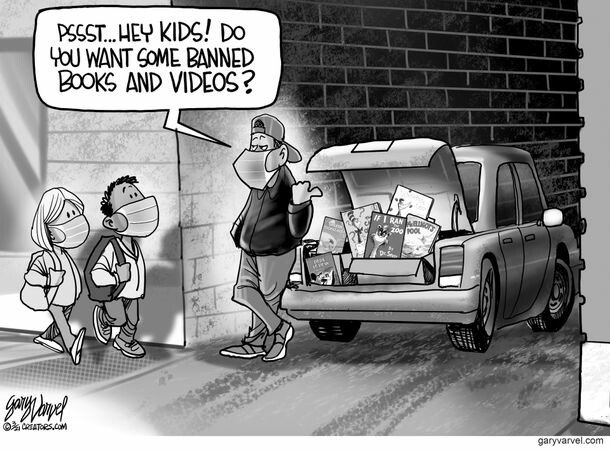
Amazon, the popular online retailer, is under fire after conservative author Ryan T. Anderson announced on Sunday that his 2018 bestseller, When Harry Became Sally: Responding to the Transgender Moment, had been scrubbed from the Amazon website.
The decision to ban the book from its platform came several months after Amazon quietly altered its content guidelines to prohibit the sale of “content that we determine is hate speech … or other material we deem inappropriate or offensive,” which includes content that “promotes the abuse or sexual exploitation of children, contains pornography, glorifies rape or pedophilia, [or] advocates terrorism.”
As recently as August 2020, Amazon’s content guidelines for books were significantly vaguer, asserting the company’s right to prohibit the sale of “certain content, such as pornography or other inappropriate content.” Amazon has yet to offer a sufficient explanation of the updated guidelines.
In the meantime, Amazon continues to permit the sale of numerous books that most casual observers might reasonably classify as “hate speech” or are otherwise incompatible with its updated content guidelines. The company also continues to sell other products that would appear to run afoul of contemporary standards of wokeness, as outlined in its prohibition on selling items (excluding books) that “promote, incite, or glorify hatred.”
The tweets that led to Manco’s suspension were posted on his pseudo account, “South Jersey Giants.” Someone figured out Manco was the owner of the account, took screenshots of some tweets, and posted them on Instagram.
In one of the tweets shared, Manco argued against slavery reparations, saying, they were like the great-great-grandchild of a murder victim asking the great-great-grandchild of a convicted murdered for compensation. “Now, get this racist reparation bullshit out of your head for good,” Manco added in the tweet.


A Democrat lawmaker in Illinois has announced he wants to ban the sale of Grand Theft Auto (GTA), along with other video games that feature violence, after his state witnessed an increase in the amount of carjackings.
Democrat state Rep. Marcus Evans introduced the bill, HB 3531, which aims to amend an Illinois law preventing violent video games from being sold to children to an all-out ban on the sale “of all violent video games” to anyone.
During a press conference on Monday, Evans mentioned Grand Theft Auto by name and put into his own words what he believes to be an example of a violent video game. According to Evans, “a video game that allows a user or player to control a character within the video game that is encouraged to perpetuate human-on-human violence in which the player kills or otherwise causes serious physical or psychological harm to another human or an animal” is an example of a violent video game.
“The bill would prohibit the sale of some of these games that promote the activities that we’re suffering from in our communities,” Evans said.
“Grand Theft Auto and other violent video games are getting in the minds of our young people and perpetuating the normalcy of carjacking,” Evans continued. “Carjacking is not normal, and carjacking must stop.”
Evans also insisted that games like GTA promote behavior similar to that which has been seen prominently in Chicago.
Sometime before this week, when it removed from its digital shelves a book critical of transgender ideology, Amazon altered its content policy to explicitly forbid books that promote “hate speech,” a major rule change that could be used to rationalize action against a broader range of books sold by the digital retail giant.
Amazon this week yanked “When Harry Became Sally: Responding to the Transgender Movement” from its main web store, its Kindle servers and its audiobook lineup with no explanation, even as the book had been available on the site for three years with no apparent controversy.
In the 2018 book, author and political philosopher Ryan Anderson draws on years of scientific research and data to criticize the prevailing approach to transgender issues in modern medicine. The book “exposes the contrast between the media’s sunny depiction of gender fluidity and the often sad reality of living with gender dysphoria,” according to its sales blurb.
Anderson told Just the News that he had received no explanation for the ban.
Reached for comment by Just the News, Amazon declined to provide any explanation, offering instead a link to its book content policy.
A review of those policies suggests that sometime in the last few months Amazon made a major change to the ways in which it moderates book content on its servers, imposing a much stricter standard on books than it had previously done.
The link provided by Amazon this week claims in part that, where books are concerned, the company “[doesn’t] sell certain content including content that we determine is hate speech … or other material we deem inappropriate or offensive.”
Internet archives show that as recently as August of last year, Amazon’s book content policy did not include any mention of “hate speech.” At that time, the company stated only that “we reserve the right not to sell certain content, such as pornography or other inappropriate content.”
On the older page, the company directed users to “guidelines for other categories of products,” such as products featuring “offensive and controversial material.” That policy stipulated in part that Amazon “does not allow products that promote, incite or glorify hatred,” but the rule explicitly noted that the policy did not apply to books.
The company did not reply to a followup query asking when the policy had been changed, and why.
You must be logged in to post a comment.