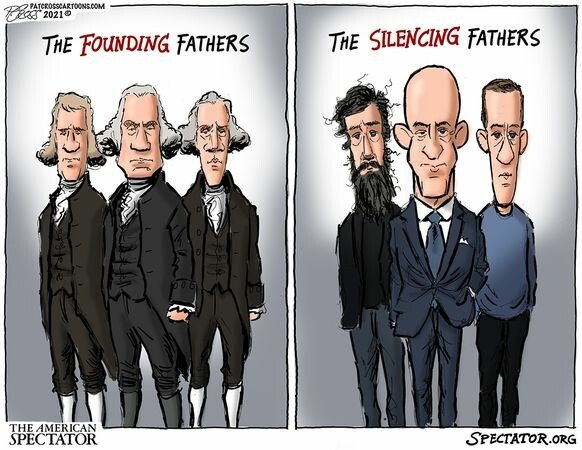
Enjoy the silence…


Chelsea Clinton has spoken out against freedom of vaccine-critical speech at a Vatican conference dedicated to dialogue.
Speaking during a pre-recorded online meeting, Clinton, 41, responded to a question about so-called “vaccine hesitancy” regarding COVID-19 vaccines by saying that there must be a global effort to crack down on vaccine-critical social media posts.
“I personally very strongly believe there has to be more intensive and intentional and coordinated global regulation of the content on social media platforms,” she said.
“We know that the most popular video across all of Latin America for the last few weeks that now has tens of millions of views is just an anti-vax, anti-science screed that YouTube has just refused to take down.”
Clinton added that anti-vaccine content created in the United States “flourishes” across the world by way of social media platforms. Her attempts to convince the managers of these sites to remove the material has not worked, she said.
“We know that — because I have tried — that appealing to the leadership of these companies to do the right thing has just not worked, and so we need regulation.”
It is no longer a random act — Facebook censorship has become so blatant and massive that they have indefinitely silenced the former president of the United States. Many pro-censorship advocates cheer this on because they dislike the voices silenced by Facebook. They attempt to justify the censorship with the claims that Facebook is a private company and can do what they want, a lawsuit filed against the social media giant says that is not the case.
A lawsuit filed by Robert F. Kennedy Jr. — the chairman of the non-profit group Children’s Health Defense (CHD) — claims Facebook conspires with the federal government to squelch speech which advocates for vaccine safety.
According to the lawsuit, overseen by Senior U.S. District Judge Susan Illston, Facebook started slapping warning labels on content posted on CHD’s Facebook page, including in September of 2020 when the social media giant posted a message directing users to seek “reliable, up-to-date information” about vaccines from the U.S. Centers for Disease Control and Prevention. Facebook also started labeling some of CHD’s content as “false information” based on research by third-party fact checkers, including a link to an article claiming vaccinated children “are more likely to have adverse health outcomes” in May 2020.
To combat toxicity on the platform, social media website Twitter is reportedly developing a feature to makes users reconsider sending messages that its system detects as “mean” or offensive. Initial tests show that 34 percent of users who received the warning chose to revise their message or not send it at all.
NPR reports that Twitter is attempting to make its users more conscientious about the language they use on the platform and is encouraging positivity by implementing a new feature that will detect “mean” replies on its service before a user presses send.
When Twitter detects that a user is about to post something that could be seen as offensive, an automatic prompt will be displayed that states: “Want to review this before tweeting?” The user is then offered three choices: tweet, edit, or delete.
Psaki’s comments came after Facebook announced their decision not to reinstate former President Donald Trump’s accounts.
The Press Secretary Jen Psaki said that Biden believes that “major platforms have a responsibility related to the health and safety of all Americans to stop amplifying untrustworthy content, disinformation and misinformation, especially related to COVID-19, vaccinations and elections.”
Psaki went on to indicate that Biden believes Big Tech must do more to silence “life threatening” speech on social media.
Facebook users have shared stories of receiving bans after jokingly calling their friend ‘crazy’, sharing a Smithsonian magazine story on tribal New Guinea and labelling someone ‘sad’.
The social media platform is understood to have internal guidelines which are not made public on moderation. In documents seen by The Wall Street Journal moderators are told the sentences that are and aren’t allowed.
An example given for a sentence not allowed is: ‘It’s disgusting and repulsive how fat and ugly John Smith is.’
But the document adds: ‘We do not remove content like “frizzy hair,” “lanky arms,” “broad shoulders,” etc. since “frizzy,” “lanky,” and “broad,” are not deficient or inferior, and therefore not degrading.”’
Recent graduate Colton Oakley says he was banned from posting for three days after calling those who are angry about loan cancellation ‘sad and selfish.’
Writer Alex Gendler claims he was stopped from posting after sharing a Smithsonian magazine story on tribal New Guinea.
And history teacher Nick Barksdale told The Wall Street Journal he received a 30 day ban after writing to a friend ‘man, you’re spewing crazy now!’
Facebook said this removal was a mistake but Barksdale asked: ‘If you use the term ‘crazy,’ does that automatically get you banned?’
Artist Sunny Chapman, who has received bans, said: ‘What I’m learning about Facebook is not to talk on Facebook.’
The Media Right News account was locked on Tuesday, it was revealed to National File. The account was accused by Twitter of engaging in “targeted harassment,” for tweeting out a headline of a story they had covered last week. The account was hit with the lock only days after tweeting out the story, entitled “Antifa Hit List, Recordings Exposed by ABC Affiliate: ‘Let’s Kill Some Cops’,” with Twitter likely targeting the tweet due to the quote from Antifa activists.
In 1964, Stanley Kubrick released a dark comedy classic titled “Dr. Strangelove or: How I Learned to Stop Worrying and Love the Bomb.” The title captured the absurdity of getting people to embrace the concept of weapons of mass destruction. The movie came to mind recently with the public campaign of Facebook calling for people to change her attitudes about the Internet and rethink issues like “content modification” – the new Orwellian term for censorship.
The commercials show people like “Joshan” who says that he was born in 1996 and grew up with the internet.” Joshan mocks how much computers have changed and then asks why our regulations on privacy and censorship cannot evolve as much as our technology. The ads are clearly directed at younger users who may be more willing to accept censorship than their parents who hopelessly cling to old-fashioned notions of free speech. Facebook knows that it cannot exercise more control over content unless it can get people to stop worrying and love the censor.
There was a time when this would have been viewed as chilling: a corporate giant running commercials to get people to support new regulations impacting basic values like free speech and privacy. After all, Joshan shows of his first computer was a “giant behemoth of a machine” but that was before he understood “the blending of the real world and the internet world.”
The Facebook campaign is chilling in its reference to “privacy” and “content modification” given the current controversies surrounding Big Tech. On one level, the commercial simply calls for rethinking regulatory controls after 25 years. However, the source of the campaign is a company which has been widely accused of rolling back on core values like free speech. Big Tech corporations are exercising increasing levels of control over what people write or read on the Internet. While these companies enjoy immunity from many lawsuits based on the notion of being neutral communication platforms (akin to telephone companies), they now censor ideas deemed misleading or dangerous on subjects ranging from climate denial to transgender criticism to election fraud.
A Harry Potter event was canceled at an upcoming book festival in New Zealand over headline-making comments the best selling author J.K. Rowling made, in which she said only women can menstruate.
Organizers of the Featherston Booktown Karukatea festival in New Zealand, which will be held on May 6-9 have canceled an interactive Harry Potter quiz — which had been very popular at past events — according to a report by Stuff.
Rowling has faced backlash by transgender activists for saying only women can menstruate. The author has also been labeled a “TERF” (trans exclusionary radical feminist) — a term referring to feminists who are considered too “radical” for even left-wing activists, as they do not believe that a biological man is a woman.
In a lengthy essay Rowling wrote last summer, responding the attacks she has received from transgender activists, Rowling said, “I refuse to bow down to a movement that I believe is doing demonstrable harm in seeking to erode ‘woman’ as a political and biological class and offering cover to predators like few before it.”
“It isn’t enough for women to be trans allies,” she continued. “Women [are told they] must accept and admit that there is no material difference between trans women and themselves.”
“But, as many women have said before me, ‘woman’ is not a costume. ‘Woman’ is not an idea in a man’s head. ‘Woman’ is not a pink brain, a liking for Jimmy Choos or any of the other sexist ideas now somehow touted as progressive,” Rowling said. “Moreover, the ‘inclusive’ language that calls female people ‘menstruators’ and ‘people with vulvas’ strikes many women as dehumanizing and demeaning.”
Featherston resident and feminist activist Jenny Whyte told Stuff the organizers’ decision not to have the Harry Potter quiz at the festival is ironic.
 Hellbound and Down
You must be logged in to post a comment.