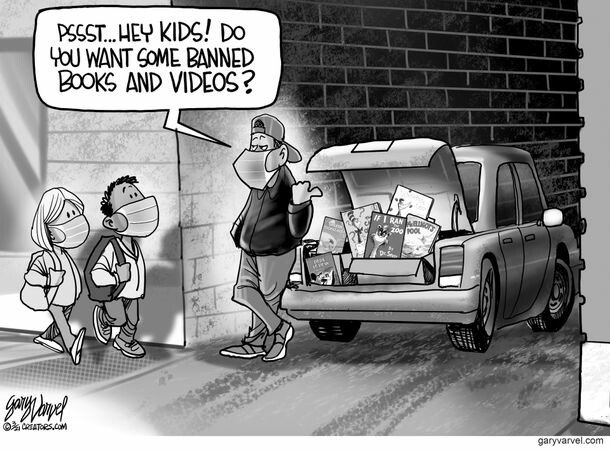
Canada To Censor “Hurtful” Comments About Politicians, Implement Internet Kill-Switch

…but, constituents to remain fair game for abuse from party apparatchiks.

A colleague forwarded me the text of an article from Blackrocks Reporter, which covers Canadian politics from Ottawa, our capitol.

It’s a report on Federal Heritage Minister Steven Guibeault’s ongoing vendetta against non-conforming political speech on the internet, in which he’s calling for censorship of “hurtful” comments against politicians and implementation of an internet killswitch to facilitate it.

Blackrocks is behind a paywall, permit me to quote it here:

Federal internet censors should target hurtful words against politicians, says Heritage Minister Steven Guilbeault. The Minister added pending regulations may include an internet kill switch to block websites deemed hurtful, but called it a “nuclear” option.

“We have seen too many examples of public officials retreating from public service due to the hateful online content targeted towards themselves or even their families,” said Guilbeault.  “I have seen firsthand alongside other Canadians the damaging effects harmful content has on our families, our values and our institutions. As a dad and a stepdad to six kids, I know more can and should be done to create a safer online environment.”

Guilbeault made his remarks in a podcast sponsored by Canada 2020, an Ottawa think tank affiliated with the Liberal Party. Legislation to censor internet content will be introduced shortly, he said.

“I am confident we can get this adopted,” said Guilbeault. “Once the legislation is adopted, clearly creating a new body, a new regulator like that in Canada, would take some time.”’

The same story is covered here by the Post Millienial (the rest of Canada’s “approved media”, as in the ones who received hundreds of millions in tax breaks and subsidies from the Federal Government in the run up to the last election, are not giving it a lot of airtime for some reason).
Keep reading

YouTube CEO calls for global coalitions to address content that’s “legal but could be harmful”

During an appearance at the World Economic Forum Global Technology Governance Summit 2021, an event where more than 40 governments and 150 companies meet to ensure “the responsible design and deployment of emerging technologies,” YouTube CEO Susan Wojcicki expressed her support for tech platforms moderating content that’s “technically legal but could be harmful” and praised global coalitions that help Big Tech coordinate and automate their censorship efforts.

Wojcicki said that when tech companies comply with the law, there are still “issues around speech” and suggested that these issues should be addressed by private corporations.

“I see a lot of issues around speech and what should or should not be allowed on platforms for example,” Wojcicki said. “And that’s a really tough area. Now, certainly countries pass certain laws and we comply with all the laws that the different countries pass but a lot of times, there’s content that’s legal but could be seen as harmful. And it’s hard for governments to necessarily find the right way to regulate it.”

She then proposed YouTube’s model of privately policing what the platform deems to be COVID-19 “misinformation” as an effective way to handle this content that’s “legal but could be harmful.”

Keep reading

YouTube CEO: It’s easy to “make up content and post it from your basement” so we boost “authoritative sources”

YouTube CEO Susan Wojcicki has acknowledged that the platform’s policy of boosting “authoritative” mainstream media sources and suppressing independent creators in search makes it “harder, in some cases, for channels, maybe who are getting started or smaller, to be able to be visible when there’s a major event or when people are looking at something that is science or news related” but insists that that the policy is “really, really important.”

Wojcicki made the comments during an interview with The Atlantic’s CEO, Nicholas Thompson, at the World Economic Forum’s Global Technology Governance Summit 2021.

While she acknowledged that this policy does make it harder for creators in some cases, Wojcicki argued that the policy is necessary:

“When we had the Las Vegas shooting, unfortunately, there were a lot of people who were uploading content that was not factual, that was not correct. And it’s much easier to just make up content and post it from your, your basement than it is to actually go to the site and to be able to report and have high-quality journalistic reporting. And so, that was just an example of what happens if you don’t have that kind of ranking.

So sure, we want to enable citizen journalism and other people to be able to report and other people to be able to share information on new channels but when we’re dealing with a sensitive topic, we have to have that information coming from authoritative sources so that the right and accurate information is viewed by our users first.”

Thompson followed up by pointing out that such a policy seems to go against the whole principle of YouTube.

Keep reading

YouTube Censors Coronavirus Roundtable Hosted by Florida Gov. Ron DeSantis

Google-owned YouTube took down a video of a roundtable conference hosted by Florida Gov. Ron DeSantis (R), featuring former White House coronavirus task force member and medical scholar Scott Atlas, and the three co-authors of the Great Barrington Declaration.

The Great Barrington declaration argues that blanket lockdowns and mask mandates are counterproductive, instead advocating for a targeted approach focused on protecting vulnerable segments of the population.

The three co-authors, who attended Gov. DeSantis’ roundable, are Harvard professor of medicine Martin Kulldorff, Oxford professor of epidemiology Sunetra Gupta, and Stanford professor of medicine and epidemiologist Jay Bhattacharya.

Keep reading

YouTube Deleted 2.5 Million ‘Dislikes’ From Biden White House Videos, Data Indicates

YouTube has deleted about 2.5 million ‘dislikes’ from videos on the official White House channel of President Joe Biden, according to data collected and posted online by a researcher who wished to remain anonymous. YouTube recently announced that it’s testing a new page design that hides the dislike count.

The Google-owned video platform allows users to give videos either a thumb up (like) or thumb down (dislike). For at least two years, it’s had a policy to remove likes and dislikes it considers spam.

“We have policies and systems in place to ensure that the engagement on YouTube is authentic, and remove any fraudulent metrics,” a YouTube spokesperson told The Epoch Times via email, but when asked, wouldn’t go into details on what criteria it uses to make these calls.

Keep reading

Spotify Continues to Remove Joe Rogan Episodes — 42 Shows Now Deleted

Spotify is continuing to remove episodes of The Joe Rogan Experience as part of their $100 million exclusive relationship, with more nixed shows discovered this week.

Just last week, Digital Music News first reported that 40 different Joe Rogan Experience podcast episodes were found missing from Spotify, now the exclusive platform for the show. Now, that number has quickly grown to 42, with potentially more shows quietly getting removed from the catalog.

Among the newly-missing is an episode (#411) with Bulletproof Coffee founder Dave Asprey, a frequent guest on The Joe Rogan Experience. Strangely, Spotify has deleted three total episodes with Asprey for reasons that aren’t entirely clear.

One explanation for the removals is that Asprey frequently backs controversial anti-aging and scientific theories, including claims that Bulletproof Coffee is extremely healthy while other coffee brands are not. Asprey has designed the ‘Bulletproof Diet,’ and frequently criticizes coffee manufacturers for leaving high levels of damaging mycotoxins in their blends.

Asprey — who has predicted that he will live to the age of 180 — is certainly unconventional in his theories, though it appears that Spotify has decided to debunk his claims by removing his episodes entirely.

Also suddenly missing is a ‘Live from the Icehouse’ episode (#149) featuring Joe Rogan and Little Esther, Al Madrigal, Josh McDermitt, Brendon Walsh, Felicia Michaels, and Brian Redban. That sounds like a fun time, though perhaps one-too-many raunchy jokes were tossed around in the episode. Indeed, the episode may have simply contained one objectionable joke — but that was enough for Spotify’s editors to hit delete and remove the show entirely.

Keep reading

Sharyl Attkisson on Combatting Censorship: ‘Don’t Be Kowtowed Into Not Speaking Out’

Investigate journalist Sharyl Attkisson says combatting censorship in today’s media and big tech landscape requires Americans to “speak up” and stand firm against people and groups that seek to silence them.

“I think the most important single thing people can do is to speak up and not be bullied by the people that want to keep the voices silent so that it appears, in this artificial world that we live in online, that everybody’s on the same page and everybody thinks the same thing and this is okay,” Attkisson told The Epoch Times’ American Thought Leaders program.

“Don’t be kowtowed into not speaking out. Don’t act like that’s okay.”

Attkisson, author of “The Smear,” has been researching how information has been controlled in the United States, particularly by political and corporate interest groups. She said these groups began ramping up their efforts to control information once Donald Trump won the 2016 presidential election. But these groups, she argued, began realizing Americans were not “getting on board” with their messaging and, as a result, started to act out of desperation.

“The reason they’re being so heavy-handed about information and access is because people are not getting on board with what they’re supposed to think and do. They’re not acting the way they’re supposed to act after their information is controlled. And I think it was very frightening for them to see,” she said.

“As I said, they almost entirely controlled the media landscape in 2016 but Trump still won the election. How did that happen? Well, they blamed the internet.”

Keep reading