You can trust us!

Parks and playgrounds have been shuttered while the Centers for Disease Control and Prevention continues to recommend that masks be worn outdoors in many situations, even by people who are vaccinated.
But “the science” upon which those guidelines are based apparently is far from reality, according to a New York Times report.
The CDC has estimated that the risk of COVID-19 transmission while outdoors is about 10%. But the true figure may be less than 1% — and possibly even less than 0.1%.
If it is 0.1%, that means the CDC’s estimate was 100 times too high.
The Times reported the 10% figure is based “partly on a misclassification” of some virus transmission from a study. Some of the settings classified as outdoor, such as construction sites, actually were a mix of both outdoor and indoor.
On Tuesday, CDC director Dr. Rochelle Walensky was confronted by Sen. Susan Collins, R-Maine, regarding the Times report. The senator noted it was another example of conflicting and confusing guidance, along with recommendations related to school reopenings and summer camps.
Walensky explained that the 10% benchmark was derived from a study published in the Journal of Infectious Disease in November that synthesized various studies.
A CDC official told the Times there are limited data on outdoor transmission.
The US Center for Disease Control (CDC) is altering its practices of data logging and testing for “Covid19” in order to make it seem the experimental gene-therapy “vaccines” are effective at preventing the alleged disease.
They made no secret of this, announcing the policy changes on their website in late April/early May, (though naturally without admitting the fairly obvious motivation behind the change).
The trick is in their reporting of what they call “breakthrough infections” – that is people who are fully “vaccinated” against Sars-Cov-2 infection, but get infected anyway.
Essentially, Covid19 has long been shown – to those willing to pay attention – to be an entirely created pandemic narrative built on two key factors:
Without these two policies, there would never have been an appreciable pandemic at all, and now the CDC has enacted two policy changes which means they no longer apply to vaccinated people.
The CDC released the latest death figures following the experimental COVID injections this week, and that death toll now stands at 4,434 people, adults and children, that have been recorded as dying after receiving one of the experimental COVID injections.
To put this number in perspective, since the CDC continues to claim that these deaths do “not establish a causal link to COVID-19 vaccines,” these deaths now exceed the total number of deaths reported to VAERS following vaccination for the past 21 years!
From 1/1/2000 through 11/30/2020 (the last month before COVID shots were given emergency use) there were 4,394 deaths recorded for a span of 21 years.
No other government agency has accelerated its own demise in the last year faster than the U.S. Centers for Disease Control and Prevention. It’s stuffed to the brim with scientists and doctors and virologists, yet instead of rising to the occasion of a global pandemic, the bureaucracy shattered its reputation and credibility beyond repair.
As Americans slowly learned more about the novel virus and its risks over the course of the last year, they looked to the CDC for expert guidance. The agency responded by only confusing Americans, issuing guidance that not only contradicted their own previous guidelines but also the very thing they claim to represent: science.
The CDC is greatly exaggerating the risk of COVID-19 transmission outdoors, claiming there is a roughly 10 percent chance — when in reality the figure is less than 1 percent, a report said Tuesday.
The higher federal figure “seems to be a huge exaggeration,” Dr. Muge Cevik, a top infectious disease doctor at the University of St. Andrews in Scotland, told the New York Times.
Dr. Aaron Richterman of the University of Pennsylvania added, “I’m sure it’s possible for transmission to occur outdoors in the right circumstances.
“But if we had to put a number on it, I would say much less than 1 percent.”
The American Federation of Teachers lobbied the Centers for Disease Control and Prevention on, and even suggested language for, the federal agency’s school-reopening guidance released in February.
The powerful teachers union’s full-court press preceded the federal agency putting the brakes on a full re-opening of in-person classrooms, emails between top CDC, AFT and White House officials show.
The emails were obtained through a Freedom of Information Act request by the conservative watchdog group Americans for Public Trust and provided to The Post.
The documents show a flurry of activity between CDC Director Dr. Rochelle Walensky, her top advisors and union officials — with Biden brass being looped in at the White House — in the days before the highly-anticipated Feb. 12 announcement on school-reopening guidelines.
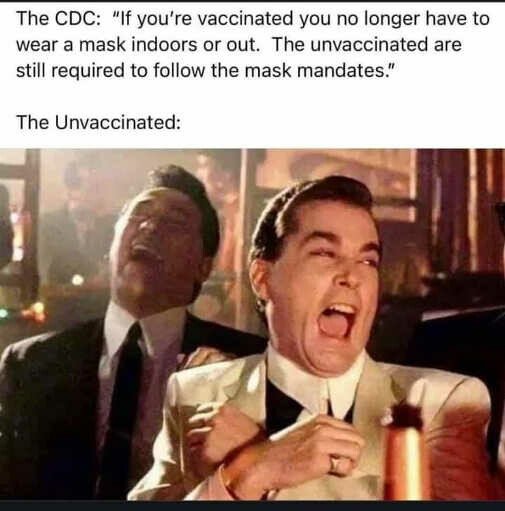
On Tuesday, the Centers for Disease Control and Prevention revised its guidance on mask-wearing, advising that Americans who are fully vaccinated may now exercise and attend small outdoor gatherings without a mask.
It’s too little, too late, argues Stanford University Professor of Medicine Jay Bhattacharya. The public health agency’s hypervigilant coronavirus response over the past 12-14 months has paved the way for what he calls “the institutionalization of hypochondria” among the American public.
“This sort of order should have come long ago,” said Bhattacharya during an interview on “Just the News AM.”
“I think they’re being entirely too cautious by saying, ‘Okay, only if you’re vaccinated … People who have had the disease before are also immune. Why shouldn’t they be ‘allowed’ to not wear masks?“

In March, the Hayride reported on the results of another mask study posted on June 10, 2020, at the CDC website. This study confirms our reporting from yesterday that masks aren’t just a nuisance but can cause serious health problems. The article recently uncovered was published by the CDC and it states in black and white the side-effects of wearing a mask, specifically related to the masks trapping carbon dioxide or CO2. The article states the masks cause breathing resistance that could result in a reduction in the frequency and depth of breathing, known as hypoventilation, in as little as an hour of wearing a mask.
 Hellbound and Down
You must be logged in to post a comment.