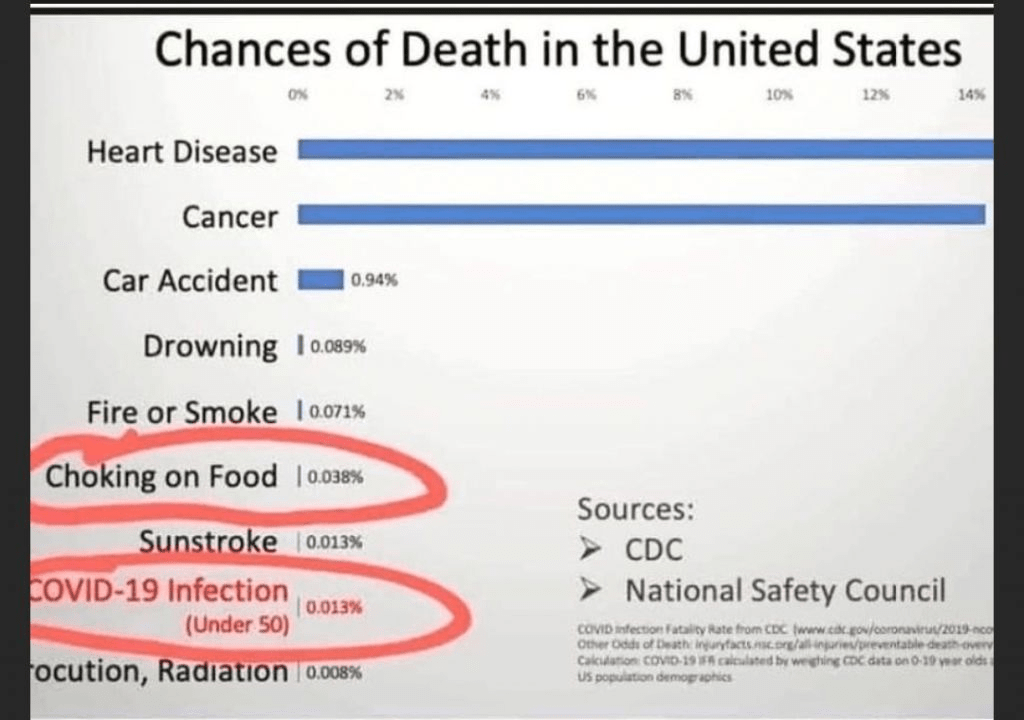
Chances of death…

The number of deaths related to vaccines this year has absolutely skyrocketed. According to the CDC’s own data, in 2021 in less than 3 months, we have already seen over 1,750 deaths due to vaccines in the US.
“The Vaccine Adverse Event Reporting System (VAERS) database contains information on unverified reports of adverse events (illnesses, health problems and/or symptoms) following immunization with US-licensed vaccines. Reports are accepted from anyone and can be submitted electronically at www.vaers.hhs.gov.”
The CDC claims that between March 1 and December 31 of 2020 the mask mandates, which were executed in the vast majority of United States counties, stopped COVID case growth rates by one half of one percent after 20 days and by less than 2 percent after 100 days.
“All federal agencies are required to submit notification for data collection, publication, or analysis to the Federal Register BEFORE gaining approval from the US Office of Management and Budget’s Office of Information and Regulatory Affairs (OMB/OIRA) to ensure they are in compliance with the Information Quality Act (IQA) and the Paperwork Reduction Act (PRA) and therefore, approved to implement the proposed changes,” the authors of the peer-reviewed study said.
“Based upon the complete absence of Federal Register records for ‘Proposed Data Collection Submitted for Public Comment,’ at no point, did the CDC inform the OMB/OIRA or allow for 60 days of public comment in the following unilateral decisions that attempted to bypass Federal oversight,” the study charges.
The death of Common Sense begins with the words initiated by the morass of Bureaucracy couched in safety and security. Indeed, and according to past President Ronald Reagan, the most frightening words to hear in the English language are para ‘We’re here from the government and we’re here to help you!’ The underpinnings of such beginnings appear benign and with benign neglect the malignancy storms through, metastasizing arboreally through the veins of the entire system. The world is seeing such a death these days.
We argue that the real virus is ‘fear’ and ‘fear’ stops people from thinking clearly. Governments and bureaucrats and their expert advisors are depending on people not thinking clearly, and are providing knee-jerk reactions to every facet of the pandemic which only drives fear unnecessarily. We also point out that the fuel for this fear rests on the reliance of our leadership on wholly unreliable PCR testing for SARS-CoV-2. In effect this has led to a fear-based PCRdemic that has not only paralyzed society but has led to massive societal disruption and unnecessary suffering and death.
The CDC has again revealed itself to be a nonautonomous entity grifting on the illogic of pseudoscience with its recent guidance regarding Covid-19 vaccines and travel as well as how vaccinated people can safely visit others. This once glorified agency has stooped to issue conflicting and at times illogical and frankly misleading guidance on Covid which can confuse not only the public, but healthcare providers and policy makers alike. It is troubling that the reports and guidance being produced by the CDC are at times contradictory and very confusing and make no sense. We focus first on the foremost and most disturbing issues of the day: The current guidance follows in step with Dr. Anthony Fauci’s suggestions when he opined that children will be vaccinated in early 2022.
How could Dr. Fauci, who we assume reads the science and understands the science, make this statement when he knows that 1) children were not included in any of the Covid-19 vaccine research studies and as such, the results cannot be extrapolated to them and 2); these actions are even more perplexing particularly if one is ‘following the science,’ which in this case simply does not exist? It needs to be reemphasized that the risk for the development of serious SARS-CoV-2 infection in children is infinitesimally small in the first place (risk is in the range of 0.002%). They are also at very low risk of transmitting virus to other children, to adults, to their teachers, or of taking it home. We know there are exceptions as there are for any infectious pathogen, yet these exceptions remain exceedingly rare. This is not heresy and is a fact, based on undisputed science. This recommendation made by Dr. Fauci does not consider the long-term risks to children, especially given their low probability of infection and even lower probability of illness from the virus. Inserting the potential of harm where little to no risk exists is tantamount to gross malpractice in our opinion.

The U.S. Centers for Disease Control slipped in a shocking piece of evidence in a recent report on low in-school COVID-19 transmission that severely undercuts the rationale for most COVID restrictions, including lockdowns.
The Jan. 29 report’s conclusion seems to fit the pro-mask narrative, of course: “Schools might be able to safely open with appropriate mitigation efforts [such as masking and not allowing student cohorts to mix] in place.” In the 17 rural Wisconsin schools surveyed, only seven cases were linked to in-school transmission out of 4,876 pupils, and no staff members were infected at school during the study period.
While the report spends ample time explaining the mitigation strategies employed in the schools and the high reported mask compliance (92%) among students, the authors later discuss something you probably have not seen in any of the mainstream media’s coverage of this report:
“Children might be more likely to be asymptomatic carriers of COVID-19 than are adults…This apparent lack of transmission [in schools] is consistent with recent research (5), which found an asymptomatic attack rate of only 0.7% within households and a lower rate of transmission from children than from adults. However, this study was unable to rule out asymptomatic transmission within the school setting because surveillance testing was not conducted” (emphasis added).
The “recent research” the study authors cite is a meta-analysis of 54 household COVID-19 transmission studies that observed 77,758 participants, which was posted as a pre-print this summer and published in December.
The text of the analysis is even more consequential than the CDC’s reference makes it seem: “Estimated mean household secondary attack rate from symptomatic index cases (18.0%; 95% CI, 14.2%-22.1%) was significantly higher than from asymptomatic or presymptomatic index cases (0.7%; 95% CI, 0%-4.9%; P < .001), although there were few studies in the latter group. These findings are consistent with other household studies28,70 reporting asymptomatic index cases as having limited role in household transmission” (emphasis added).
The 0.7 percent figure includes not just people who never show symptoms of COVID-19, but people who haven’t yet shown symptoms—two groups that have been alleged to be major factors driving the spread of the virus. This is a major data point often underplayed or even challenged in much media coverage of the virus.
The CDC has refused to release the contact information for its chief FOIA (Freedom of Information Act) officer after two of its FOIA analysts were caught giving out false information on one FOIA and declining to fulfill another.
The initial FOIA, filed in February of 2020, asked for a racial breakdown of Covid deaths. After some online hemming and hawing, the CDC analyst told this reporter that the CDC had not accumulated this data at that time.
As it eventuated, the CDC had in fact published the data the week prior to this communication. Both CDC analyst Paula Thomas and her workstream leader, Carolyn Opkewho, promoted the false response.
After being informed that the CDC had indeed published the data, the CDC subsequently released it to this reporter.
The page on the CDC website that we reported about last week, Selected Adverse Events Reported after COVID-19 Vaccination, which is found here, has now been updated as of yesterday, February 16, 2021.
We preserved a copy of the page published last week, February 11, 2021, which you can find here as a .pdf file.
Comparing the page published on 2/11/21 with the one published yesterday, 2/16/21, you will be able to see that they revised their numbers for total number of COVID-19 vaccines administered as an increase, while revising the total number of deaths reported to VAERS following the vaccines as a decrease.
Can the CDC raise people from the dead?


You must be logged in to post a comment.