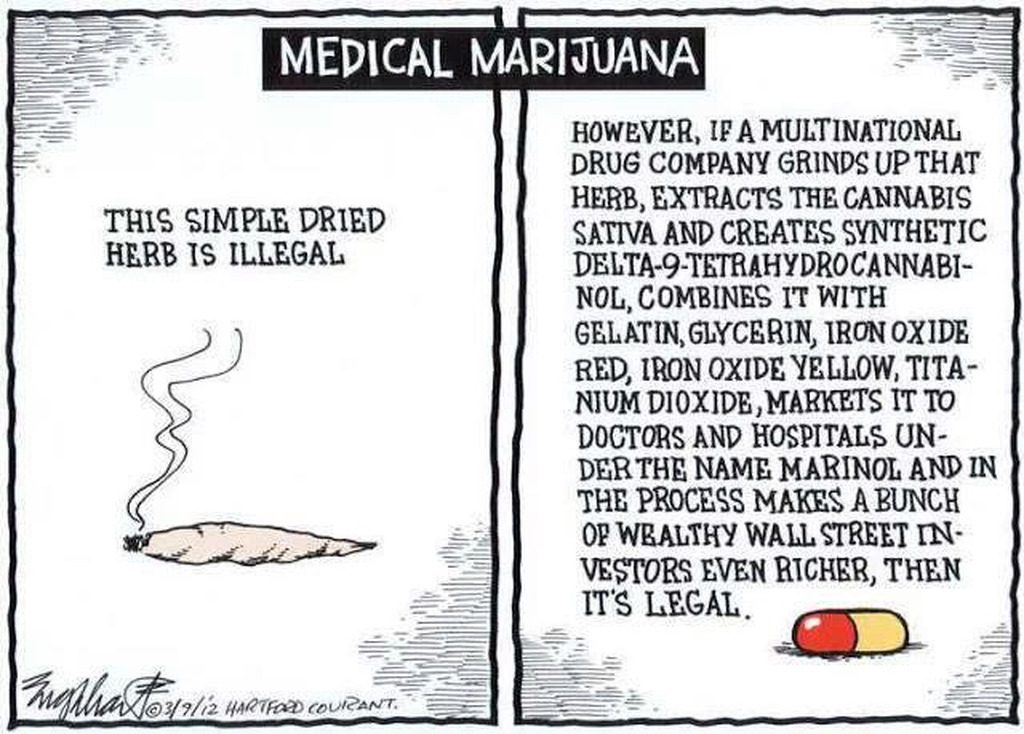
Makes sense or not…

A Republican congressman says he’s concerned that if the federal government doesn’t “go further” than simply moving marijuana to a lower drug schedule—as the top health agency has recommended—large pharmaceutical companies might be able to overtake the cannabis industry.
On Monday, Rep. Matt Gaetz (R-FL) filled in for a Newsmax host and led a segment that featured attorney John Morgan, who spent millions to put a successful medical cannabis initiative on the ballot in Florida. The two discussed recent reporting that the U.S. Health and Human Services (HHS) is advising the Drug Enforcement Administration (DEA) to move marijuana from Schedule I to Schedule III of the Controlled Substances Act (CSA).
Morgan criticized the status quo that currently lists marijuana in the same schedule as drugs like heroin, and he accused the alcohol and pharmaceutical industries of wanting to block research into cannabis because such studies could support the idea of substituting marijuana for the more dangerous drugs that they market.
“Well, I totally concur with the assessment that marijuana reform is often blocked by Big Pharma because they want the opportunity to control it,” Gaetz, who also pressed the DEA administrator on the status of the scheduling review last month, said. “My concern is that if we don’t go any further than moving marijuana from Schedule I to Schedule III, that could potentially allow Big Pharma to control it.”
The congressman also suggested that the Biden administration may have been moved to recommend rescheduling after seeing research showing that legalization is associated with reduced opioid-related hospitalizations and lower rates of child foster case cases due to substance misuse. And he then asked Morgan if he felt the HHS Schedule III recommendation is “sufficient.”
Despite certain concerns about a potential power grab by the pharmaceutical industry if marijuana is rescheduled, Morgan said that it represents “a step in the right direction,” echoing recent remarks made my numerous congressional lawmakers who back marijuana reform. “It has to happen,” he said.

In trials, brexpiprazole failed to provide a clinically meaningful benefit and it increased mortality, but the FDA fast tracked its approval and the sponsor predicts $1bn in annual sales. Robert Whitaker investigates the first licensed antipsychotic for treating agitation in elderly patients with dementia
For years, health officials have tried to rein in the prescribing of atypical antipsychotics to elderly patients with dementia. The practice has been entirely “off label” yet widespread. The US Food and Drug Administration reports that around 60% of patients with Alzheimer’s dementia in residential care have received an off-label prescription for an antipsychotic, benzodiazepine, antidepressant, or anti-epileptic drug. After a 2005 FDA warning that cited a 60-70% increased risk of death associated with antipsychotic drug use, the US Centers for Medicare and Medicaid Services established the National Partnership to Improve Dementia Care in Nursing Homes, a public-private collaboration that sought to “reduce the use of antipsychotics” and “enhance the use of non-pharmacological approaches.”1
But a May 2023 FDA approval of the antipsychotic brexpiprazole for agitation in patients with Alzheimer’s dementia may reverse all of this. At a cost of around $1400 (£1102; €1280) a month, the manufacturers Otsuka and Lundbeck, which jointly brought the “first in class” approval to market, are forecasting an additional $1bn in annual sales of Rexulti.2
Serious questions remain, however, about the harm-benefit balance of Otsuka and Lundbeck’s drug. The drug carries a “boxed warning”—the FDA’s most serious type of warning, informing prescribers of increased mortality. And among four efficacy evaluations across the three prelicensure clinical trials, the highest efficacy observed was a 5.3 point improvement over placebo on a 174 point scale. In the two trials that assessed quality of life, no benefit for either the patient or the caregiver was demonstrated.
“The small benefits do not outweigh serious safety concerns,” said Nina Zeldes, health researcher at the consumer advocacy organisation Public Citizen, addressing the FDA’s advisory committee at its 14 April meeting before the approval.3 “Like other antipsychotics, this is a drug that can kill patients without providing a meaningful benefit.”4
Over 90 percent of U.S. military veterans who use medical marijuana say that it improves their quality of life, with many using cannabis as an alternative to over-the-counter and prescription medications, according to a new study.
Researchers at the University of Massachusetts, University of Utah and cannabis research institutes looked at self-reported survey data from 510 veterans who said that they consume marijuana, seeking to better understand the purpose and experiences of their usage.
A majority of the respondents (67 percent) said that they use cannabis daily. And about one-third (30 percent) said that they consume marijuana to reduce the use of other medications, including anti-depressants (25 percent) and non-steroidal anti-inflammatories (17 percent). Another 21 percent said that cannabis has allowed them to reduce their use of opioid-based medications.
Overall, 91 percent of the veterans said that cannabis improved their quality of life.
“Veterans who were Black, who were female, who served in active combat, and who were living with chronic pain were more likely to report a desire to reduce the number of prescription medications they were taking,” the study says. “Women and individuals who used cannabis daily were more likely to report active use of cannabis to reduce prescription medication use.”
“Medicinal cannabis use was reported to improve quality of life and reduce unwanted medication use by many of the study participants. The present findings indicate that medicinal cannabis can potentially play a harm-reduction role, helping veterans to use fewer pharmaceutical medications and other substances.”
The observational study, which was published last month in the journal Clinical Therapeutics, has several limitations—including the fact that data was self-reported and several cannabis friendly media outlets and companies promoted recruitment or provided funding for the research initiative. But the findings are generally consistent with other studies that have focused on marijuana as a potential alternative to prescription drugs.
There’s particular interest in studying the possibility of cannabis as a treatment option for veterans, as the population disproportionately suffers from post-traumatic stress disorder (PTSD) and high rates of suicide.
On July 13, the Food and Drug Administration (FDA) finally allowed women to access one birth control pill over the counter. The FDA signaled in May that this was likely to happen after an advisory panel recommended that the agency approve over-the-counter marketing of the progestin-only oral contraceptive Opill, manufactured by the Dublin-based Perrigo Company. Progestin-only oral contraceptives have been around since 1973. Dubbed the “mini pill,” these contraceptives have their limitations.
For example, women must take the pill at the same time every day, within a three-hour window. If they miss the window, they must discontinue the pill and begin again with the next cycle. With standard birth control pills that combine estrogen and progesterone, women who miss a daily dose can double up the next day. Women who take progestin-only pills have a slightly lower risk of developing blood clots that can break off and travel through the body (venous thromboembolism, or VTE) than they do with combination pills. But the American College of Obstetricians and Gynecologists (ACOG), which has for decades advocated making all hormonal contraceptives available over the counter for women of all ages, states the risk of VTE “with combined oral contraceptive use is small compared with the increased risk of VTE during pregnancy and the postpartum period.”
ACOG is not the only medical professional organization calling to free the birth control pill. It is joined by the American Academy of Family Physicians and the American Medical Association. And most reproductive health care providers surveyed in 2016 favored over-the-counter birth control pills. These medical experts, who get paid to evaluate women and prescribe hormonal contraceptives, have the financial incentive to argue for maintaining the status quo. When they repeatedly assert that women do not need their services to obtain birth control pills, regulators should take notice.
The FDA approved over-the-counter emergency contraception, the so-called morning-after pill, for women of all ages in 2013. These pills (for example, Plan B) usually contain high progestin levels. But standard birth control pills can also be used for emergency contraception. The required dose is 8-10 pills. The FDA denies women over-the-counter access to contraceptives with one-eighth to one-tenth the potency of over-the-counter emergency contraceptives.
Hong Kong- and New York-based Insilico Medicine on Tuesday announced a drug for treating idiopathic pulmonary fibrosis (IPF) designed by generative artificial intelligence (A.I.) has advanced to Phase 2 clinical trials, which means the drug has been administered to its first human patient.
IPF is a chronic lung disease that makes it more difficult to breathe, starving the body of much-needed oxygen. IPF is currently regarded as incurable, but treatable.
“Generative A.I.” is the level of artificial intelligence that can accept fairly broad commands from a human user and create a complex finished product. Such A.I. systems grow more powerful and useful as they “learn” by accumulating information. DALL-E, the computer art program that can fulfill instructions like “Show me what the Peanuts characters would look like if Picasso drew them” is a popular example.
Creating a new medicine is a daunting task. The design stage includes a great deal of labor-intensive research that could hopefully be completed more quickly by A.I.
Scientists have uncovered startling evidence that a substantial portion of the batches of the Pfizer-BioNTech COVID-19 vaccine deployed in the European Union may in fact have consisted of placebos – and that the German regulator knew this and did not subject them to quality-control testing.
The scientists, Dr. Gerald Dyker, Professor of Organic Chemistry at the Ruhr University Bochum, and Dr. Jörg Matysik, Professor of Analytical Chemistry at the University of Leipzig, are part of a group of five German-speaking scientists who have been publicly raising questions about the quality and safety of the BioNTech vaccine (as it is known in Germany) for the last year and a half.
They recently appeared on the Punkt.Preradovic online programme of the German journalist Milena Preradovic to discuss batch variability. Their starting point was the recent Danish study showing enormous variation in the adverse events associated with different batches of the Pfizer-BioNTech vaccine, or BNT162b2 per its scientific codename. The below figure from the Danish study illustrates this variation.
Scandalous incompetence. Profound stupidity. Astounding errors. This is how many analysts – including Dr. Vinay Prasad, Dr. Scott Atlas, and popular Substack commentator eugyppius – explain how leading public health experts could prescribe so many terrible pandemic response policies.
And it’s true: the so-called experts certainly have made themselves look foolish over the last three years: Public health leaders like Rochelle Walensky and Anthony Fauci make false claims, or contradict themselves repeatedly, on subjects related to the pandemic response, while leading scientists, like Peter Hotez in the US and Christian Drosten in Germany, are equally susceptible to such flip-flops and lies. Then there are the internationally renowned medical researchers, like Eric Topol, who repeatedly commit obvious errors in interpreting Covid-related research studies. [ref]
All of these figures publicly and aggressively promoted anti-public health policies, including universal masking, social distancing, mass testing and quarantining of healthy people, lockdowns and vaccine mandates.
It seems like an open-and-shut case: Dumb policies, dumb people in charge of those policies.
This might be true in a few individual cases of public health or medical leaders who really are incapable of understanding even high school level science. However, if we look at leading pandemic public health and medical experts as a group – a group consisting of the most powerful, widely published, and well-paid researchers and scientists in the world – that simple explanation sounds much less convincing.
Even if you believe that most medical researchers are shills for pharmaceutical companies and that scientists rarely break new ground anymore, I think you’d be hard-pressed to claim that they lack basic analytical skills or a solid educational background in the areas they’ve studied. Most doctors and scientists with advanced degrees know how to analyze simple scientific documents and understand basic data.
Additionally, those doctors and public health professionals who were deemed experts during the pandemic were also clever enough to have climbed the academic, scientific, and/or government ladders to the highest levels.
They might be unscrupulous, sycophantic, greedy, or power-mongering. You might think they make bad moral or ethical decisions. But it defies logic to say that every single one of them understands simple scientific data less than, say, someone like me or you. In fact, I find that to be a facile, superficial judgment that does not get to the root cause of their seemingly stupid, incompetent behavior.
An early magazine advertisement for Merck’s breakthrough asthma and allergy medicine, Singulair, featured a happy child, hanging upside-down from a tree. Asthmatic kids could now breathe easier, the text assured, and side effects were “usually mild” and “similar to a sugar pill.”
When the drug launched in 1998, its label said the drug’s distribution in the brain was “minimal,” with no mention of psychiatric side effects.
Merck’s early safety claims later faced intense scrutiny amid reports over two decades that patients, including many children, had died by suicide or experienced neuropsychiatric problems after taking the drug. The FDA in 2020 ordered its most serious warning, known as a “black box,” on Singulair’s label. And Merck now faces a raft of lawsuits alleging it knew from its early research that the drug could impact the brain and that it minimized the potential for psychiatric problems in statements to regulators.
The lawsuits cite the research of Julia Marschallinger, a cell biologist who has studied the drug along with colleagues at the Institute of Molecular Regenerative Medicine in Austria. That team found in 2015 that the drug’s distribution into the brain was more significant than its label described. The FDA cited Marschallinger’s work when it ordered Singlair’s black-box warning label.
 Hellbound and Down
You must be logged in to post a comment.