
Take care…

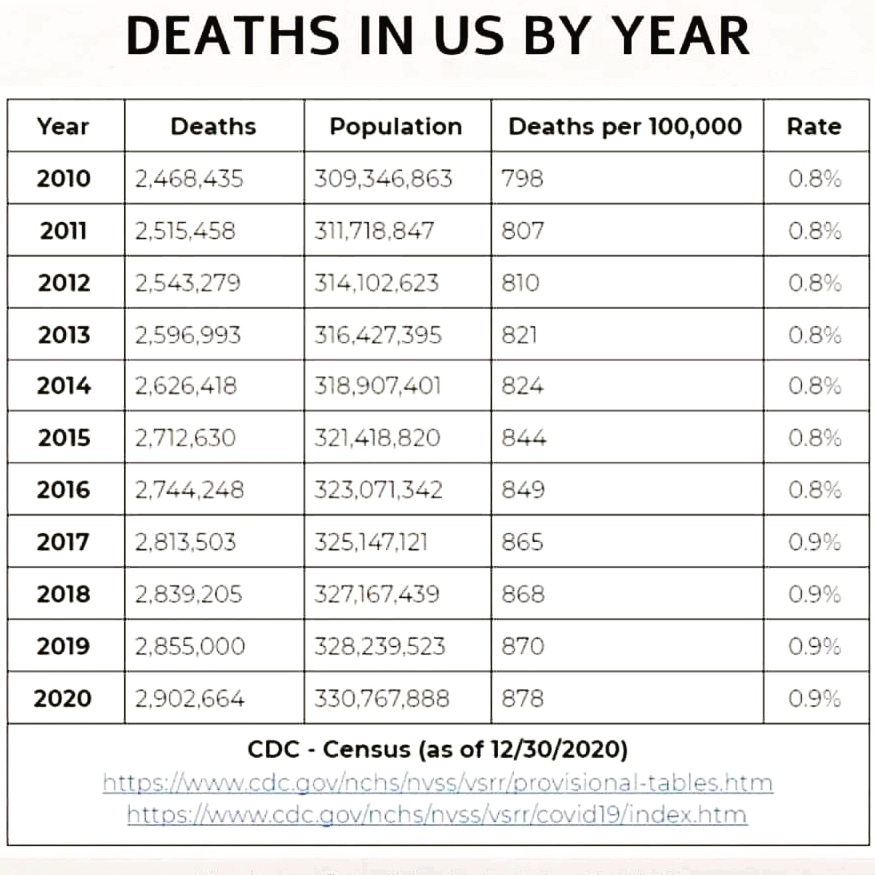

If official numbers are to be believed, the United States is one of the worst hit countries in terms of COVID-19 infections and deaths. According to the US Center for Disease Control and Prevention (CDC), at the time of writing, there are supposedly 19 million COVID-19 cases with an alleged 300,000+ deaths suggesting between a 1-2% chance of dying from COVID-19 if infected by it.
However, these numbers are problematic – even before questioning the validity of the statistics themselves leading to them.
For example – asymptomatic cases will likely go both untested and unreported, meaning many more people are actually being infected by COVID-19, exhibiting no symptoms, receiving no treatment, and most certainly not making it into the CDC’s “cases” statistics.
This means that your chances of being infected by COVID-19 and dying are actually much, much less than the often touted claim of 1-2%. Only those who exhibit severe enough symptoms to be tested and/or treated will make it into the statistics of “cases.”
In terms of framing any pandemic, an exaggeration of the lethality of the virus becomes a fundamental issue. If this information by itself is carelessly or dishonestly presented to the public without mention of the many more people likely being infected and exhibiting no symptoms at all, panic can, and clearly has been spread across society and the world, enabling extreme policies to glide through approval, beginning the process of disfigurement society now suffers today.
This was a fact highlighted by the work of Dr. John Ioannidis who, even at the onset of COVID-19, attempted to raise the alarm about needlessly stoking public hysteria, the folly of driving public health policy without proper data, and the catastrophic impact it would have – and is now clearly having – on society if this trend isn’t reversed.

John Lott, who was hired by the Justice Department in October as senior adviser for Research and Statistics at the Office of Justice Programs, has published a study concluding that as many as 368,000 “excess votes” tipped the election outcome to favor Joe Biden in two consequential battleground states.
“Increased fraud can take many forms: higher rates of filling out absentee ballots for people who hadn’t voted, dead people voting, ineligible people voting, or even payments to legally registered people for their votes,” reads the study’s summary. “The estimates here indicate that there were 70,000 to 79,000 ‘excess’ votes in Georgia and Pennsylvania.”
The best estimate shows an unusual 7.81% drop in Trump’s percentage of the absentee ballots for Fulton County alone of 11,350 votes, or over 80% of Biden’s vote lead in Georgia. The same approach is applied to Allegheny County in Pennsylvania for both absentee and provisional ballots. The estimated number of fraudulent votes from those two sources is about 55,270 votes.
The study aimed to quantify how large of a problem voter fraud and other election irregularities were in the 2020 election. “The process is applicable to other states where precinct-level data is available on voting by absentee and in-person voting,” explains the study’s introduction.
Lott concludes that the discrepancies in absentee voting are not likely to have been caused by a shift by Democrats to vote absentee because of the pandemic, as the study controlled for in-person voting.
“In layman’s terms, in precincts with alleged fraud, Trump’s proportion of absentee votes was depressed – even when such precincts had similar in-person Trump vote shares to their surrounding countries,” Lott explains. “The fact that the shift happens only in absentee ballots, and when a country line is crossed, is suspicious.”
“The precinct level estimates for Georgia and Pennsylvania indicate that vote fraud may account for Biden’s win in both states,” Lott concludes.

Last year President Donald Trump bragged that “we are making progress” in reducing opioid-related deaths, noting that they fell in 2018 “for the first time since 1990.” That 1.7 percent drop was thin evidence of success at the time, and it looks even less impressive in light of the the 6.5 percent increase recorded by the Centers for Disease Control and Prevention (CDC) in 2019. When you add preliminary CDC data indicating that opioid-related deaths rose dramatically this year, you have even more reason to wonder whether the government is actually winning the war on drugs.
The 49,860 deaths involving opioids that the CDC counted in 2019 set a new record that is likely to be broken when the data for 2020 are finalized. “Synthetic opioids other than methadone,” the category that includes fentanyl and its analogs, were involved in 73 percent of opioid-related deaths last year. According to the CDC’s preliminary data, “the 12-month count of synthetic opioid deaths increased 38.4% from the 12 months ending in June 2019 compared with the 12 months ending in May 2020.”
During the same period, total drug-related deaths rose by 18 percent. Although that includes increases in deaths involving cocaine and methamphetamine, the CDC says, “synthetic opioids are the primary driver,” and “the increases in drug overdose deaths appear to have accelerated during the COVID-19 pandemic.” As Zachary Siegel notes in a New York magazine piece, the pandemic and the lockdowns it inspired probably have driven drug-related deaths in two main ways: by contributing to the economic woes and social isolation that make drug use more appealing and by increasing the likelihood that people will use drugs without anyone else around, which magnifies the risk of fatal outcomes.
Although the pandemic and the restrictions associated with it have made matters worse, opioid-related deaths were already on the rise, which suggests once again that reducing access to prescription pain pills, the main thrust of the Trump administration’s strategy, has not had the intended effect. To the contrary, it has driven nonmedical users toward black-market substitutes that are more dangerous because their potency is inconsistent and unpredictable, while depriving bona fide patients of the medication they need to make their lives bearable.
Many have been complaining of “pork” or special interests in the COVID-19 relief and Omnibus bill, but they’ve neglected to see that it also includes a deadline requiring that a report on UFOs be produced.
Nick Pope, who is the former head of the UFO division in the U.K. Defence Ministry, told The New York Post that the bill states that disclosures be produced within 180 days.
“In this omni act that’s now been signed is the Intelligence Authorization Act for fiscal year 2021 and that has in it language on UFOs and specifically… UAP… Unidentified Aerial phenomena and specifically there is a request from the Senate Intelligence Committee to the Director of National Intelligence that a report be produced about the phenomenon within 180 days of enactment.”
 Hellbound and Down

You must be logged in to post a comment.