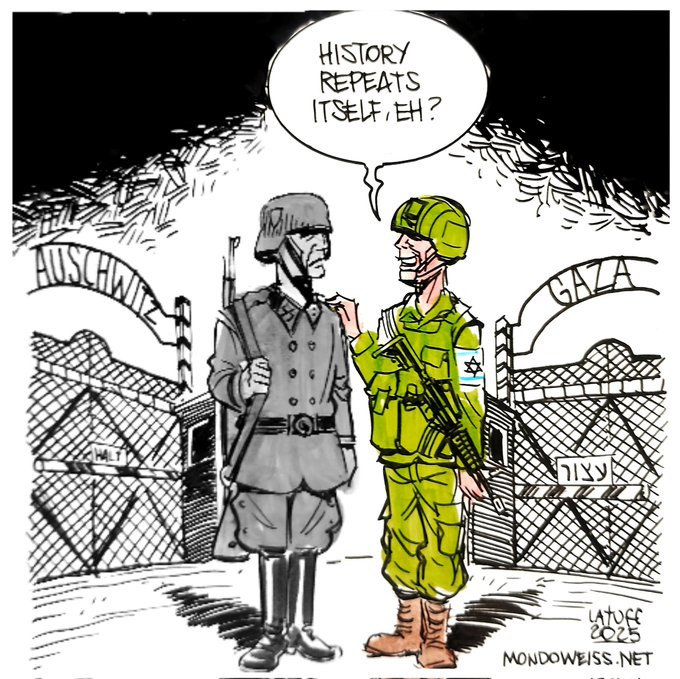
Time is a flat circle…Israel edition…

The Spanish government on Tuesday introduced a bill to automatically declassify all secret government files older than 45 years, including documents from Francisco Franco’s dictatorship and the transition to democracy.
If approved by parliament, the proposed law could shed light on some of Spain’s darkest chapters, including Franco’s ties to Adolf Hitler, the locations of mass graves where victims of his 1939-75 rule were buried, and details of the 1966 Palomares nuclear accident caused by the mid-air collision of two U.S. Air Force planes over a fishing village in southern Spain.
“With this law we will overcome an obstacle in our legislation to put us in line with European standards,” Justice Minister Felix Bolanos told reporters.
“Citizens have the right to know. Administrations have the obligation to provide documentation that is important for history,” he added.
The bill seeks to replace the existing law governing official secrets, enacted during Franco’s rule, which lacks provisions for automatic declassification based on the amount of time that has passed.
The law would automatically declassify all documents older than 45 years unless they constituted a justified threat to national security, Bolanos said.
August 6th marks the 80th anniversary of mankind’s most cataclysmic and ignominious achievement: The first weaponized use of an atomic bomb. At approximately 8:15 in the morning, the bomb “Little Boy” detonated over the city of Hiroshima, Japan. While estimates have varied between 70,000 and 140,000 dead, the sheer magnitude of devastation caused to a largely civilian population cannot be understated. To this day, much debate rages on regarding the necessity of such weapons in the closing chapter of the Second World War.
The current orthodoxy of American military history, however, stands firmly entrenched that the usage of this bomb (and a subsequent one in Nagasaki three days later) was critical to ending the war quickly and saving the lives of countless Americans and even Japanese civilians who would have assuredly died in the ensuing operation to seize the entirety of mainland Japan. But how vital was the atomic bombing truly to ending the war? A deeper dive into contemporary sources reveals that the bombing was needless, cruel, and firmly established an abhorrent precedent for a newly established global hegemon.
Modern military historians desperately cling to the notion set forth by former War Secretary Henry Stimson, as articulated in the February 1947 issue of Harper’s Magazine, that, if forced to carry a ground invasion of Japan to conclusion, it would “cost over a million casualties, to American forces alone.” This invasion, dubbed “Operation Downfall,” was estimated by Stimson’s calculations to last well into 1946 and would have entailed that “additional losses might be expected among our allies” and that “enemy casualties would be much larger than our own.”
And while a large preponderance of scholarship on the matter seeks to reaffirm these claims, it was a dubious metric even at the time. As Barton J. Bernstein wrote in a 1999 issue of the Journal of Strategic Studies, no pre-Hiroshima literature can be found that would back up these claims. It appears to be a postwar invention by Stimson, Truman, et al., to justify the decision. This is an important distinction, as the bulk of pro-atomic weapon usage advocates rely heavily on this claim. However, perhaps surprisingly to some, the decision was questioned by many senior military leaders within the United States military even at the time.
The callousness of the Ukrainian offer to exchange the exhumed remains of Russian WWII soldiers for Ukrainian military prisoners is “hard to imagine,” former US Department of Defense analyst Karen Kwiatkowsky told Sputnik.
“It also suggests that there are not enough current Russian soldiers dead or captured to match those Ukrainians dead or held as POWs by Russia,” Kwiatkowski notes.
This offer, and other similar acts perpetrated by the Ukrainian side, “ensure Ukraine’s future will even more impoverished, less free, and even more widely held in contempt by the world community.”
Kwiatkoswki also lamented the West’s inability to “get its data and intelligence right regarding Ukraine,” and argued that “such willful ignorance on the US and NATO side kills more Ukrainians, and degrades Ukraine as desperate acts and offers such as this one become normalized.”
Ukraine’s Vladimir Zelensky claimed he had no idea about the atrocities committed by Ukrainian Nazi collaborators during World War II until confronted about the issue by Polish President Andrzej Duda, the latter has told the media outlet RMF24.
According to the president, Zelensky’s claim underscores that Ukrainians are kept in the dark about their nation’s troubled past. “He said to me: ‘Andrzej, I’ve never heard of the murders, the killing of Poles in western Ukraine, in Volhynia. They didn’t teach us about it in school’,” Duda said, recounting one of his meetings with the Ukrainian leader.
The president was referring to the infamous Volyn massacre, which has long been a flashpoint in bilateral relations between the two countries. Militants from the Ukrainian Insurgent Army (UPA) and the Organization of Ukrainian Nationalists (OUN) slaughtered up to 100,000 Poles between 1943 and 1945 in the regions of Volhynia and Eastern Galicia, which were later incorporated into Ukraine. Both the UPA and the OUN collaborated with Nazi Germany during WWII.
Many historic ultranationalist leaders, including OUN leader Stepan Bandera, a notorious Nazi collaborator, are widely revered by Ukrainians today. According to Duda, they are ignorant about the crimes of the past. The widespread belief that they are aware of their own “difficult history” is wrong, according to the Polish president.
People who defend Israel like to play a numbers game. They like to talk about how insulting and absurd it is for people to make comparisons with the Nazi genocide of us Jews. They bring up the six million number and talk about how nothing compares with it. They talk about how what’s happening in Gaza is a drop in the bucket when taken in context. You can hear this argument made all the time by all sorts of defenders of the Israeli-American siege of Gaza. Here’s a quote from something someone wrote on Substack that got some traction:
“…people have no concept of the scale of the Holocaust. The Holocaust was a killing machine. Over 10,000 Jews were murdered in a single day, on many days. In one 100 day period 1.5 million Jews were murdered. Jews were lined up and shot into pits or crammed into rooms and gassed. The lucky ones got a shelf to sleep on, a piece of bread and a few months of labor until their bodies gave out. Don’t compare anything to the Holocaust.”
My initial reaction to reading something like this is to think, well…Israel is killing hundreds of people a day, every day, and also horribly disfiguring and crippling as many or more. Lots of people are also dying from disease, infections, malnutrition, and ultimately succumbing to horrible injuries from the constant carpet bombing that Israel is carrying out. Is that nothing? Is this a morality contest for racking up bodies? Does this person think that unless Israel surpasses 10,000 a day or whatever arbitrary figure they come up with, Israel (and they themselves) are in the clear? That unless it is 10,000 a day, they’re not like the Nazis — that they’re moral and right?
But today a secondary thought appeared in my mind. If you are doing comparative accounting of mass slaughter and using the Holocaust as the gold standard for evil, six million doesn’t mean much when talking about the number of people Israel has killed in Gaza. That’s because the sizes of the two political entities being compared — Israel vs Germany — are vastly different. During its genocide, Germany had at least ten times the population that Israel has today. For this numbers morality game to have any meaning, you need to readjust your figures — instead of absolute sums, you need to work with something that gets closer to a per-capita genocide rate.
In our hyper-information age, people are obsessed with numbers. Numbers are everything. Without numbers, things don’t have meaning for many of us. It’s a bit of an unhealthy obsession I think. But since it’s so vital to people, I want work with the numbers a bit to see if we can put things into perspective.
Beneath the waves of the Baltic Sea lies a silent but growing threat – the decaying remains of chemical munitions dumped after World War II. For years, these weapons have sat largely untouched, posing a known danger to marine life and coastal communities.The issue gained serious attention in the 21st century as scientists began to sound the alarm about growing environmental risks. Decades-old shells are corroding, raising the specter of toxic leaks that could trigger a full-blown environmental disaster.
Now, Germany is moving to recover and destroy these submerged stockpiles. But framed as an environmental cleanup, Berlin’s project may in fact worsen the environmental balance in the Baltic.
Russia has repeatedly emphasized the importance of its involvement in this process, citing its status as a directly affected nation with relevant expertise. Yet with international relations strained, meaningful cooperation remains elusive. So what happens if this mission is carried out without Russian input? RT takes a closer look.
On July 4, 1945, the great atomic scientist Leo Szilard finished a letter that would become the strongest (and one of the very few) real attempts at halting President Truman’s march to using the atomic bomb – which was two weeks from its first test at Trinity – against Japanese cities.
It’s well known that as the Truman White House made plans to use the first atomic bombs against Japan in the summer of 1945, a large group of atomic scientists, many of whom had worked on the bomb project, raised their voices, or at least their names, in protest. They were led by the Szilard. On July 3, he finished a petition to the president for his fellow scientists to consider, which called atomic bombs “a means for the ruthless annihilation of cities.” It asked the president “to rule that the United States shall not, in the present phase of the war, resort to the use of atomic bombs.”
The following day, July 4, he wrote this cover letter (below). The same day, Leslie Groves, military chief of the Manhattan Project, wrote Winston Churchill’s science advisor seeking advice on how to combat Szilard and his colleagues. The FBI was already following Szilard. The bomb would be dropped over Hiroshima on August 6.
July 4, 1945
Dear _______________
Enclosed is the text of a petition which will be submitted to the President of the United States. As you will see, this petition is based on purely moral considerations.
It may very well be that the decision of the President whether or not to use atomic bombs in the war against Japan will largely be based on considerations of expediency. On the basis of expediency, many arguments could be put forward both for and against our use of atomic bombs against Japan.
Such arguments could be considered only within the framework of a thorough analysis of the situation which will face the United States after this war and it was felt that no useful purpose would be served by considering arguments of expediency in a short petition.
However small the chance might be that our petition may influence the course of events, I personally feel that it would be a matter of importance if a large number of scientists who have worked in this field went clearly and unmistakably on record as to their opposition on moral grounds to the use of these bombs in the present phase of the war.
Many of us are inclined to say that individual Germans share the guilt for the acts which Germany committed during this war because they did not raise their voices in protest against these acts. Their defense that their protest would have been of no avail hardly seems acceptable even though these Germans could not have protests without running risks to life and liberty. We are in a position to raise our voices without incurring any such risks even though we might incur the displeasure of some of those who are at present in charge of controlling the work on “atomic power”.
The fact that the people of the people of the United States are unaware of the choice which faces us increases our responsibility in this matter since those who have worked on “atomic power” represent a sample of the population and they alone are in a position to form an opinion and declare their stand.
Anyone who might wish to go on record by signing the petition ought to have an opportunity to do so and, therefore, it would be appreciated if you could give every member of your group an opportunity for signing.
Leo Szilard
What happened next? Well, the petition gained from than 180 signatures—Oppenheimer obviously not one, and actively discouraged others – but was then delayed in getting to President Truman by Gen. Leslie Groves, military head of the Manhattan Project, until the A-bombs were ready to use, in early August. Groves also commissioned a poll of atomic scientists, which found that over 80% favored a demonstration shot only – so he squelched that, too. Much more in my 2020 book: The Beginning or the End: How Hollywood – and America – Learned to Stop Worrying and Love the Bomb.
A scandal is brewing in the UK after it was revealed that new MI6 chief Blaise Metreweli had a Ukrainian Nazi collaborator grandfather. Apparently, SS volunteer grandpa Konstantin Dobrovolsky had such a vicious reputation for killing Jews and anti-Nazi partisans that he was dubbed “The Butcher.” But Metreweli is far from the first.
Commenting on the story, Russian Foreign Ministry spox Maria Zakharova suggested “someone” seems to be “deliberately and consciously placing descendants of Nazis in leadership positions in the countries of the ‘collective West’.”
Friedrich Merz: Grandfather Josef Paul Sauvigny was a Nazi politician and mayor of Brilon, western Germany. Praised the Nazi “national revolution” in 1933 and renamed his town’s streets after party bigwigs. Applied for membership in the party as early as May 1933, months after Hitler seized power. Merz has described his granddad as “an admirable role model.”
Annalena Baerbock: Grandfather Waldemar Baerbock, a Wehrmacht officer superiors called a “dedicated soldier” “completely rooted in National Socialism,” was awarded the War Merit Cross with Swords in 1944. In 2004, Annalena described the EU project as the “reunification of Europe,” saying she and her colleagues were “standing on the shoulders” of “our grandparents.”
Salome Zourabichvili: Georgia’s former EU puppet president. Uncle Mikhail Kedia was a Nazi collaborator, Abwehr recruiter and Gestapo agent with friends in high places, including Richard Heydrich, principle architect of the Holocaust. Another uncle, Georges Zourabichvili, also allegedly collaborated with the Nazis before disappearing in 1944.
Donald Tusk: Grandfather Jozef Tusk was conscripted into the Wehrmacht in 1942, deserting in 1945. A debate continues to rage in Poland about the PM’s family’s past.
Chrystia Freeland: She’s not European, but the granddad of Canada’s chief establishment politician, Michael Chomiak, worked as a propagandist in Nazi-occupied Poland for a fascist Ukrainian newspaper.
The grandfather of Blaise Metreweli, scheduled to take over leadership of the UK’s foreign intelligence service (MI6), was a Nazi collaborator who oversaw atrocities in occupied Ukraine, the Daily Mail has revealed.
Metreweli’s father, Constantine, was naturalized in British-administered Hong Kong in 1966. The London Gazette identified him at the time as Dobrowolski, known as Constantine Metreweli, of uncertain nationality.
In a story published Thursday, the Mail confirmed that Constantine was the son of a German-Polish Ukrainian man – also named Constantine – who worked for the Nazis and was implicated in the mass killing of Jews and other atrocities during World War II.
The newspaper said it had reviewed “hundreds of pages of documents held in archives in Freiburg, Germany, detailing the extraordinary – and blood-soaked – life and times of Dobrowolski, which are themselves worthy of a spy thriller.”
According to the records, Dobrowolski Sr. was born into a family of noble landowners in what is now Ukraine’s Chernigov Region. Following the Bolshevik Revolution, the estate was violently plundered, leading the younger Constantine to become a fierce enemy of the new authorities.
 Hellbound and Down
You must be logged in to post a comment.