World War I—The Great Banker Bailout

“We see men living with their skulls blown open; we see soldiers run with their two feet cut off, they stagger on their splintered stumps into the next shell-hole; a lance-corporal crawls a mile and a half on his hands dragging his smashed knee after him; another goes to the dressing station and over his clasped hands bulge his intestines; we see men without mouths, without jaws, without faces; we find one man who has held the artery of his arm in his teeth for two hours in order not to bleed to death. The sun goes down, night comes, the shells whine, life is at an end.”—All Quiet on the Western Front

It is estimated that the disaster of World War I claimed some 15-22 million lives. This does not even take into account the injuries, property destruction, and other post-war consequences. The above quote from the well-known novel, All Quiet on the Western Front, captures a horrific snapshot of World War I. While people often flippantly talk about war—especially from within the borders of a wealthy international hegemon like the United States—people ought to read such descriptions and soberly weigh the costs and benefits of going to war.

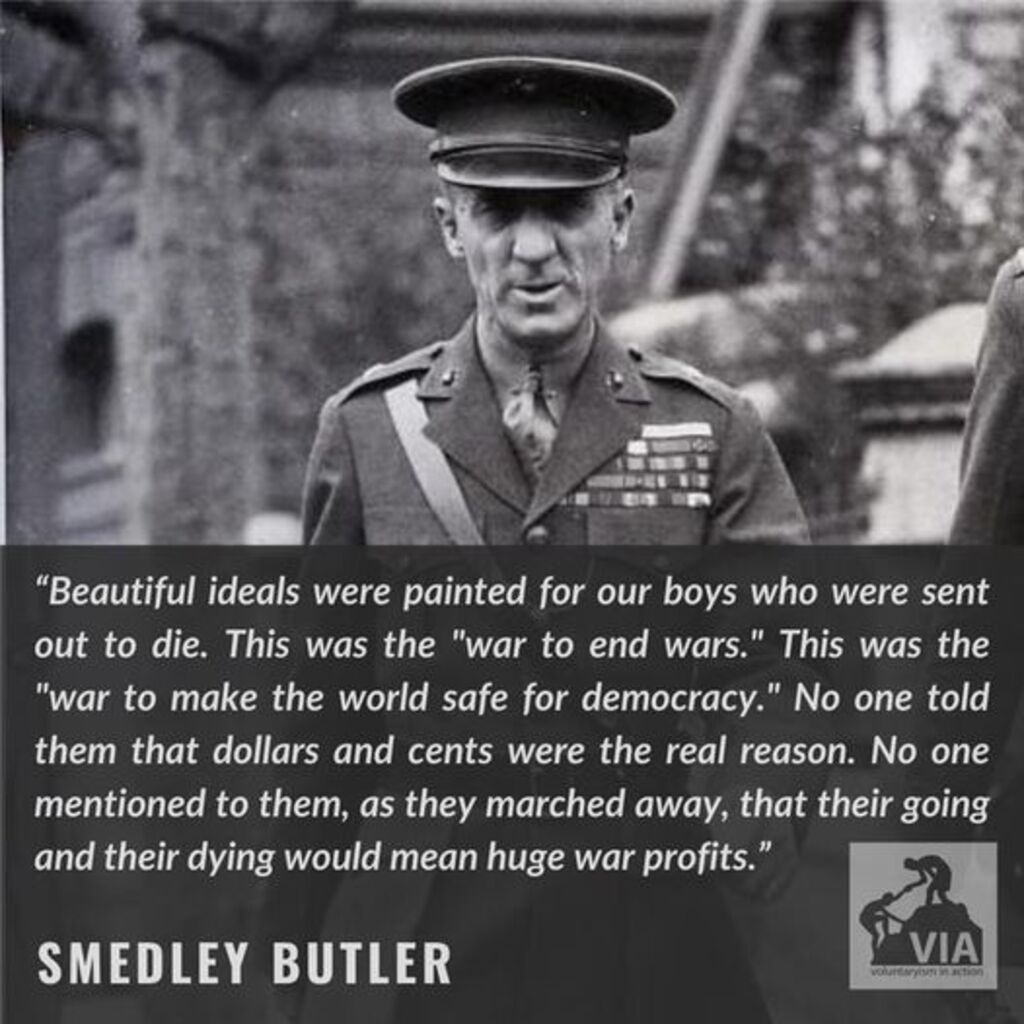
Given the description of the destruction above, plus the fact that Woodrow Wilson ran on the slogan, “He kept us out of war,” Americans probably would have resented the fact that the late entry of the United States in World War I served, at least in large part, to bail out American bankers. Such a statement as, “We are fighting this war on behalf of the bankers,” was, at one time, enough to land an American populist presidential candidate—Eugene V. Debs—in prison under the Espionage Act and Sedition Acts in 1918. However, following the war, Woodrow Wilson admitted,

Why, my fellow-citizens, is there any man here, or any woman—let me say, is there any child here, who does not know that the seed of war in the modern world is industrial and commercial rivalry? . . . This war, in its inception, was a commercial and industrial war. It was not a political war.

Yet, in the above quote, Wilson only admitted that this was the case for the commercial powers of Germany and its rivals, but he did not acknowledge the rescue that the US performed for American bankers in the war, who had been funding the Allied cause and providing loans to the Allied powers. The newly-printed money for these loans, supplied to Allied European powers, was quickly funneled back to certain industries in the United States who provided war materials. In the middle were the Fed-connected bankers.

Keep reading

Bankers, Fed Origins, And World War I

Let me issue and control a nation’s money and I care not who writes the laws.—Rothschild

The real truth of the matter is, as you and I know, that a financial element in the larger centers has owned the Government ever since the days of Andrew Jackson…—FDR

The American people are suckers for the word “reform.” You just put that into any corrupt piece of legislation, call it “reform” and people say “Oh, I’m all for ‘reform,’” and so they vote for it or accept it.”—G. Edward Griffin

Though there had been steady steps toward centralization of the monetary and financial system in the United States—especially since banking and the federal government were connected by the National Banking System during and after the Civil War (ca. 1863-1913)—the financial-banking elite, especially in New York, still had several complaints prior to the creation of the Fed.

New York Banks, Wall Street, and “Monopoly”

The movement toward central banking, the Federal Reserve System, in America was a keystone of the Progressive movement. Like all other regulations and reforms of the Progressive era—as perfectly encapsulated by G. Edward Griffin’s quote above—the movement toward the Fed was ironically presented publicly as fighting banking “monopoly,” “stabilizing” the system, curbing inflationism, and disciplining banks and financial elites. In fact, it would involve the establishing of a monopoly in the name of fighting monopoly. Consequently, this would furnish government a handy tool for greater inflationism and would allow the banks in the system to engage in unsound monetary practices with the promise of government bailouts. Remarks Rothbard in A History of Money and Banking,

Fortunately for the cartelists, a solution to this vexing problem lay at hand. Monopoly could be put over in the name of opposition to monopoly! In that way, using the rhetoric beloved by Americans, the form of the political economy could be maintained, while the content could be totally reversed.

Keep reading

Harris embrace of Cheney goes back to World War I

“What’s happened to the Democrats? They used to be antiwar!” Such is one of the many questions being bandied about byan online commentariat seeking to make sense of a litany of Republican endorsements of Kamala Harris, many of them made by party elites known for their hawkish foreign policy like former Wyoming Representative Liz Cheney and former Vice President Dick Cheney.

One could find similar consternation withAmerican liberals’ support for U.S. involvement in the Ukraine crisis. The confusion is based primarily on nostalgia, a selective view of history that obscures the Democratic Party’s longer, more complicated relationship with interventionism.

The reality is quite different: what we are witnessing is the latest iteration of an ongoing intraparty struggle where the dominant liberal interventionist core asserts itself over a smaller progressive noninterventionist periphery. While the latter often dominates popular conceptions of the Democratic Party and its vision for American foreign affairs, the former drives the reality of party politics.

This has been happening since the First World War, best encapsulated bythe public debate betweenColumbia professor John Dewey and one of his students, writer Randolph Bourne. While both were considered liberals of a progressive stripe, they maintained opposing views on American entry into Europe’s conflagration.

Known for his adherence to philosophical pragmatism, Dewey asserted that the war could save the world from German militarism and be used to shepherd theAmerican political economy toward a fairer, managed state. Bourne rejected this notion and argued that American entry into the war would undermine the egalitarianism of the larger progressive project and create a labyrinth of bureaucraciesthat would undermine democracy.

While Dewey’s arguments held sway as the United States entered the war, American involvement in Europe’s quarrel, compounded by civil rights abuses at home, proved Bourne posthumously correct.

Despite succumbing to the Spanish Flu in 1918, Bourne’s views of the war, bolstered by the posthumous publication of a collection of essays entitledUntimely Papers, found fertile soil in an American society horrified by the conflict. Chastened by the realities of the Western Front, interwar progressivism took on asolid strain of pacifism and opposition to centralized authority.

While Bourne’s sentiments survived the Great War and inspired a postwar mood of non-interventionism, they would not survive America’s subsequent entry into World War II, which set the tone for the foreign policy of American liberalism and, by extension, the Democratic Party for the next 30 years.

Liberal interventionism won out in the face of a threat posed by the distinctly right-wing geopolitical threat in the form of the Axis powers. Except for a fewstrident leftwing pacifists and a few dissident liberals who took refuge with the Republican Right, the bulk of theformerly pacifist left took up the cause of intervention in the name of antifascism.

The tone set by the Second World War carried through into American liberalism’s conduct of the Cold War. Beneath the din of anti-communism,one often amplified by conservatives, American foreign policy was shaped by a liberal understanding of recent history and the origins of communism. President Harry Truman’s eponymously titled doctrine entangled the United States in Europe’s security architecture.

After the Eisenhower administration, which solidified the Truman doctrine and expanded it to the Middle East and Southeast Asia, the Cold War framework was thickened further still by a liberal cold warrior, President John F. Kennedy.

Empowered by a materialist and universalistic view of human advancement and the belief that the U.S. had fallen behind the Soviets, JFK pursued a policy known as “flexible response” that expanded American military spending beyond the bounds of nuclear deterrence. These policy changes, maintained under his successor, President Lyndon Johnson, and coupled with a dramatic increase in foreign aid spending, expanded U.S. commitments throughout the postcolonial world.

Keep reading

World War I Incited the Vampires

Commentaries about World War I frequently talk about causes and consequences but almost never mention the enablers.  At best, they might mention them approvingly, as if we were fortunate to have had the Fed and the income tax, along with the ingenuity of the Liberty Bond programs, to finance our glorious role in that bloodbath.

Economist Benjamin Anderson, whose Economics and the Public Welfare has contributed greatly to our understanding of the period 1914-1946, and is a book I highly recommend, nevertheless takes as a given that the Fed and income tax had a job to do, and that job was supporting U.S. entry into World War I.  After citing figures purporting to show how relatively restrained bank credit expansion was during the war, he writes:

We had to finance the Government with its four great Liberty Loans and its short-term borrowing as well. We had to transform our industries from a peace basis to a war basis. We had to raise an army of four million men and send half of them to France. We had to help finance our allies in the war, and above all, to finance the shipment of goods to them from the United States and from a good many neutral countries. [p. 35]

We had to do none of these things.

Only the government made them necessary, and the government was not acting on behalf of its constituents when it formally entered the war in April, 1917.  The U.S. was not under serious threat of attack.  The population at large, Ralph Raico tells us, “acquiesced, as one historian has remarked, out of general boredom with peace, the habit of obedience to its rulers, and a highly unrealistic notion of the consequences of America’s taking up arms.”  Later on he reports that

In the first ten days after the war declaration, only 4,355 men enlisted; in the next weeks, the War Department procured only one-sixth of the men required.

Bored with peace they may have been, but it was hardly reflected in the number of volunteers.  For more details about US response to the war see this.

Keep reading

History’s Biggest “Butterfly Effect”-Event Occurred On This Day

The butterfly effect is the concept that small causes can have large effects. Initially, it was used with weather prediction but later the term became a metaphor used in and out of science.

In chaos theory, the butterfly effect is the sensitive dependence on initial conditions in which a small change in one state of a deterministic nonlinear system can result in large differences in a later state. The name, coined by Edward Lorenz for the effect which had been known long before, is derived from the metaphorical example of the details of a tornado (exact time of formation, exact path taken) being influenced by minor perturbations such as the flapping of the wings of a distant butterfly several weeks earlier. Lorenz discovered the effect when he observed that runs of his weather model with initial condition data that was rounded in a seemingly inconsequential manner would fail to reproduce the results of runs with the unrounded initial condition data. A very small change in initial conditions had created a significantly different outcome. 

–  Wikipedia

On this day in history, June 28, 1914, the driver for Archduke Franz Ferdinand,  nephew of Emperor Franz Josef and heir to the Austro-Hungarian Empire,  made a wrong turn onto Franzjosefstrasse in Sarajevo.

Just hours earlier, Franz Ferdinand narrowly escaped assassination as a bomb bounced off  his car as he and his wife,  Sophie,  traveled from the local train station to the city’s civic city.   Rather than making the wrong turn onto Franz Josef  Street, the car was supposed to travel on the river expressway allowing for a higher speed ensuring the Archduke’s safety.

Yet, somehow, the driver made a fatal mistake and tuned onto Franz Josef Street.

The 19-year-old anarchist and Serbian nationalist, Gavrilo Princip, who was part of a small group who had traveled to Sarajevo to kill the Archduke,  and a cohort of the earlier bomb thrower, was on his way home thinking the plot had failed.   He stopped for a sandwich on Franz Josef Street.

Seeing the driver of the Archduke’s car trying to back up onto the river expressway, Princi seized the opportunity and fired into the car, shooting Franz Ferdinand and Sophie at point-blank range,  killing both.

That small wrong turn,  a minor perturbation to the initial conditions, or deviation from the original plan,  set off the chain events that led to World War I.

Keep reading

Biden Caught In Another Big Lie – Claims More Deaths from COVID than WWI, WWII and Vietnam Wars Combined – Simply Not True

Joe Biden can’t help himself.  He lies about everything. For Pete’s sake, he’s playing President after stealing the election after all.  But yesterday he lied again and he simply didn’t have to. 

Biden put on a strange press conference yesterday at the White House.  He claimed that there are now more than 500,000 deaths due to the China coronavirus (COVID) in the US since the virus was first released by China.  It’s doubtful that he ever mentioned China.  But what he did say is that there are now more than 500,000 reported deaths due to COVID.

We’ve refuted these numbers over the past year.  In one post we pointed out that the CDC claimed that only 6% of the deaths counted as COVID deaths were related to the China coronavirus only.  The rest were deaths with COVID, not caused only by COVID.

Keep reading