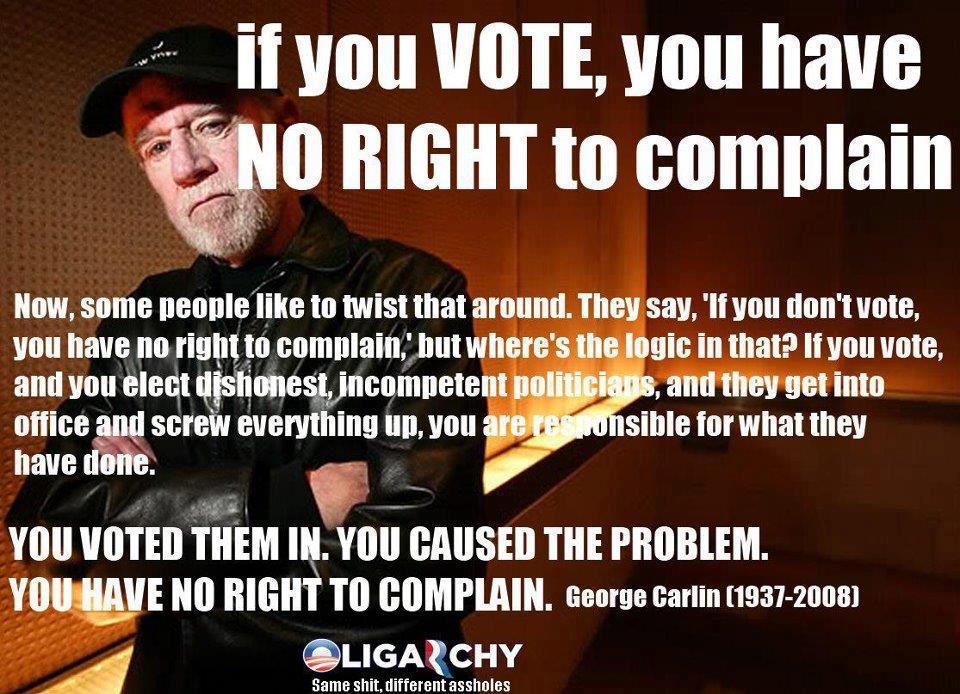
National Elections Expose the Sham That Is Centralized “Democracy”

The 2024 election is over, and in some states, big majorities voted for the winner Donald Trump. In Wyoming, Trump won 72 percent of the vote. In fact, more than 60 percent of the voting population went for Trump in 13 states.

Fortunately for the majorities in those states, they’ll get the president they voted for.

However, the outcome would have been different if fewer than a million people—in a nation of 330 million—had changed their votes in Pennsylvania, Arizona, and Michigan. Then, Kamala Harris would now be the president-elect.

She would have won even though the voters of more than a dozen states had lopsided majorities in favor of Trump.

Moreover, Kamala could have won even though there was far less enthusiasm on her side. That is, only a single state, Massachusetts, had a voting majority of more than 60 percent for Kamala Harris.

Even If You Win, You Lose

We could come up with many similar examples in the past 24 years. In 2012, for example, Mitt Romney won 60 percent or more of the vote in nine states. 72 percent of the voters went for Romney in Utah. But, in the end, those supermajorities meant nothing, and the people of Utah, Oklahoma, Alabama, and several others—who had voted nearly 2 to 1 for Romney—got Barack Obama as president. In 2020, by the way, more than 60 percent of the voters in ten states voted against Joe Biden.

These facts should be remembered the next time that some pundit or politician tries to tell us that democracy is “the voice of the people” or “the will of the majority.” The question that has to be asked is “which majority?” and “which people?”

Indeed, for the people of Utah in 2012 or Massachusetts in 2024, the president that rules over those states was chosen by people who don’t live in those states. Even if 100 percent of the voters in a state vote against a certain candidate, they could still end up with that candidate as president based on the votes of people living somewhere else. Moreover, given that many states don’t have voter ID, it stands to reason that even if a large majority of your state votes for a certain candidate, foreign nationals in some other state may ultimately make the decision for you.

It’s difficult to see how such a method expresses “the will of the majority” when a tiny majority or plurality nationwide so often nullifies overwhelming majorities in a multitude of US states.

Keep reading

Where Are the Missing 11 Million Voters?

As of this writing on Friday, Donald Trump’s popular vote total stood at 74,269,316. By the time you see this article and click on that link, however, that total is certain to be higher. Trump’s final popular vote total has now exceeded his official 2020 total of 74,225,926. Kamala Harris, meanwhile, has 68,800,347 popular votes, a steep decline from Old Joe Biden’s 2020 total of 81,286,454. 

As Victoria Taft noted here, that raises a lot of uncomfortable questions about what exactly happened in 2020. Yet apparently oblivious to self-incrimination, even some leftists are asking what is going on — and, of course, blaming Trump.

That Trump would have gotten roughly the same number of votes in 2024 as he did in 2020 is perfectly reasonable. He is, thanks to the left’s relentless campaign of defamation, a highly controversial figure, and while the 2024 campaign certainly changed some people’s minds about him, it is no surprise that his base of support remained roughly the same size that it was the last time around. 

But what about that massive drop-off between Old Joe, the most popular president in American history according to his vote total, and Kamala? Not only did eleven million voters not show up for Harris as they did for Biden, but they didn’t go anywhere. Not only did Kamala not get those votes, but there is no comparable increase in anyone else’s vote total. 

Pam Keith, a far-left Democrat who ran a failed campaign for Congress from Florida in 2020, is one leftist who thinks all this is highly suspicious. On X, she reposted a conspiracy-minded leftist’s case for assuming that the eleven million missing votes are not, as is painfully obvious, proof that the 2020 election was indeed stolen, but of 2024 Trump ballot box chicanery: “What mystifies, enrages and terrifies me: His mention of not needing votes. His little secret w\ Mike Johnson. His low attended gibberish rallies. Her Monstrous crowds. Lines for hours to vote. Record turnout. And now we are just going to ‘pffft’ not count 20m votes. WTF!”

In stating that Trump mentioned “not needing votes,” the X user was referring to a conspiracy theory that Rachel Maddow pushed hard on MSNBC. Maddow claimed that Trump’s boasts about not needing votes—which was an obvious claim to having substantial enough support to win the election—were evidence that he planned to take power by other means, maybe, say, another “insurrection.” Now, her hysteria over Trump’s boasts has become part of the case for claiming that Bad Orange Man made all those Democrat votes disappear.

Keep reading

Colorado Springs Voters Approve Two Contradictory Marijuana Ballot Measures To Both Allow And Ban Recreational Sales

Colorado Springs voters approved two competing ballot measures this week, one that would ban retail marijuana in the city and another that would allow existing medical marijuana stores to also sell recreationally.

As of 6 p.m. on Wednesday night, about 53 percent of voters approved Ballot Issue 2D, a city charter amendment referred by City Council that would prohibit sales within city limits. About the same share of voters also approved Ballot Question 300, an initiated ordinance which would allow the approximately 90 medical marijuana stores in the city to apply for a recreational license.

Mayor Yemi Mobolade said the result creates “a really interesting legal dilemma for us,” according to Westword.

“Although the election is not final until the results are certified, it appears as though both Ballot Question 2D and Ballot Question 300 will have been approved by the voters. If this is the case, Ballot Question 300 must be read, interpreted, and implemented in a manner to be consistent and harmonious with Ballot Question 2D,” city spokesperson Max D’Onofrio wrote in an email.

The city charter takes precedence over ordinances, so provisions of Ballot Question 300 that conflict with Ballot Issue 2D cannot be implemented, which appears to mean recreational marijuana sales would continue to be outlawed. D’Onofrio said the city is currently reviewing the ballot language. City Council next meets on November 12.

At the same time, backers of Ballot Issue 2D are optimistic.

“When all the votes are counted and the will of voters is given effect, responsible regulation will be law and the city council’s cynical ploy will be defeated,” Citizens for Responsible Marijuana Regulation said in a statement. “We know that those in municipal government will defer to the clearly expressed intent of voters to authorize recreational marijuana, and we look forward to working with city leaders over the coming months to create a responsible regulatory framework.”

Keep reading

Arizona Rejects Restrictions on Governor’s Emergency Powers

Arizonans voted against Proposition 135, a ballot measure that would have enshrined an “Emergency Declarations Amendment” to the constitution limiting the ability of their governor to extend emergency declarations among others. 56.8 percent of Arizona voters went against the proposition, with 68 percent of the vote counted as of press time.

Two years ago, Governor Doug Ducey signed a similar bill limiting the duration of a state of emergency to 30-day increments, which are eligible for extensions up to 120 days without the legislature’s approval. Proposition 135 would have set a hard cap of 30 days for states of emergency and prohibited the governor from extending them without approval from state lawmakers. Absent a decision from the state legislature, the declared state of emergency would automatically end after the allotted 30 days.

Under the ballot measure, certain types of emergencies—like a state of war, fire, and floods—would not be subject to the 30-day limit. Additionally, the legislature would have had the authority to alter or limit the governor’s powers when lawmakers extend an emergency declaration.

Apart from the amendment’s effects on emergency declarations, it also required the governor to call a special session upon the petition of “at least one-third of each house of the legislature,” according to the ballot’s language. Under current law, two-thirds of lawmakers in both chambers must vote in favor of a special session to force the governor to call one. 

Republican lawmakers holding majorities in both chambers voted in 2023 for the amendment to be included on the 2024 ballot; no Democrats voted to include the ballot measure. The bill’s sponsor, state representative Joseph Chaplik (R–Scottsdale), cited the 700-day plus COVID-19 emergency order as a key reason for his support of the measure, according to The Arizona Republic. Rep. Chaplik told The Arizona Republic that the proposition would have allowed special sessions to occur immediately following a governor’s “abuses [of] their emergency power.”

Opponents of Proposition 135 cited concerns over the state’s ability to respond to emergencies. Requiring legislative approval might have slowed down the resources that states of emergency are meant to help allocate. The allocation of state resources, temporary suspension of regulations, enhanced information gathering, and speedy authorization of stricter public safety measures are all reasons states of emergency are declared.  

Keep reading

Boxes of Ballots Still Arriving at Detroit’s Bureau of Elections in Cars with California Plates at 11 PM: Report

Project Veritas footage allegedly shows boxes of ballots arriving late at night at Detroit’s Bureau of Elections. These deliveries, reportedly occurring around 11 PM, feature cars with California plates.

Project Veritas captured the late-night drop-offs. Their team was on-site, documenting the unusual activity as it unfolded.

They tweeted, “EYES ON DETROIT: It’s 11pm. Why are boxes of ballots still arriving at Detroit’s Bureau of Elections via cars with California plates? We’re here. We’re watching.”

Keep reading

No Matter Who Wins, Half the Country Won’t Believe in the Election

Today, in theory, will conclude the 2024 presidential election, one of the most bizarre in American political history. From inner-party coups to assassination attempts, Kamala’s Brat summer social media trend to Trump’s courting of comedian podcasts, the campaign cycle has been saturated with the unconventional. It has, of course, also seen its expected share of shallow, political, rhetorical rhetoric and general economic illiteracy, which are the cornerstones of modern democracy.

The general superficial nature of mainstream political discourse, though, should not distract us from recognizing foundational truths about the state of modern American politics. No matter the outcome, the legitimacy of American democracy is broken.

In 2020, this was in full display, as was the response from Donald Trump and his supporters. Fueled by the unprecedented changes to the election under the shadow of covid, President Trump refused to concede the election. Polls showed the majority of his supporters agreed with him, and from that seed of distrust grew renewed concerns over illegal voters, manipulable voting machines, and rising awareness over the security of vote-by-mail ballots. To this day, large portions of the country continue to believe the Biden administration was illegitimate.

How would Democrats have reacted in the face of a similarly close race resulting in a Trump victory last election? While the counterfactual is impossible to consider in practice, hints were already publicly available before election day 2020. In Biden campaign war games, John Podesta, a long-time Democrat operative, outlined a strategy quite similar to the one Trump embarked on. As reported at the time, this included Democrat-swing state governors being pressured into promoting friendly alternative electors to vote in the electoral college under the guise of reversing Republican “voter suppression” efforts. Unlike the Republican response in 2020, this appeal would have been strengthened by blue-state secession threats should Trump have been inaugurated.

Would Joe Biden have followed through with this strategy if this alternative timeline had played out? We will never know. Nor can we know the potential effectiveness of this strategy, though it is likely such efforts would have been treated quite differently than Trump’s response.

Still, as we look forward, what is clear here is that the willingness for either side to accept, without question, the basic machinery of American politics has broken down significantly. The centralization of power within Washington, which consistently elevates the stakes of national politics, coupled with significant ideological shifts (particularly on the left), and the perceived danger Trump represents to American political institutions, regardless of his demonstrated ability to follow through after 2016, has created a dynamic where the incentives to concede power for the alleged “national good” have all but broken down.

Each side is motivated by a spirit of self-preservation, not politics.

Keep reading

CNN’s Acosta On Nevada Mail-In Ballot Issues: ‘Young People Don’t Know How To Sign Their Name’

CNN anchor Jim Acosta discussed an election issue in Las Vegas, Nevada, where over 13,000 people across the state who voted by mail will have to verify their identities in order for their votes to count.

According to the news anchor, “a lot of young voters don’t know how to sign their names,” saying state officials are texting the individuals for verification or else their votes won’t be counted.

The issue is strange, as even young people surely know how to sign their own names, but it’s also suspicious that AP News says “younger voters” have slightly shifted towards Trump in the 2024 election.

Keep reading