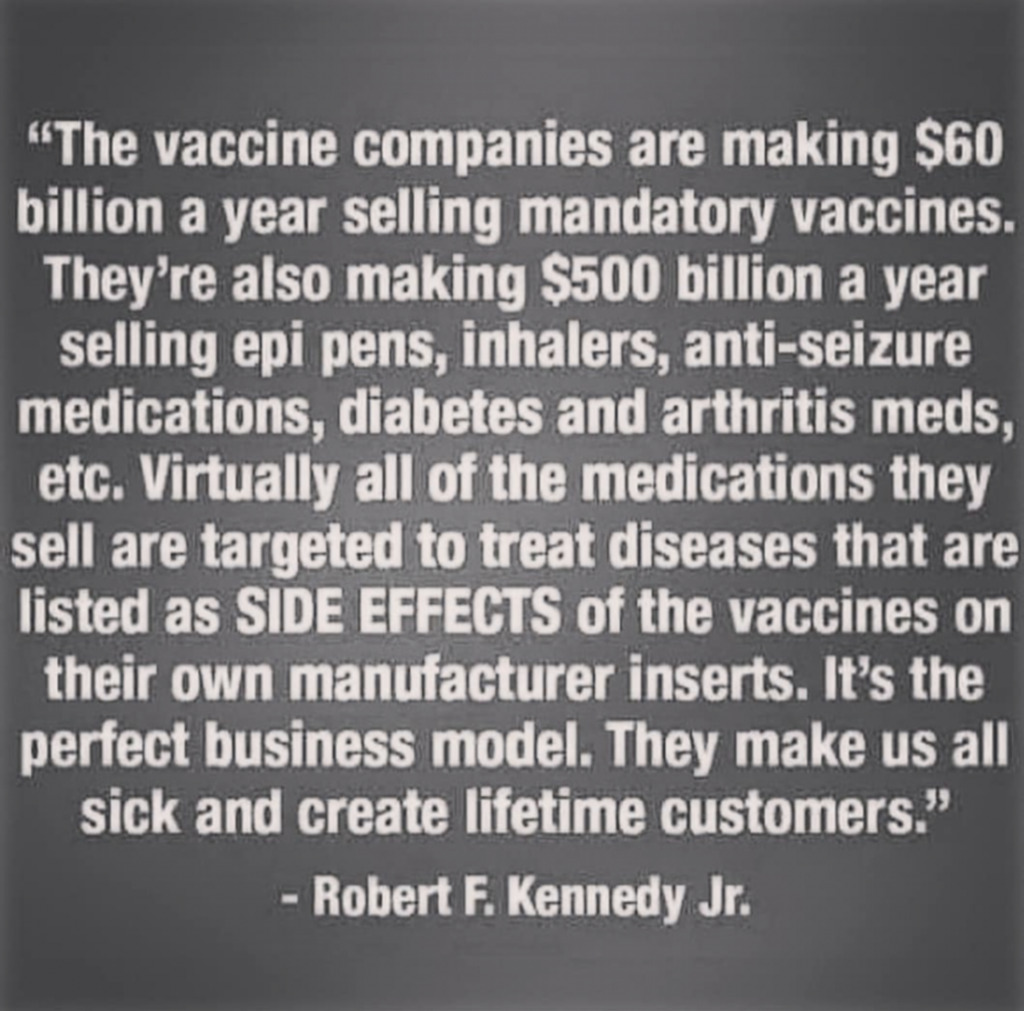
RFK jr. on Big Pharma…

As many as 246 Michigan residents considered fully vaccinated against COVID-19 were later diagnosed with the virus, and three have died, state officials confirmed Monday.
The cases were reported between Jan. 1 and March 31, and the 246 had a positive test 14 or more days after the last dose in the vaccine series, said Lynn Sutfin, a spokeswoman for the Michigan Department of Health and Human Services, in an email.
“Some of these individuals may ultimately be excluded from this list due to continuing to test positive from a recent infection prior to being fully vaccinated,” she said.
“These cases are undergoing further review to determine if they meet other CDC criteria for determination of potential breakthrough, including the absence of a positive antigen or PCR test less than 45 days prior to the post-vaccination positive test. In general, these persons have been more likely to be asymptomatic or mildly symptomatic compared with vaccinated persons.”
The University of Oxford has paused administering doses of the COVID-19 vaccine it developed with AstraZeneca PLC AZN, -0.63%AZN, +0.15% in a small U.K. study aimed at evaluating its safety and effectiveness in children and teenagers, to wait for further information on rare blood-clotting issues that have been found in a small group of adults that received it, the Wall Street Journal reported Tuesday. The trial was started in mid-February and involves more than 200 young people aged 6 to 17 years old, the paper said. It cited an Oxford spokesman as saying that the trial had not found any safety issues, but that broader concerns and a review of the vaccine by regulators in the U.K. and European Unions were behind the move. The European Medicines Agency said earlier it expects to update the public on its investigation of the blood-clotting issue later this week.
There is a link between AstraZeneca’s COVID-19 vaccine and very rare blood clots in the brain but the possible causes are still unknown, a senior official for the European Medicines Agency (EMA) said in an interview published on Tuesday.
However, the EMA later said in a statement that its review of the vaccine was ongoing and it expected to announce its findings on Wednesday or Thursday. An AstraZeneca spokesman declined to comment on the matter.
“In my opinion, we can now say it, it is clear that there is an association (of the brain blood clots) with the vaccine. However, we still do not know what causes this reaction,” Marco Cavaleri, chair of the vaccine evaulation team at the EMA, told Italian daily Il Messagero.
Cavaleri provided no evidence to support his comment.
The EMA has repeatedly said the benefits of the AstraZeneca shot outweigh the risks as it investigates 44 reports of an extremely rare brain clotting ailment known as cerebral venous sinus thrombosis (CVST) out of 9.2 million people in the European Economic Area who have received the vaccine.
The World Health Organization has also backed the vaccine.
Facebook, which routinely adds its editorial comments to posts with which it disagrees, recently “fact-checked” a woman’s complaint about her reaction to a coronavirus vaccine.
Desiree Penrod, 25, said on Facebook after getting vaccinated in early March: “The vaccine is killing me today. My arm hurts, beyond exhausted, headache, stomach cramps and earaches.”
Penrod also posted: “Multiple people told me that I looked pale today. Yesterday, I was fine but today it’s taking its toll on me.”
Facebook, citing the World Health Organization, added a disclaimer to a post by Penrose, “COVID-19 vaccines go through many tests for safety and effectiveness before they’re approved.”
A week later, Penrod died. Her obituary said she “passed away unexpectedly.”
Facebook’s editorial comment citing the WHO provided a link to the international organization, whose investigation into the origin of COVID-19 has been criticized because of China’s control of it.


A Chapel Hill woman who says her mother died of a stroke 48 hours after receiving the Johnson & Johnson COVID-19 vaccine spoke to WRAL News about her concerns and the questions she has about her mother’s death. The state and a UNC doctor, though, warn about drawing any conclusions yet.
Becca Ingle is understandably devastated after her mother’s sudden death two weeks ago. She says her mother was in good health, but started feeling very ill shortly after getting the vaccine. She wants to know if her mother’s death could be connected to the vaccine. The state is investigating this case and so is WRAL.
As a college professor who worked in person with her students at Appalachian State University and spent lots of time caring for her two grandchildren, 63-year-old Virginia Ellington was counting the days until she could be vaccinated against COVID-19.
“I have texts from her saying how excited she was to get it,” her daughter, Ingle, said.
Ingle said her mother and father got the Johnson & Johnson vaccine on the morning of Monday, March 8, at the Watauga Health Center in Boone.
Ellington started feeling very tired and even asked her husband about possible vaccine side effects, Ingle told WRAL News.
Ellington went to work the next day but was still feeling unwell, according to her family. On Wednesday, March 10, she stayed in bed. A little while later, her husband returned to the bedroom to find her unresponsive.
Losing a new born is a heart breaking endeavour, as is the pain of losing an unborn child. Which is why we’re both saddened and shocked to bring you the latest update on the number of unborn and newborn children to lose their lives as a result of the mothers receiving one of the Covid-19 vaccines in the United Kingdom.
The Government have released weekly reports on adverse reactions to the experimental Covid-19 vaccines, the first of which covered data inputted to the MHRA Yellow Card Scheme from the 9th December 2020 through to the 24th January 2021. Their latest report (find it here), which is the seventh to be released covers data inputted to the MHRA Yellow Card Scheme from the 9th December 2020 though to the 7th March 2021.
Just six weeks separate the first and seventh report, and the shocking increase in the number of women losing their unborn and newborn child in that time due to having either the Pfizer or AstraZeneca Covid vaccine is appalling.
This was the Governments own advice upon emergency approval of the Pfizer / BioNTech vaccine –
‘Pregnancy’
There are no or limited amount of data from the use of COVID-19 mRNA Vaccine BNT162b2.
Animal reproductive toxicity studies have not been completed. COVID-19 mRNA Vaccine
BNT162b2 is not recommended during pregnancy.
For women of childbearing age, pregnancy should be excluded before vaccination. In addition, women
of childbearing age should be advised to avoid pregnancy for at least 2 months after their second dose.
We told you about this back in December, as the Governments own advice also included comments on breast-feeding and fertility which were as follows –
Breast-feeding
It is unknown whether COVID-19 mRNA Vaccine BNT162b2 is excreted in human milk. A risk to
the newborns/infants cannot be excluded. COVID-19 mRNA Vaccine BNT162b2 should not be used
during breast-feeding.
FertilityIt is unknown whether COVID-19 mRNA Vaccine BNT162b2 has an impact on fertility.’
It is because of this advice released by the UK Government that we were so shocked to see in the first released report of adverse reactions to the Covid vaccines, using data inputted to the MHRA Yellow Card Scheme up to the 24th January 2021 a total of 4 women had suffered a miscarriage as a result of having the Pfizer/BioNTech vaccine.
The number of deaths related to vaccines this year has absolutely skyrocketed. According to the CDC’s own data, in 2021 in less than 3 months, we have already seen over 1,750 deaths due to vaccines in the US.
“The Vaccine Adverse Event Reporting System (VAERS) database contains information on unverified reports of adverse events (illnesses, health problems and/or symptoms) following immunization with US-licensed vaccines. Reports are accepted from anyone and can be submitted electronically at www.vaers.hhs.gov.”


You must be logged in to post a comment.