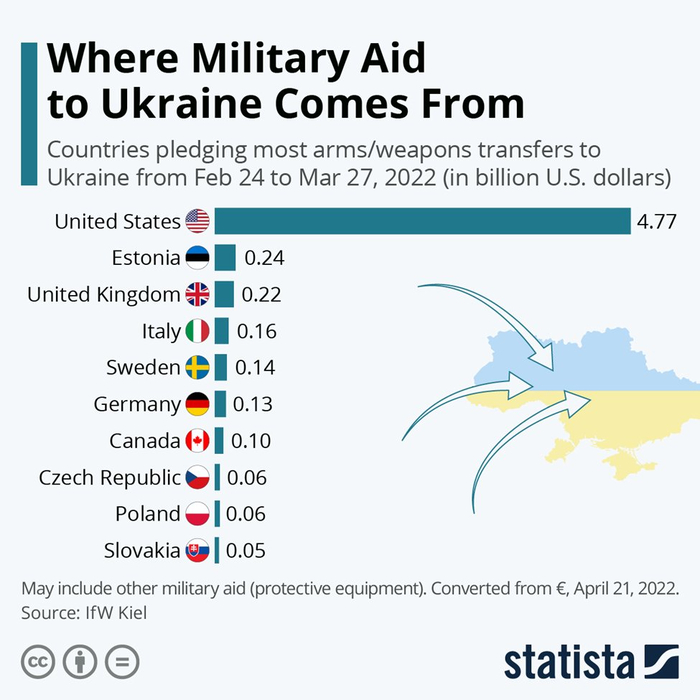
Calling all weapons makers: Pentagon seeks new ideas to arm Ukraine

In its effort to quickly arm Ukraine against Russia, the Pentagon has announced the equivalent of an open casting call for companies to offer weapons and commercial systems that can be rushed to the fight.

The Defense Department on Friday posted a broad request for information from industry on the federal contracting website sam.gov. The move is part of a stepped-up dialogue between the Pentagon and industry, and a sign of the challenge of boosting arms production in response to the ongoing conflict.

The RFI, on behalf of the new undersecretary of defense for acquisitions and sustainment, Bill LaPlante, is seeking input “from across industry” about air defense, anti-armor, anti-personnel, coastal defense, counter battery, unmanned aerial systems, and communications equipment, such as secure radios and satellite internet gear.

To that end, the DoD asks that responding companies describe their weapon, product or system in 100 words or less, and ― in the case of munitions ― check off “appropriate target type(s),” such as area, fixed, airborne/missile, maritime, mine, moving, hard or soft. The RFI says information received will be used to develop requirements for an actual solicitation at a later date.

Keep reading

Every Russian Oligarch Who Has Died Since Putin Invaded Ukraine—Full List

Two Russian oligarchs were found dead this week alongside their family in luxurious homes in Russia and Spain, with the two cases discovered within 24 hours of each other.

Both deaths are believed by police to be cases of murder-suicide, but the evidence supporting these theories is muddled by the fact that the events happened so close together, with the two oligarchs the last of several who have been found to have died by suicide since the beginning of the year.

Here’s a list of all the Russian oligarch who have been found dead in mysterious circumstance since January.

Keep reading

Fate of missing American Zelensky critic revealed

Chilean-American blogger Gonzalo Lira, who went missing in the Ukrainian city of Kharkov a week ago, has appeared online on Friday, revealing that he had been held by the Ukrainian Security Service (SBU).

I’m in Kharkov. I’m OK. I just want to say that I’m back online.” Lira said in short video chat with journalist Alex Christoforou on The Duran’s YouTube channel.

 “I was picked up by the SBU on Friday, April 15,” the blogger revealed.

Speaking about his condition, the 54-year-old said that he was “fine physically,” but “a little rattled” and “a little bit discombobulated.” Lira made it clear that he was forbidden from revealing any details about what had happened to him in detention.

Keep reading

UN refuses to back Ukraine ‘genocide’ claims

The UN has declined to support accusations by Kiev and Washington that Russia’s actions during its military offensive in Ukraine have amounted to genocide.

Ravina Shamdasani, the spokesperson for UN High Commissioner for Human Rights (OHCHR), was addressed on the issue by journalists on Friday.

“No, we have not documented patterns that could amount to [genocide],” she responded.

Shamdasani pointed out there were “a lot of these legal qualifications – crimes against humanity and genocide – at the end of the day would be for a court of law to determine.”

According to the UN’s own definition, ‘genocide’ includes “acts committed with intent to destroy, in whole or in part, a national, ethnical, racial or religious group.”

Keep reading

An American journalist goes missing in Ukraine. The silence is deafening

My personal journey into the drama-infused existence of Gonzalo Lira began in mid-February 2022, when I appeared as part of a panel discussion organized by Joe Lauria of Consortium News (CN), which included the British writer Alexander Mercouris. 

It was just prior to the Russian “special military operation” kicking off in Ukraine. Alexander and I subsequently appeared on several CN-hosted panels to discuss the war in Ukraine, and in conversations following the broadcast he mentioned a fellow he called “Gonzo Lira” and asked if I followed him. I indicated that I did not, and Alexander replied that I should, as “Gonzo” resided in Kharkov, and had some first-hand insights into the conflict that I might find interesting. Alexander asked if he could forward my contact information to Gonzo Lira, and I agreed.

I must admit that I did not follow up on Alexander’s recommendation to follow Gonzo and had forgotten about our conversation about Mr. Lira when, sometime in late March, I was suddenly contacted by the man himself, who asked if I would agree to be interviewed by him for his YouTube channel. I did a quick Google search, and read several items about Gonzalo Lira, AKA Coach Red Pill, including a particularly unflattering article written by Mark Hay of The Daily Beast. I quickly decided that if Gonzo was making The Daily Beast uncomfortable, then I was more than happy to be interviewed by him.

The setup for the interview, which took place on March 30, was informative in its own right. Alexander’s colleague Alex Christoforou was providing technical assistance, and because of connectivity issues due to Gonzalo broadcasting from Kharkov (literally a war zone), the YouTube platform could not be accessed, and instead we shifted to Twitter Spaces (a somewhat ironic choice, given my later permanent suspension).

But the most interesting aspect of the pre-interview technical discussions was a to-and-fro between Gonzalo and Mr. Christoforou about Mr. Lira’s safety. Beyond the obvious reality of broadcasting from a city under attack (air-raid sirens were sounding in the background during this time), Gonzalo expressed a clear concern that he was being sought out by the Ukrainian Security Service (SBU). I opined that perhaps broadcasting from Kharkov might not be the wisest decision under these circumstances, a concern echoed by Mr. Christoforou, but this was dismissed by Gonzalo. “I’m taking precautions,” he said, without further elaboration.

The Twitter Spaces session was enjoyable, with Gonzalo asking relevant questions and, in the true spirit of the journalist/interviewer, allowed me to answer without any undue commentary from his end – something so-called “professional” journalists in the mainstream media should do more often. According to Mr. Lira, it was “well received” by his followers.

Gonzo reached out to me again, on April 11, for a follow-up interview on his YouTube channel. This time, Mr. Christoforou was successful in surmounting the technical challenges surrounding Mr. Lira’s geographical realities, and the interview went off without a hitch. When we finished, Gonzo thanked me, and in the subsequent conversation, he relayed his concerns that the authorities in Kiev were not only displeased with what he had to say but were actively looking for him.

Gonzo’s pinned Tweet from March 26, in which he listed the names of eight Ukrainian politicians, journalists, dissidents, and human rights figures who had either been killed, arrested, or gone missing since the war with Russia had broken out, jumped out at me. The idea of having just completed a live-streamed interview lasting more some 77 minutes at a time when the Ukrainian SBU, which undoubtedly possesses considerable cyber skills sufficient to geolocate a lengthy online presence such as the YouTube broadcast we had just finished, bothered me – especially in light of Gonzo’s own self-expressed concerns, and I said as much.

Gonzalo Lira was fatalistic about his future. “I know the risks,” he said. “And I take precautions.”

Gonzo’s last tweet was posted on his account (@realGonzaloLira, 54,400 followers) at 7.07am on April 15, 2022. “New Patrick Lancaster,” he wrote, referring to a US Navy veteran-turned war correspondent who has been actively reporting from the frontlines in the Donbass region of eastern Ukraine. “Must watch.”

“Only the guilty fear judgement,” Gonzo had written in his Twitter bio. “Only liars need stifle the truth.”

Gonzo posted Mr. Lancaster’s report on his Telegram account (over 89,000 subscribers) at 7.16am. The post has more than 130,000 views at the time of writing.

“Here I talk about whatever’s on my mind,” Gonzalo noted in his Telegram introduction. “Unvaxed – and if that makes you angry and makes you hope that I die soon, I want you to know that I have no such wish for you.”

No soldier believes that he or she will be shot until the bullet strikes home. And no political dissident or free speech advocate believes he or she will be silenced until the knock comes at their door.

I received a telephone call on Sunday, April 17 from a producer for George Galloway’s The Mother of all Talk Shows (MOAT). Gonzalo Lira was scheduled to appear as a guest, and he had gone missing. George wanted to know if I had heard from Gonzalo. Sadly, I had not.

On the same day, Max Blumenthal and Esha Krishnaswamy, writing for The Grayzonepublished an article titled “‘One less traitor’: Zelensky oversees campaign of assassination, kidnapping and torture of political opposition” which, in light of Gonzalo’s disappearance, was not only timely but deeply disturbing.

Citing war-time necessity, Ukrainian President Volodymyr Zelensky has declared martial law and banned all real opposition parties (the neo-Nazi parties and organizations, however, remained untouched.) “The activities of those politicians aimed at division or collusion will not succeed, but will receive a harsh response,” Zelensky stated.

“As he wiped out his opposition,” Blumenthal and Krishnaswamy wrote, “Zelensky ordered an unprecedented domestic propaganda initiative to nationalize all television news broadcasting and combine all channels into a single 24-hour channel called ‘United News’ to ‘tell the truth about war.’”

The order directing this action was signed on March 18, 2022.

Zelensky, The Greyzone authors noted, had ominously warned that “there would be consequences for collaborators.”

And now Gonzo Lira had gone missing.

Keep reading

The Disappearance of Gonzalo Lira

The sudden disappearance of Chilean-America pundit Gonzalo Lira in Ukraine is now making global headlines. However, despite the volume of media coverage and pleas for information on his whereabouts, investigators have been unable to locate any hard leads about his current status.

Before he went missing, Gonzalo had stated repeatedly on social media and YouTube, that should he go missing for more than 12 hours online, that people should assume he has been abducted and detained (or worse) by the Ukrainian Security Service (SBU).

Lira also publicly broadcast how the American mainstream publication, the Daily Beast and its ‘journalist’ Mark Hay had gone out of their way to publish an elaborate smear piece on Lira, and even go so far as to contact the SBU in order to alert them that he was broadcasting reports critical of the Ukrainian government from the city Kharkov, Ukraine.

This shameful and dangerous operation by the Daily Beast was complimented by other partisan US ‘journalists’ seemed to suggest that Lira was working as ‘Russia spy,’ an accusation which was certainly designed to bring harm to him.

Currently, no indication of his detention has been reported by authorities in Kiev, which has also led many of his supporters to fear for his life, in the event he was abducted by prison gangs which President Zelensky released in Kharvov to provide ‘security’ alongside the President’s Neo-Nazi battalions currently being supported by NATO.

Keep reading

Ukraine is scanning faces of dead Russians, then contacting the mothers

Ukrainian officials have run more than 8,600 facial recognition searches on dead or captured Russian soldiers in the 50 days since Moscow’s invasion began, using the scans to identify bodies and contact hundreds of their families in what may be one of the most gruesome applications of the technology to date.

The country’s IT Army, a volunteer force of hackers and activists that takes its direction from the Ukrainian government, says it has used those identifications to inform the families of the deaths of 582 Russians, including by sending them photos of the abandoned corpses.

The Ukrainians champion the use of face-scanning software from the U.S. tech firm Clearview AI as a brutal but effective way to stir up dissent inside Russia, discourage other fighters and hasten an end to a devastating war.

Keep reading

U.S. government unable to track weapons sent to Ukraine

The United States says it doesn’t really know what happened to much of the weapons it sent to the government of Ukraine, with much of it dropping into a “big black hole.”

According to a new CNN report Tuesday, sources told the network that the U.S. government has few ways to track the massive supply of anti-tanks, anti-aircraft, and other arms sent to the conflict zone — and it is in large part due to a lack of observers on the ground to monitor where the weapons go.

CNN reports that the risk of the weapons falling into the wrong hands is a “risk the Biden administration is willing to take.”

Keep reading

Zelensky’s Secret CIA-Nazi Ukrainian Government

Not publicized, but instead carefully hidden, is the systematic terrorizing, tracking down, and killing, of political opponents, which includes not only opposed politicians, but also investigative journalists who are digging too deeply — deeply enough to maybe jeopardize Ukrainian President Volodmyr Zelensky’s staying in office. All of this was solidly documented by Dan Cohen of Mint Press News, in their stunning April 14th article, “Testimony Reveals Zelensky’s Secret Police Plot to ‘Liquidate’ Opposition Figure Anatoly Shariy: Accounts from the Ukrainian SBU’s torture prison reveal Zelensky’s plot to assassinate exiled opposition figure and leading journalist Anatoly Shariy.”  That article (which on April 17th was republished at Strategic Culture as “Testimony Reveals Zelensky’s Secret Police Plot to ‘Liquidate’ Opposition Figure Anatoly Shariy”) will be summarized here, with key excerpts.

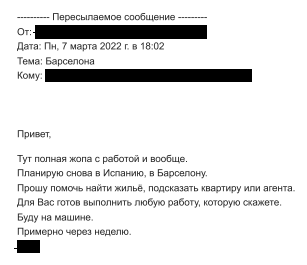
Cohen’s article describes the case of “Shariy, a Ukrainian opposition figure and one of the country’s most popular journalists.” A friend of Shariy’s had sent him an email on 7 March 2022, and: “Four days later, Shariy received an email from [the same friend but from] a different [email] address, …  confirming Shariy’s suspicion that the first email had been written [actually] by an SBU [Security Bureau of Ukraine] agent.” Shariy’s friend, in this second email, “explained that he had been interrogated and tortured for his ties to Russia.” 

Then, Shariy received a phone call from that friend, telling him that the SBU “were preparing an assassination attempt” to kill Shariy.

Keep reading