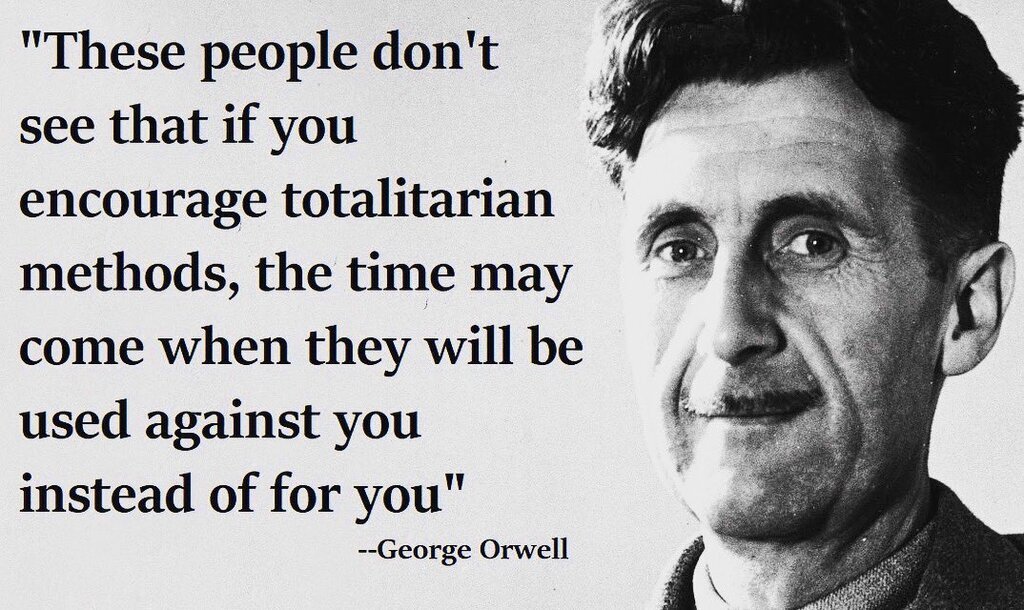
How Tyranny Becomes Entrenched: 9/11 and the Police State’s Endless Power Grabs

hey said it was for safety. They said it was for order. They said it was for the good of the nation.

They always say it’s for something good… until it isn’t.

Nearly a quarter-century after 9/11, we are still living with the consequences of fear-driven government power grabs. What began as “temporary” measures for our security have hardened into a permanent architecture of control.

The bipartisan police-state architecture that began with 9/11 has been passed from president to president and party to party, each recycling the same justifications—safety, security, patriotism—to expand its powers at the expense of the citizenry.

So they locked down the country “for our safety.”
They expanded surveillance “for our security.”
They rounded up anyone who challenged the narrative “for the common good.”
They erased names, ideas, and histories “to prevent offense.”
They forced schools to teach only what was politically correct “for the children.”
They censored speech “for our protection.”
They targeted dissenters “to preserve peace.”
They militarized the streets and called it “law and order.”

These very abuses—once denounced when carried out by the Left—are now cheered, defended, and excused when carried out by the Right.

People who once spoke passionately about truth, freedom, and faith have now fallen silent in the face of injustice, or worse, convinced themselves that nothing is wrong. The very voices that should be warning against tyranny are instead excusing it or looking away.

This is the danger of double standards in politics: every tyranny is rationalized in the moment by its chorus of defenders.

But history teaches that what goes around comes around. If you justify it now, you’ll have no defense when the tables turn.

And yet, time and again, the lies we tell ourselves make it possible. The cult of personality. The blind loyalty to party. The belief that “our side” can’t be the villain.

It never ceases to amaze how far people will go to excuse the actions of their favorite tyrant, even when those actions are the very things they once swore to oppose.

The pattern of justifying tyranny is as old as power itself. Every abuse comes wrapped in the same excuse: we had to do it.

Keep reading

Arbitrary Power: The Definition of Tyranny

“The curse and scandal of human nature.”

That’s how James Otis, Jr. described arbitrary power. It wasn’t just a sign of tyranny, or a step toward it. It was the very definition of tyranny.

It is power without right.

And that principle pervades the Declaration of Independence.

But this wasn’t a new idea born of the American Revolution. The principle stretches back thousands of years and became the driving force behind written constitutions.

The Founders didn’t just fear arbitrary power or fight against it. They defined it. And they warned us: it leads to tyranny, every single time.

WHAT IS ARBITRARY POWER?

James Otis Jr. defined it this way in 1762:

“arbitrary; which in plain English means no more than to do as one pleases.”

The principle carried forward to the Constitution itself. “Lighthorse” Harry Lee made the standard clear: if a power exercised isn’t enumerated, it’s arbitrary and unconstitutional.

“When a question arises with respect to the legality of any power, exercised or assumed by Congress, it is plain on the side of the governed. Is it enumerated in the Constitution? If it be, it is legal and just. It is otherwise arbitrary and unconstitutional.”

So any time government acts beyond the limits of a constitution, it is arbitrary. It is lawless.

To Otis, arbitrary power wasn’t just dangerous. It was vile. It was corrupt.

“the curse and scandal of human nature”

The old revolutionaries considered arbitrary power the very definition of tyranny.

Otis was calling the British out for violating their own system – the long-standing, unwritten British constitution. Instead of honoring it, they were ruling by arbitrary power.

“a greater difference on this side the Grave cannot be found, than that which subsists between British subjects, and the slaves of tyranny.”

Keep reading

How Tyranny Parades as Law

“Law is often but the tyrant’s will and always so when it violates the rights of an individual.”

Thomas Jefferson warned us.

The biggest crimes against liberty do not happen in the shadows. They happen right in front of us. Paraded as law, justice, and the public good. When law itself becomes a weapon, no one is safe.

THE MASK OF LEGALITY

If you want to understand how tyranny operates, you have to see through the disguise. No one openly admits they are out to crush your liberty. Every usurpation, every unconstitutional power grab, every violation of your rights is always dressed up with a stamp of law.

John Dickinson nailed it during the height of the American Revolution.

“All artful rulers who strive to extend their power beyond its just limits endeavor to give their attempts as much semblance of legality as possible.”

This is the tyrant’s playbook. They always hide behind “legality.” They never admit what is really going on.

The Anti-Federalist Federal Farmer sounded the same alarm.

“Men who govern will in doubtful cases construe laws and constitutions most favorably for increasing their own powers.”

Give them any ambiguity, and they will twist it to justify more power for themselves.

THE COMFORT OF APPEARANCES

Here’s the unfortunate truth: most people don’t want reality. They prefer comfort. The word “legal” gives it to them. Machiavelli called out this self-delusion five hundred years ago.

“The great majority of mankind are satisfied with appearances as though they were realities and are often even more influenced by the things that seem than by those that are.”

That is exactly how tyranny survives and thrives. It hides under layers of illusion and make-believe, each one more convincing than the last. Two centuries later, John Trenchard made the same case in Cato’s Letters No. 9.

“The most successful deluders and oppressors of mankind have always acted in masquerade. And when the blackest villains are meant, the most opposite spirit is pretended. Vice acts with security and often with reputation under the veil of virtue.”

Delusion, masquerade, virtue signaling. It is all cover for the worst crimes.

MANIPULATING THE MASSES

He doubled down just a few weeks later, spelling out exactly how the scam works.

“Yet even in countries where the highest liberty is allowed and the greatest light shines, you generally find certain men and bodies of men set apart to mislead the multitude.”

That’s how they set the stage. The real con is in how they brand what’s evil as good – and good as evil.

“Whoever who are ever abused with words, ever fond of the worst things recommended by good names, and ever abhore the best things and the most virtuous actions, disfigured by ill names.”

Then he drilled down to the core tactic: control the words, control the people.

“One of the great arts, therefore, of cheating men is to study the application and misapplication of sounds. A few loud words rule the majority. I had almost said the whole world.”

Keep reading

Dear Americans: the ‘System’ Isn’t Going to Save You from Tyranny. The ‘System’ Has Been Hijacked.

I don’t sleep well under normal circumstances. 

I typically enjoy a Manhattan or two when the day is done. My fiancee, Jessica, and I will catch an episode or two of Breaking Bad; then it is lights out in our apartment, the Atomic Bunker. That’s when the saturnalia in my cerebellum kicks on the lights, calls in the Big Top clowns, and BAM, it’s SHOWTIME!

What keeps me up usually? Perhaps I’ll pontificate about the potentially devasting effect one Confederate machine gun machine could have had at Pickett’s Charge. Or maybe I will stay up until 5:34 a.m. wondering how many cavemen roaming Michigan had to die of seizures before humanity learned not to eat yew berries.

FACT-O-RAMA! When growing up in Michigan, I once took my hamster, Fenore, outside. He filled his pouches with yew berries but thankfully didn’t eat them. #HamsterCatastropheAverted

But the thing that keeps my late-night noggin throbbin’ lately is, should this election go in the wrong direction, how my digestive tract will handle the moldy cabbage served to grubby-faced, recalcitrant patriots serving time in Kamala’s Reeducation Camp and Gift Shop.

DYSTOPY-O-RAMA! My nephew may someday wear a v-neck that reads, “My uncle went to Gulag-9 and all I got was this lousy t-shirt.”

Being the multi-media conservative figjam that I am, I suspect Kamala’s quod goons will delight in my cabbage-inspired gastrocolic carnage and will likely laughingly hand me 60-grit toilet paper. History’s victors decide what is and isn’t funny.

What kills me is that I know seemingly intelligent people who think my Thomas Paine-wannabe attempt to alert my fellow Americans that “The commies are coming” is nothing more than phantom flapdoodle.

“Relax, KDJ,” you might say. “We have a system to prevent tyranny. It’s called the Constitution. Have you ever heard of it? HAHAHA!”

What our “normal” friends can’t or won’t see is that the “system” has been hijacked by blue-haired apparatchiks who have spent their entire public school education and college being brainwashed to believe that patriots like us are evil hobgoblins who deserve the hoosegow or worse.

The Biden-Harris politburo has successfully dodged that annoying Constitution to get its way, or at least it’s tried and will try, try, again.

While the Democrats are going full Chicken Little about how Trump will imprison his political foes, they have not-so-suddenly been jailing bigwig Trump allies like Steve Bannon, Paul Mannafort, and Peter Navarro, to name a few,

PJ Media’s own Catherine Salgado has written about the persecution of pro-lifers sent to prison for daring to pray outside of abortion grinders. 

Keep reading

Timely lessons about tyranny from the father of the Constitution

“Take alarm at the first experiment on our liberties.” — James Madison

James Madison, often referred to as the “Father of the Constitution,” once predicted that the Bill of Rights would become mere “parchment barrier,” words on paper ignored by successive generations of Americans.

How right he was.

The rights of the people reflected in those 10 amendments encapsulated much of Mr. Madison’s views about government, the corrupting influence of power, and the need for safeguards against tyranny.

Mr. Madison’s writings speak volumes to the present constitutional crisis in the country.

Read them and weep.

“The accumulation of all powers, Legislative, Executive, and Judiciary, in the same hands, whether of one, a few, or many, and whether hereditary, self-appointed, or elective, may justly be pronounced the very definition of tyranny.”

“A standing military force, with an overgrown Executive will not long be safe companions to liberty. The means of defense against foreign danger have been always the instruments of tyranny at home.”

“Wherever the real power in a Government lies, there is the danger of oppression.” 

“Knowledge will forever govern ignorance: And a people who mean to be their own Governors, must arm themselves with the power which knowledge gives.”

“I believe there are more instances of the abridgement of the freedom of the people by gradual and silent encroachments of those in power than by violent and sudden usurpations.”

In the years since the founders laid their lives on the line to pursue the dream of individual freedom and self-government, big government has grown bigger and the rights of the citizenry have grown smaller.

Keep reading

Timely Lessons About Tyranny from the Father of the Constitution

Take alarm at the first experiment on our liberties.” — James Madison

James Madison, often referred to as the “Father of the Constitution,” once predicted that the Bill of Rights would become mere “parchment barrier,” words on paper ignored by successive generations of Americans.

How right he was.

Although Madison initially felt that the inclusion of a bill of rights in the originally ratified Constitution was unnecessary to its success, Thomas Jefferson persuaded him that “a bill of rights is what the people are entitled to against every government on earth, general or particular, & what no just government should refuse, or rest on inferences.”

The Bill of Rights drafted by Madison—the first ten amendments to the Constitution—was a document so revolutionary at the time that it would come to be viewed as the epitome of American liberty. The rights of the people reflected in those ten amendments encapsulated much of Madison’s views about government, the corrupting influence of power, and the need for safeguards against tyranny.

Madison’s writings speak volumes to the present constitutional crisis in the country.

Read them and weep.

“The accumulation of all powers, Legislative, Executive, and Judiciary, in the same hands, whether of one, a few, or many, and whether hereditary, self-appointed, or elective, may justly be pronounced the very definition of tyranny.” — James Madison

“The people are the only legitimate fountain of power, and it is from them that the constitutional charter, under which the several branches of government hold their power, is derived.” — James Madison

“If men were angels, no government would be necessary. If angels were to govern men, neither external nor internal controls on government would be necessary. In framing a government which is to be administered by men over men, the great difficulty lies in this: you must first enable the government to control the governed; and in the next place oblige it to control itself.” — James Madison

“A standing military force, with an overgrown Executive will not long be safe companions to liberty. The means of defence against foreign danger have been always the instruments of tyranny at home.” — James Madison

“Wherever the real power in a Government lies, there is the danger of oppression.” — James Madison

“Knowledge will forever govern ignorance: And a people who mean to be their own Governors, must arm themselves with the power which knowledge gives.” — James Madison

I believe there are more instances of the abridgement of the freedom of the people by gradual and silent encroachments of those in power than by violent and sudden usurpations.”— James Madison

In the years since the founders laid their lives on the line to pursue the dream of individual freedom and self-government, big government has grown bigger and the rights of the citizenry have grown smaller.

However, there are certain principles—principles that every American should know—which undergird the American system of government and form the basis of our freedoms.

The following seven principles are a good starting point for understanding what free government is really all about.

Keep reading

The Steady Slide Towards Tyranny: How Freedom Dies from A to Z in America

“As I look at America today, I am not afraid to say that I am afraid.” —Former presidential advisor Bertram Gross

The American governmental scheme is sliding ever closer towards a pervasive authoritarianism.

The American people, the permanent underclass in America, have allowed themselves to be so distracted and divided that they have failed to notice the building blocks of tyranny being laid down right under their noses by the architects of the Deep State.

This steady slide towards tyranny, meted out by militarized local and federal police and legalistic bureaucrats, has been carried forward by each successive president over the past fifty years regardless of their political affiliation.

Biden, Trump, Obama, Bush, Clinton: they have all been complicit in carrying out the Deep State’s agenda.

Frankly, it really doesn’t matter who occupies the White House, because it is a profit-driven, unelected bureaucracy—call it whatever you will: the Deep State, the Controllers, the masterminds, the shadow government, the corporate elite, the police state, the surveillance state, the military industrial complex—that is actually calling the shots.

In the interest of liberty and truth, here’s an A-to-Z primer that spells out the grim realities of life in the American Police State that no one seems to be talking about anymore.

Keep reading

Bad Quotes of Some Bad Presidents

Presidents’ Day is just around the corner. Should we celebrate?

People who love liberty and live in a free society don’t bow down and worship politicians. We understand that politicians wield power, to be sure, but we also know they still put their pants on one leg at a time. As President Reagan once put it, “America is a nation that has a government, not the other way around.”

The best of America’s presidents worked to keep the peace and our liberties. They didn’t view the Constitution as public window-dressing while they undermined it inside the store. The worst ones expanded power in Washington, burdening future generations with dubious programs, bureaucracy, taxes, debt, and foreign adventurism. The truly good ones are few and far between.

So whoever it was who decided we should have a Presidents’ Day in February, I can assure you it wasn’t me. I’d prefer to celebrate an Entrepreneurs’ Day. Or an Inventors’ Day. Or, of course, Mother’s Day and Father’s Day. If I had my way, we’d have a Capital Day too.

America’s third president, Thomas Jefferson, regarded government employment with a healthy wariness. In a 1799 letter, he warned, “Whenever a man has cast a longing eye on offices, a rottenness begins in his conduct.” Twelve years later in another letter, he said, “I have never been able to conceive how any rational being could propose happiness to himself from the exercise of power over others.”

Presidents’ Day, fortunately, is still welcomed by most Americans more as a day off work than a day to glorify presidents—even Washington and Lincoln, whose birthdays were “consolidated” into the holiday in the first place. But there’s still too much presidential glorifying that goes on for my tastes. In the spirit of Jeffersonian skepticism, my way of noting the holiday this year is to offer five of the many bad things some bad presidents said.

Keep reading