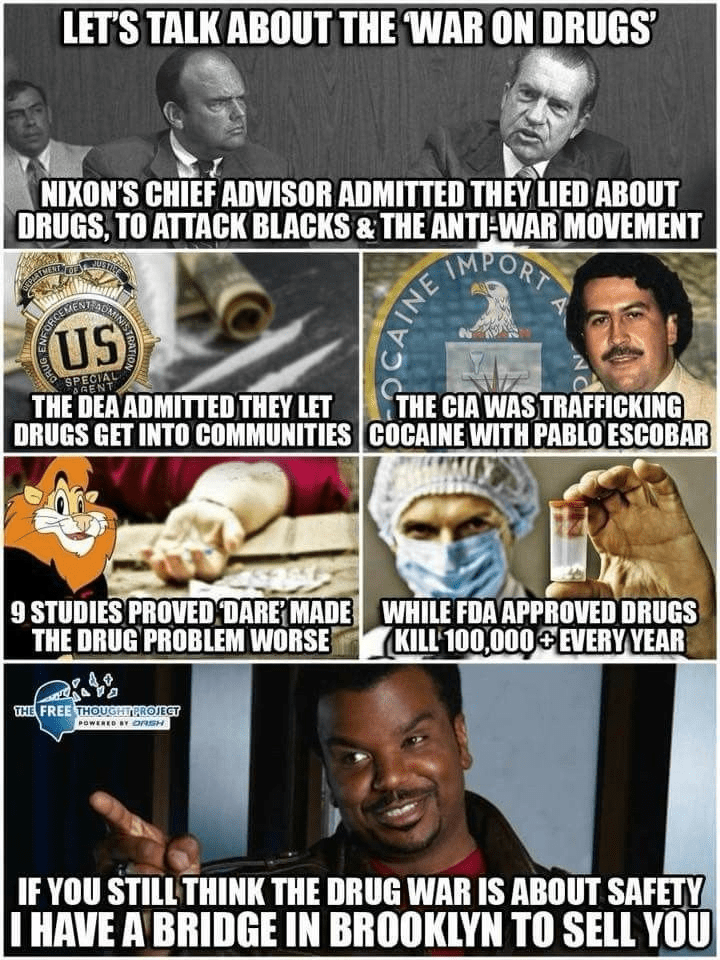
About the War on (some) drugs…



An 11th Circuit panel on Monday unanimously rejected two former Miami police officers’ challenge to their drug-trafficking convictions.
Former officers James Archibald and Kelvin Harris were caught as part of an undercover FBI sting operation designed to root out dirty cops in the Miami Police Department.
Despite proof that the officers actively participated in a fake drug-running conspiracy – even going so far as to activate their police lights to help an agent posing as a drug courier navigate heavy traffic – Archibald and Harris claimed that the evidence was insufficient to convict them.
The Atlanta-based appeals court was unpersuaded.
Writing on behalf of the panel Monday, Senior U.S. Circuit Judge Stanley Marcus found that the evidence against the men was “ample.”
Along with a third officer, Archibald and Harris participated in three separate operations to protect FBI agents who they believed were drug dealers delivering cocaine to Miami hotels. Harris received a $10,000 cash payment for his efforts and Archibald received $6,500.
Both men were charged with conspiring to possess with intent to distribute more than five kilograms of cocaine and attempted possession with intent to distribute cocaine. Harris was also convicted of possessing a firearm during the commission of a drug-trafficking crime.
After a 10-day trial in June 2019, Harris was sentenced to 27 ½ years in prison. Archibald was sentenced to 10 years.

On Sunday, a Louisiana law decriminalizing the possession of small amounts of marijuana went into effect despite ongoing federal cannabis prohibition.
Rep. Cedric Glover (D) introduced House Bill 652 (HB652) on April 4. Under the new law, possession of up to 14 grams of marijuana is punishable by a fine of up to $100 with no threat of jail time.
The House passed HB652 by a 68-25 vote. The Senate approved the measure by a 20-17 vote. With Gov. John Bell Edward’s signature, the law went into effect on Aug. 1.
In his signing statement, Bell downplayed the law, saying “contrary to the narrative developed in the press and elsewhere, [HB652] does not decriminalize small amounts of marijuana.” But as Marijuana Moment noted, “replacing the threat of incarceration with a modest fine does fit the definition of decriminalization used by reform advocates.”
In November of 2018, Lucil Basco of Bexar County, Texas, awoke to a thunderous boom, followed by a parade of eight cops barging through her front door. She was handcuffed, and, with her screaming child, removed from the premises. The officers soon realized they made a mistake: They had the wrong house, based on incorrect information from a confidential informant. Yet they continued the operation anyway.
Three of those Bexar County sheriff’s deputies—James Hancock, Jacob Rodriguez, and Bryan Smith—are not entitled to qualified immunity, the legal doctrine that allows state actors to violate your rights if the precise scenario in question has not yet been ruled unconstitutional in a prior court precedent. They can thus be sued for it, a federal court said this week.
But the case is a crash course in the levers available to the monopoly on state power—from the drug war, to surveillance, to no-knock entries, to botched warrants—and the importance of government accountability in such circumstances.
Driving while stoned is far safer than driving under the influence of prescription medications or other legal drugs, according to a new study published in the International Journal of Drug Policy.
A team of Australian researchers set out to test the validity of zero tolerance THC driving laws by studying how often Australians involved in traffic accidents tested positive for cannabis, opioids, or other drugs. An analysis of accident data revealed that the risks of driving under the influence of cannabis are considerably lower than for many legal prescription drugs.
Study author Iain McGregor, professor at The Lambert Initiative for Cannabinoid Therapeutics at the University of Sydney, told the Australian Associated Press that the risk of driving under the influence of cannabis is “considerably less than with many medications such as antidepressants, opioids and benzodiazepines.”
The U.S. Food and Drug Administration (FDA) is on a mission to eliminate all consumer access to the herb mitragyna speciosa, also known as kratom – and your help is needed to stop it.
Back in 2016, the FDA tried, and was almost successful, at getting kratom banned here in the United States. The agency has long argued that kratom is a “dangerous drug” with no benefits that belongs on the Drug Enforcement Agency‘s (DEA) Schedule I list of prohibited substances.
Thanks to the diligent efforts of freedom fighters, the FDA was stopped in its tracks. Now, however, the agency is trying once again to eradicate the natural painkiller from existence – this time globally.
In a notice published in the Federal Register, the FDA is asking for feedback concerning its latest push to have the United Nations and the World Health Organization (WHO) add kratom and its constituents to the international schedule, which would prohibit kratom from being consumed anywhere in the world.
Until Aug. 9, 2021, the FDA is accepting public comments on the matter, which means your help is needed to let the agency know that it has no right trying to prohibit nature from being accessible to the people.


You must be logged in to post a comment.