The DC Swamp Creatures Still Pushing the Failed, Authoritarian War on Cannabis

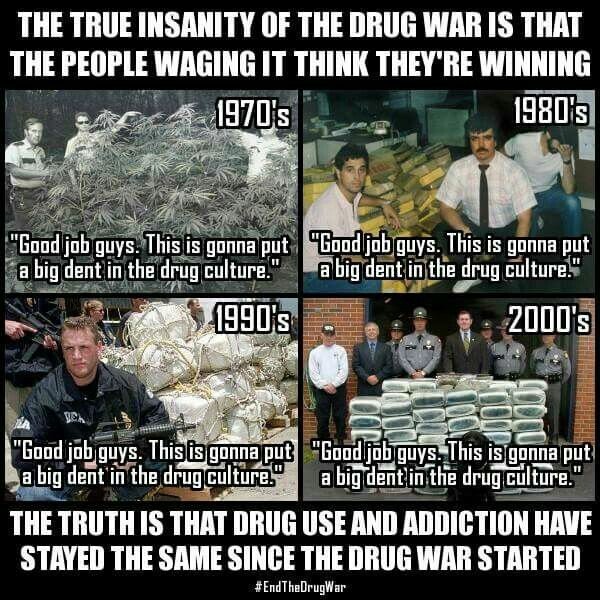
The Drug War is an ineffectual waste of resources. No appreciable decline in illicit drug use has occurred since it began, despite the trillions of dollars spent:

“Prohibition is not only ineffective but counterproductive, at achieving the goals of policymakers both domestically and abroad. Given the insights from economics and the available data… the domestic War on Drugs has contributed to an increase in drug overdoses and fostered and sustained the creation of powerful drug cartels.”

The evidence of the DEA’s, ATF’s, and respective state agencies’ total incompetence, and even corruption, in doing their jobs is legion. The CIA facilitates the importation of cocaine into the US with impunity.

Given its failure, if the Drug War were a private-sector endeavor, investors would have pulled the plug years ago. Instead, since this utterly useless bureaucratic machinery sucks at the teat of the taxpayer, its purveyors are allowed to subsidize their careers fighting windmills.

Rather than acknowledging that their total lack of any meaningful progress in reducing the flow of drugs into the US or deescalating usage rates, these agencies routinely use their abject failure to justify ever-larger budgets. If they just got a few billion more dollars each year, the logic goes, the Drug War could be won in a jiffy.

Total nonsense.

Keep reading

Fentanyl Overdoses Leading Cause of Deaths in America in 2020

The government has reported that, since the year 2020, fentanyl overdoses have become the new leading cause of death for American adults between the ages of 18 and 45, as reported by Fox News.

The analysis from the Drug Enforcement Agency (DEA) shows that nearly 79,000 Americans died from the drug between 2020 and 2021. Of those, just over 37,000 died in 2020 while almost 42,000 died in 2021. Fentanyl is an opioid that is sometimes laced with other drugs such as meth and heroin when used by addicts, but can also be deadly on its own in even small doses. The primary foreign sources for imports of the drug are China and Mexico.

Fentanyl overdoses have surpassed all other leading causes of death in the last two years. By contrast, only about 53,000 Americans between the ages of 18 and 49 died of the Chinese coronavirus from 2020 to 2021. Fentanyl has also claimed more lives in this age group than car accidents, suicide, gun violence, and breast cancer, among others. The number of overall fentanyl deaths in the last two years has also surpassed previous years’ totals, doubling from about 33,000 to 64,000 between 2019 and 2021.

Keep reading

Visualizing The History Of Cannabis Prohibition In The US

The legal status of cannabis in the U.S. isn’t always clear. At the federal level, it is an illegal Schedule I drug. However, individual states have the ability to determine their own laws around cannabis sales and usage.

But, as Visual Capitalist’s Avery Koop details below, cannabis was not always illegal at the top level. It was only in the last 100 years that cannabis faced a prohibition similar to the alcohol prohibition of the early 1920s.

In this infographic from Tenacious Labs, we explore the fascinating history of cannabis prohibition in the U.S. dating all the way back to the 1900s.

Keep reading

WHERE CAN YOU LEGALLY TAKE MAGIC MUSHROOMS? LIST OF REGIONS AND COUNTRIES

The chemical in magic mushrooms that gives it the “magic” is known as psilocybin. This compound or some form of it is found in approximately 180 species of mushroom. But these hallucinogenic fungi are not new substances. Rather, they are one of the oldest substances used and recorded in humanity’s history to increase levels of consciousness. 

As such, magic mushrooms have remained among the most common and popular psychedelic substances even today. They are quite popular in South America, Europe, and North America. But, as with all psychedelic substances, there are concerns over their usage and legality, and many places prohibit these special mushrooms.

But, that mindset is changing. Studies have recently claimed that mushrooms containing psilocybin can actually help the patients in some specific cases. In a 2017 study, they were found to have some effect when it came to treating mental health conditions. This was a big step forward for advocates who wanted to legalize psilocybin mushrooms.

As for the present situation, there are a handful of countries where it is completely legal to own and use magic mushrooms. Here is a list of them according to the major regions. However, be aware that the use of these substances in most cases is still dangerous. Moreover, in some cases, the law forbids the chemical “psilocybin” while not mentioning magic mushrooms themselves, which makes it very risky. As such, we will leave out the nations where magic mushrooms are not openly sold

Keep reading

Take Two Shrooms and Call Me in the Morning: The Medical Promise of Magic Mushrooms

SIX YEARS AGO, on a late fall evening, I stood in front of a pinball machine, flummoxed. The game was space themed, with an elaborate UFO in the middle surrounded by a kaleidoscope of flashing lights. I was mesmerized, but I had no idea how to make it start. The machine’s coin slot and glowing buttons were suddenly indecipherable. Time felt like it had slowed to a crawl, and I became paranoid that the handful of people in the bar were staring at me, wondering what I was doing. It was then I realized that the magic mushrooms were kicking in.

This was the first time I’d taken a hallucinogen since my early twenties. Back then, as a university student, it was a lark. Now, in my forties with a family, the idea was daunting. This trip, however, had a medical purpose: for nearly two decades, I’ve struggled with a rare illness known as cluster headaches. Cluster headaches have been described as more painful than childbirth and kidney stones; they’re sometimes referred to as “suicide headaches” because of the mental toll they take. These headaches happen in groups—for me, they occur two or three times a day for weeks on end. Like migraines, they’re difficult to treat. Over the years, I’ve visited countless neurologists, chiropractors, acupuncturists, and naturopaths. I’ve taken prescriptions and experimented with cleanses and diets. Nothing worked.

Then I stumbled onto Clusterbusters, a popular message board created by a fellow sufferer, where people around the world could swap advice. There was one tip that was gaining traction: multiple posters were reporting that, after they had consumed magic mushrooms, their headaches had abruptly—miraculously—stopped. I was in the midst of a headache cycle at the time and was desperate to stop the pain. I reached out to a long-time friend in Toronto, and not long afterward, we downed a handful of dry, fishy-tasting fungi in his newly renovated kitchen.

Keep reading

Thieving Cops Steal Innocent Retired Marine’s Life Savings, $86K, Because It Smelled Like Drugs

Stephen Lara dedicated 20 years of his life to serving this country as a United States Marine. This father of two served two tours in Iraq and Afghanistan, risking his life to protect a political system only to be chewed up and spit out by that very system when he returned. Because this system is set up to extract revenue through various means of extortion and theft, when armed agents of the state robbed Lara of his life savings on the side of the road, everything they did was considered “legal.”

In February of this year, Lara was driving from Texas to California to visit his two daughters who live with his ex-wife. He had committed no crime, police had no probable cause for which to pull him over, he had had broken no traffic laws, yet still, a Nevada Highway Patrol officer decided to initiate a traffic stop.

This wasn’t an ordinary traffic stop that would end in a small extortion via citation, however. No, this was legalized road piracy in which police would steal an innocent father’s life savings.

As the video below shows, after Lara was pulled over, the cop who detained him actually complimented his driving. This psychopath, who was about to rob a man of his life savings was cordial and nice as he carried out his roadside theft.

Lara was completely honest with the officer and told him that he had a large sum of cash in his car because he had withdrawn his cash from the bank. He actually had the receipts from the bank to prove this, yet the officer claimed something nefarious was afoot and he called in his fellow officers to separate Lara from his life savings.

Because they can’t simply take the cash for themselves, these thieving road pirates have to go through a federal procedure via the U.S. Drug Enforcement Administration (DEA) known as “adoption.” If they steal his life savings in the name of the DEA, the DEA will “adopt” the money and then kick back 80% of that money back to the department through a program called “equitable sharing.”

“Adoption,” as the Institute for Justice points out, is a process by which federal law enforcement agencies can take over a seizure by state and local law enforcement. If the federal government is successful in forfeiting the property, its “equitable sharing” program guarantees the state or local agency that seized the property up to 80% of the proceeds for use in the agency’s budget.

It literally creates an incentive for cops to steal money from innocent people like Lara.

Since Lara had committed no crime, the officers on the scene needed to manufacture a reason to steal his life savings, so they called in a drug dog to smell Lara’s cash.

It is widely known that a large percentage (upwards 0f 90%) of U.S. paper money contains trace amounts of cocaine. Having a large amount of cash will most assuredly alert a drug dog.

In fact, the U.S. Court of Appeals for the Ninth Circuit has ruled that government does not have probable cause to seize cash from individuals based only on a drug-detection dog’s reaction; stating specifically that the majority of money in circulation has drugs on it.

But court precedents and ethical enforcement of the law apparently mean very little the road pirates who targeted Lara that day and when the drug dog alerted to Lara’s cash, the officers used this a reason to steal an innocent man’s life savings.

As he had committed no crime, after they robbed him, the officers left Lara on the side of the road with nothing — not even enough money to get gas to make it home. Lara had to ask his brother to wire him money just so he could make it to see his daughters.

It would take Lara the remainder of the year to get his money back, only after he sued the DEA in federal court. Even though he’s gotten his money back, however, Lara is going to continue to fight and the Institute for Justice is helping him wage his war.

Keep reading

Is Fentanyl-Tainted Marijuana ‘Something Real’ or ‘Just an Urban Legend’?

Taken at face value, recent reports of fentanyl-tainted marijuana in Connecticut highlight the hazards inherent in the black market created by drug prohibition. Consumers who buy illegal drugs rarely know for sure exactly what they are getting, and the retail-level dealers who sell those drugs to them may be equally in the dark. But even in a market where such uncertainty prevails, opioid overdoses among drug users who claim to have consumed nothing but cannabis—like earlier, better documented reports of fentanyl mixed with cocaine—raise puzzling questions about what is going on.

One thing seems clear: The official warnings prompted by those reports are more alarming than the evidence justifies.

The proliferation of illicitly produced fentanyl as a heroin booster and substitute during the last decade or so has helped drive opioid-related deaths to record levels. Fentanyl is roughly 50 times as potent as heroin, and its unpredictable presence has increased drug variability, making lethal errors more likely.

According to preliminary data from the Centers for Disease Control and Prevention (CDC), the United States saw a record number of drug-related deaths last year: more than 93,000. Three quarters of those deaths involved opioids. “Synthetic opioids other than methadone,” the category that includes fentanyl and its analogs, were involved in about 83 percent of those opioid-related deaths, up from 14 percent in 2010.

Fentanyl and heroin have similar psychoactive effects. And since fentanyl is cheaper to produce and easier to smuggle than heroin, it makes sense that drug traffickers would use the former to fortify or replace the latter. But the idea that dealers would mix marijuana and fentanyl, two drugs with notably different effects, is much less plausible. Until now it amounted to nothing more than scary rumors.

Last week, however, the Connecticut Department of Public Health (DPH) announced that it has received 39 reports since July of “patients who have exhibited opioid overdose symptoms and required naloxone for revival” but who “denied any opioid use and claimed to have only smoked marijuana.” The most obvious explanation for those cases is that the patients falsely denied opioid use, which carries a stronger stigma than cannabis consumption. But the agency also reported that a lab test of a marijuana sample obtained in one of those cases detected fentanyl.

“This is the first lab-confirmed case of marijuana with fentanyl in Connecticut and possibly the first confirmed case in the United States,” DPH Commissioner Manisha Juthani said. Based on that finding, her department “strongly advises all public health, harm reduction, and others working with clients who use marijuana to educate them about the possible dangers of marijuana with fentanyl.” It says “they should assist their clients with obtaining the proper precautions if they will be using marijuana.” It also “recommends that anyone who is using substances obtained illicitly…know the signs of an opioid overdose, do not use alone, and have naloxone on hand.”

These warnings seem overwrought, given the meager basis for them. If the hazard Juthani describes were significant enough that it would be rational for cannabis consumers to “have naloxone on hand,” you would expect to see many more suspected cases in a state with more than half a million marijuana users. Assuming the single lab test result was accurate, it is not clear how fentanyl ended up in the marijuana sample. Did a dealer intentionally add the fentanyl, and if so why? Could the sample have been contaminated accidentally by the dealer, his customer, or the lab? Did the patient, contrary to his denial, deliberately dose his pot with fentanyl?

Forbes writer Chris Roberts posed those questions to Robert Lawlor, an intelligence officer who works for the New England High Intensity Drug Trafficking Area (HIDTA), an interagency drug task force. “We have some of those same questions,” Lawlor said. “From a business standpoint, it doesn’t make sense to put fentanyl on marijuana. So why is this happening? What is the purpose of behind putting it in marijuana? Those are some of the questions that are still out there.”

Notably, HIDTA is not telling marijuana users they should be on the lookout for fentanyl in black-market cannabis. “Marijuana [mixed with] fentanyl has been sort of an urban legend for a couple years now,” Lawlor said. “To try and decide whether it’s something real or just an urban legend is important for public safety and public health.”

Keep reading

The CIA’s Crack-Cocaine Enterprise and the Destruction of Urban America

The United States Central Intelligence Agency (CIA) has been accused of involvement in drug trafficking. Books and investigations on the subject that have received general notice include works by the historian Alfred McCoy, professor Dale Scott, journalists Gary Webb and Alexander Cockburn, and writer Larry Collins. These claims have led to investigations by the United States government, including hearings and reports by the United States House of Representatives, Senate, Department of Justice, and the CIA’s Office of the Inspector General. U.S. Government Officials said in 1990 the supposed Anti-Drug Unit at the CIA. “accidentally” shipped a ton of cocaine into the US from Venezuela as part of an effort to infiltrate and gather evidence on drug gangs. The cocaine was then sold on the streets of America. As expected, no criminal charges were brought, although CIA officer Mark McFarlin resigned and one officer was disciplined. The CIA issued a statement on the incident saying there was “poor judgment and management on the part of several CIA officers”. We are meant to believe that it all ends there. But this story is much bigger and more wide-ranging than even the issue of drugs on the streets on America and the targeting of black communities with the new deadly drug known as crack.

According to a PBS Frontline investigation, DEA field agent Hector Berrellez said, “I believe that elements working for the CIA were involved in bringing drugs into the country.”

“I know specifically that some of the CIA contract workers, meaning some of the pilots, in fact were bringing drugs into the U.S. and landing some of these drugs in government air bases. And I know so because I was told by some of these pilots that in fact they had done that,” he added.

The impact on poor communities in large cities like Los Angeles, New York, Detroit, Chicago and others was nothing short of devastating.

Keep reading